All species › Passerines › Reed warblers › Basra Reed Warbler
Basra Reed Warbler | Acrocephalus griseldis
Basrakarekiet | Carricero de Basora
The Basra Reed Warbler is an endangered, fairly large reed warbler that breeds in the marshes of southern Iraq and winters in East Africa. The region lies at the southern edge of its wintering range: in southern Malawi and central Mozambique it is a scarce, inconspicuous visitor from December to April, further south an exceptional vagrant.
Voice
The song is a series of scratchy, grating notes, cherr-cherr-karra-chik, resembling that of Great Reed Warbler but softer, lower and less gurgling, without the high notes. In the wintering range it sings mainly late in the season. The call is a hard chak and a grating chrr.
Recording: Gregory Askew — CC BY-NC-SA 4.0 · converted to mono · xeno-canto
Identification
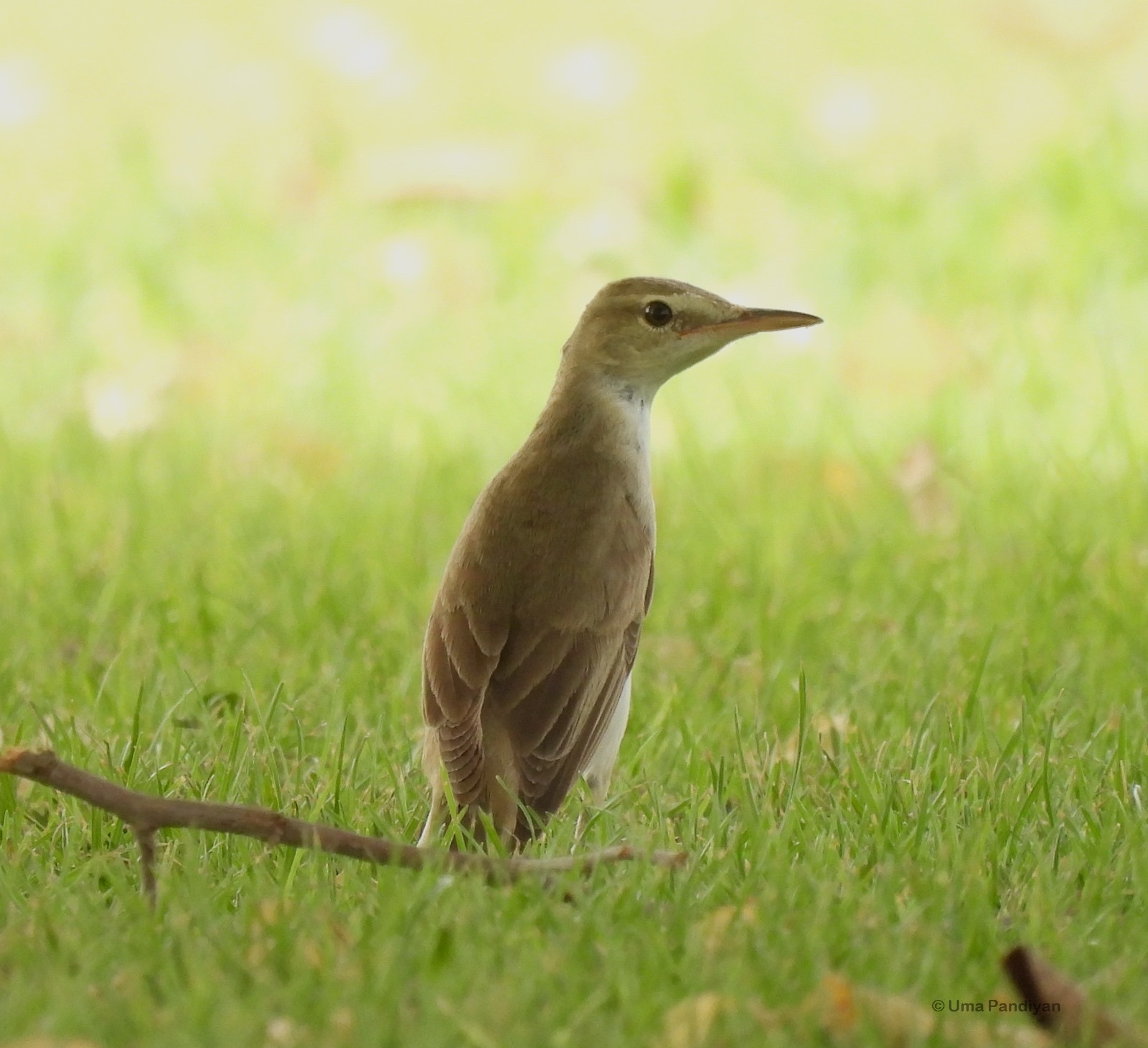
15–16 cm, slim and elongated, with a long, thin, pointed bill, a flat forehead and a fairly long tail. The upperparts are cool greyish olive-brown, without warm tones; the underparts are white to off-white, with a faint grey-buff wash on the flanks. A narrow white supercilium is clear in front of the eye and extends a short way behind it; the lores are dark. The wings are long, with a long primary projection; the legs are grey. The sexes are alike. It moves hidden through dense reed fringes and rank growth and rarely shows well.
Confusion species
Great Reed Warbler Acrocephalus arundinaceus is larger and bulkier, with a thicker bill, warmer, browner upperparts, buff flanks and a stronger supercilium, and sings a loud, grating karra-karra-keet-keet. Common Reed Warbler Acrocephalus scirpaceus is smaller and warmer brown, with a shorter bill. Lesser Swamp Warbler Acrocephalus gracilirostris is warm brown above, with dark legs and a rich, fluid song, and is resident. Olive-Tree Warbler Hippolais olivetorum is greyer, has a pale wing panel and a yellow-orange lower mandible, and lives in dry thornbush.
Habitat
Reed fringes, dense rank vegetation and bushes along rivers, swamps and floodplains in the lowlands, also in rank growth along sugar-cane fields and in dense thickets near water. It forages low in cover for insects.
Where the bird is most at home, classified by the vegetation units of southern Africa.

Range and movements
Within the region scarce in southern Malawi (mainly the lower Shire River, such as the Elephant Marsh area) and in central Mozambique around the lower Zambezi; a few records from Zimbabwe and exceptional vagrants in north-eastern South Africa and Botswana. It breeds in the marshes of southern Iraq and south-western Iran and winters in East Africa, from Somalia and Kenya through Tanzania to Malawi and Mozambique.
- Summer visitor (c. Oct–Mar)
- dark = core range, pale = thinly spread
How and when to look
From December to April; within the region only with a targeted search of the reed and rank-growth zone of the lower Shire Valley in Malawi or the Zambezi Delta in Mozambique. Listen for a low, grating reed-warbler song weaker than that of Great Reed Warbler, and check every ‘Great Reed Warbler’ with a long, thin bill and cool, grey upperparts; ringing produces most certain records.
Conservation status
Endangered according to the IUCN. The breeding grounds in the Mesopotamian Marshes were largely drained in the 1990s; after partial restoration, drought, upstream dams and renewed drainage remain a serious threat. In the wintering range the loss of riparian vegetation plays a part.
Scientific name
Acrocephalus griseldis | (Hartlaub, 1891)
Hartlaub described the species in 1891 as Calamoherpe griseldis; because it was later moved to another genus, the author and year stand in brackets. The genus Acrocephalus was introduced in 1811 by Naumann & Naumann. Acrocephalus is Greek, from akros 'topmost, pointed' and kephalē 'head'; the Naumanns, who introduced the genus, called these birds Spitzkopf 'pointed head', so they read akros as 'pointed'. griseldis probably comes from Latin griseus 'grey', but the derivation remains uncertain. The specimen the first description was based on came from Nguru, Tanzania.