All species › Passerines › Reed warblers › Lesser Swamp Warbler
Lesser Swamp Warbler | Acrocephalus gracilirostris
Kaapse rietzanger | Carricero Picofino
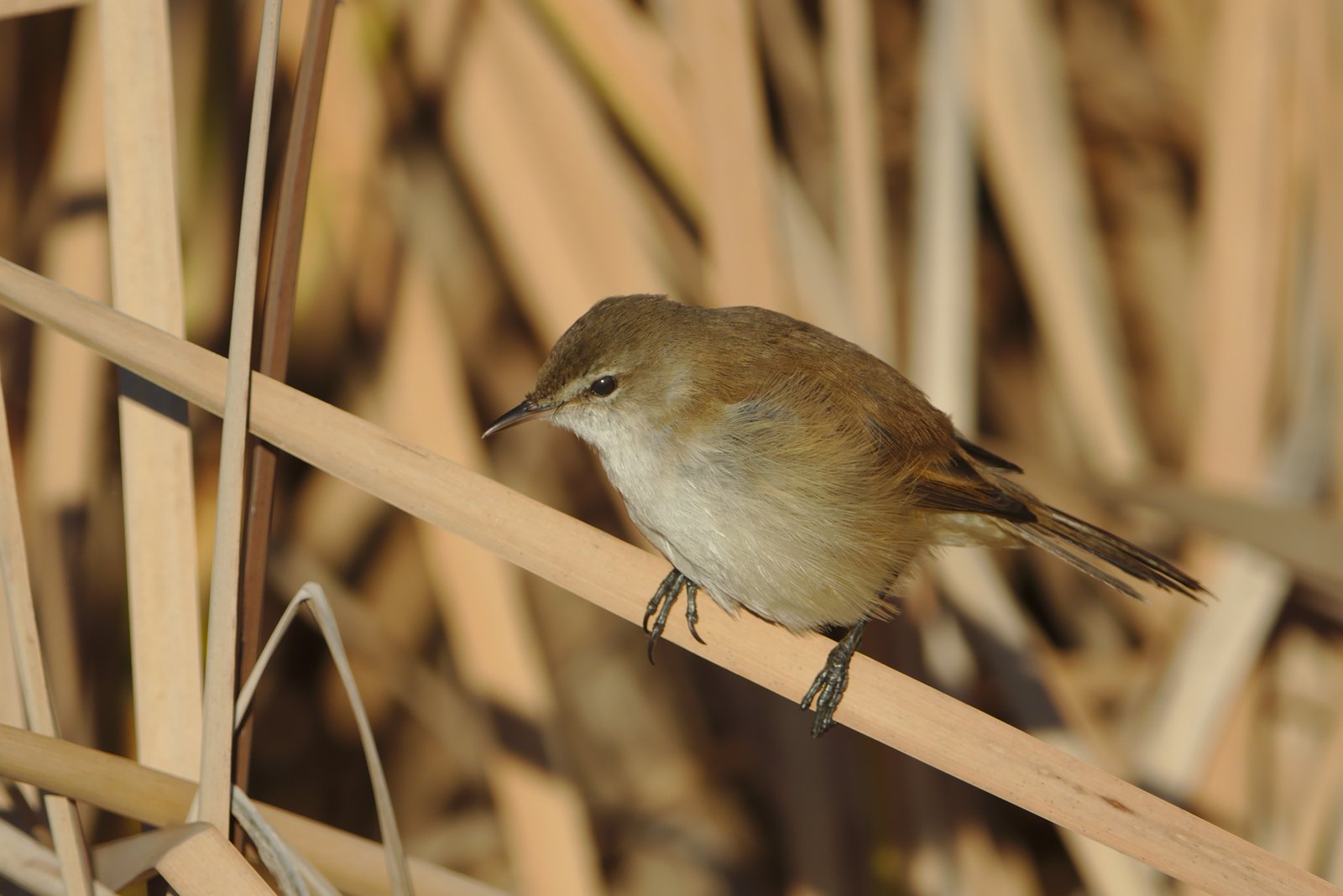
The Lesser Swamp Warbler is the large, warm brown and white reed warbler of reed fringes and bulrush beds across almost the whole region. It is resident and sings its rich, fluid, liquid song throughout the year, a characteristic sound of African wetlands.
Voice
The song is rich, fluid and liquid: short, varied phrases of clear whistles and gurgling notes, chirp-chirp-teeroo-teeroo-chrrr, often repeated with pauses, recalling the bubbling of a stream; heard all year, also at night. The call is a hard chak and a rattling chrrrr.
Recording: African Bioacoustics Community — CC BY-NC-SA 4.0 · converted to mono · xeno-canto
Identification
14–16 cm, slim, with a long, thin, pointed bill and a long, rounded tail. The upperparts are warm dark brown, slightly more rufous on the rump; the throat and belly are clean white and the flanks warm buff-brown. A narrow white supercilium runs from the bill to behind the eye, above dark lores. The legs are dark grey-brown to blackish, long and strong. The sexes are alike; juveniles are warmer and more rufous. It climbs up reed stems and often sings fairly openly from a stem at mid-height or at the top of the reeds.
Confusion species
Common Reed Warbler Acrocephalus scirpaceus is smaller, with paler legs, a fainter supercilium and buffier underparts, and sings a rhythmic, repetitive churring rather than rich, fluid phrases. Greater Swamp Warbler Acrocephalus rufescens is larger and darker, without a clear supercilium, with greyish underparts, and lives in papyrus in the north. Great Reed Warbler Acrocephalus arundinaceus is larger and heavier, paler brown, with a thicker bill and a grating song; it is a summer visitor. Basra Reed Warbler Acrocephalus griseldis is cooler grey-brown and extremely scarce.
Habitat
Reed fringes, bulrushes, papyrus and rushes along rivers, dams, vleis, lakes, sewage ponds and estuaries, from sea level to high in the interior; also in small, isolated reed patches. It hunts insects, spiders and small frogs among the stems and on the mud. The nest is a deep cup of reed leaves, slung between stems above the water.
Where the bird is most at home, classified by the vegetation units of southern Africa.


Range and movements
Across almost the whole region wherever permanent reeds or bulrushes grow: South Africa (including the Western Cape), Lesotho, Eswatini, Zimbabwe, Mozambique, Malawi, Zambia, Botswana (mainly Okavango, Chobe and Linyanti), northern and central Namibia and Angola; absent from the driest parts of the Namib and Kalahari. Beyond the region it occurs locally in East and Central Africa, north to Ethiopia, Chad and Cameroon.
- Resident
- Summer visitor (c. Oct–Mar)
- Winter visitor (c. Apr–Sep)
- Passage (Mar–Apr, Oct–Nov)
- dark = core range, pale = thinly spread
How and when to look
All year, best in the early morning in summer, when the song rings out from every reedbed. Almost any dam or vlei with reeds will do, for example Rondevlei near Cape Town, Marievale in Gauteng or the riverbanks of the Okavango. Wait at the edge of the reeds: the bird often perches singing halfway up a stem, when the white throat and supercilium stand out well.
Conservation status
Not threatened and common. Habitat disappears locally through drainage and the burning and cutting of reeds, but the species quickly colonises new reed fringes at dams and sewage works.
Scientific name
Acrocephalus gracilirostris | (Hartlaub, 1864)
Hartlaub described the species in 1864 as Calamoherpe gracilirostris; because it was later moved to another genus, the author and year stand in brackets. The genus Acrocephalus was introduced in 1811 by Naumann & Naumann. Acrocephalus is Greek, from akros 'topmost, pointed' and kephalē 'head'; the Naumanns, who introduced the genus, called these birds Spitzkopf 'pointed head', so they read akros as 'pointed'. gracilirostris comes from the Latin gracilis, 'slender', and rostrum, 'bill' — for the long, thin bill. The specimen the first description was based on came from Liesbeek River, Cape Town, South Africa.