All species › Hoopoes and hornbills › Hornbills › Black-and-White-Casqued Hornbill
Black-and-White-Casqued Hornbill | Bycanistes subcylindricus
Grijsoorneushoornvogel | Cálao Carigrís
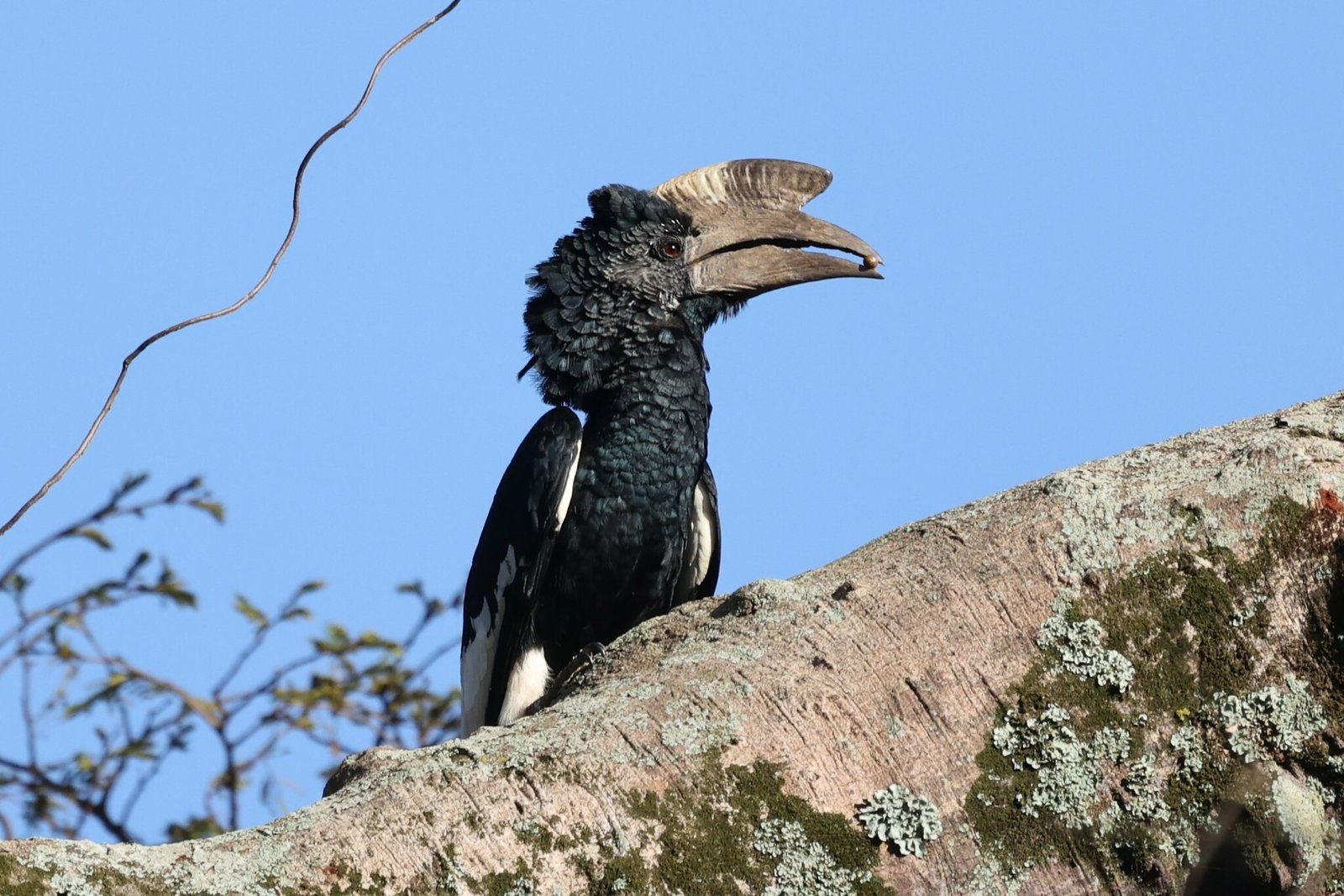
The Black-and-White-Casqued Hornbill is a large black-and-white forest hornbill of Central Africa that reaches the region only in northern Angola. The male carries a high casque that is mostly cream with a black base.
Voice
A loud, raucous grating ka-ka-ka-kaa and braying calls repeated in chorus, often from the canopy or in flight. As in all Bycanistes, the wingbeats make a loud whooshing sound.
Recording: Jonathan Onongo — CC BY-NC-SA 4.0 · converted to mono · xeno-canto
Identification
About 65 cm. Head, neck, breast, back and forewing are black; the cheeks have grey feather tips. Lower back, rump, belly and undertail coverts are white, and the wing carries a large white patch across the secondaries and primaries that shows as a broad white panel in flight. The tail is white with black central feathers. The male's bill is black and cream with a large, high casque; in the female bill and casque are smaller and darker. The bare skin around the eye is dark. Juveniles have a small bill without a casque.
Confusion species
Trumpeter Hornbill (Bycanistes bucinator) is smaller, with a grey casque, pink skin around the eye and only a white trailing edge to the wing, not a large white panel. Piping Hornbill (Bycanistes fistulator) is clearly smaller, with a low, pale bill lacking a large casque. Black-Casqued Hornbill (Ceratogymna atrata) is larger, with wholly black wings, a black casque and blue throat skin; the female has a rufous head.
Habitat
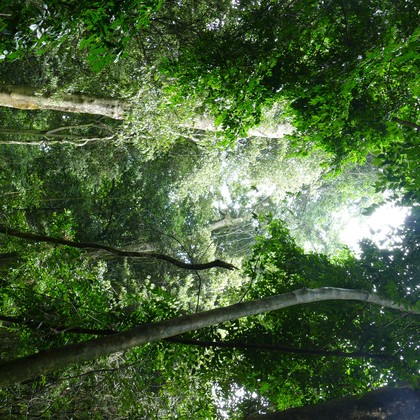
Lowland rainforest, gallery forest along rivers and forest–savanna mosaic, also secondary forest and forest edge near villages. It feeds mainly on fruit, with figs and oil-palm fruit as important sources, supplemented with insects and small vertebrates. It nests in cavities in large trees, the female sealing herself in.
Where the bird is most at home, classified by the vegetation units of southern Africa.

Range and movements
Within the region only in northern and north-eastern Angola, in gallery forest and forest remnants; its status and exact distribution there are poorly known. Beyond the region it ranges through West and Central Africa from Sierra Leone to Cameroon and DR Congo, and east to Uganda, western Kenya, Rwanda, Burundi and north-western Tanzania.
How and when to look
A species for the little-visited forest areas of northern Angola; search gallery forest and forest edges where figs are fruiting. Flocks are noisy and fly over on audibly whooshing wings; the large white wing panel is the best feature in flight.
Conservation status
Not threatened and common over much of Central and East Africa, including in secondary forest. Within the region it is scarce and little studied; clearance of gallery forest and hunting are the main threats there.
Scientific name
Bycanistes subcylindricus | (Sclater, 1871)
Sclater described the species in 1871 as Buceros subcylindricus; because it was later moved to another genus, the author and year stand in brackets. The genus Bycanistes was introduced in 1860 by Cabanis & Heine. Bycanistes comes from the Greek bykanistēs, 'trumpeter' — for the loud, braying and trumpeting calls of these hornbills. subcylindricus is Latin for 'almost cylindrical', from sub, 'somewhat', and cylindricus — for the shape of the casque on the bill. The specimen the first description was based on came from Ashanti, Ghana.