All species › Passerines › Vangas and helmetshrikes › Black-and-White Shrike-Flycatcher
Black-and-White Shrike-Flycatcher | Bias musicus
Zwart-witte klauwiervliegenvanger | Bias Músico
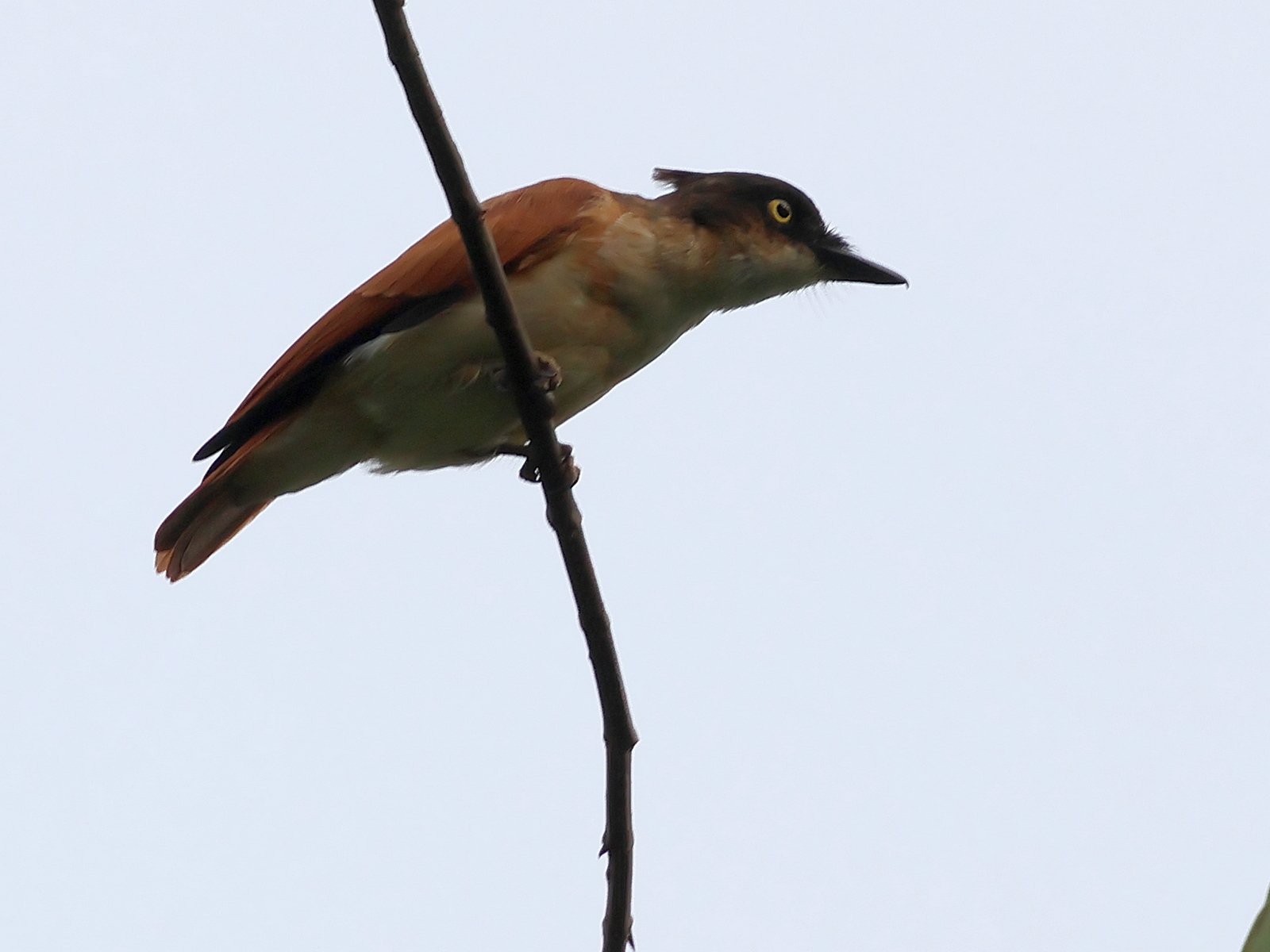
Black-and-White Shrike-Flycatcher is a stocky, crested bird with a short tail and a bright yellow eye, which sits watching from clearings in lowland forest like a small shrike. The sexes differ strongly: the male is black with a white belly, the female has a black head and a chestnut back. The male draws attention with his display flight over the treetops on crackling wings.
Voice
A clear, whistled whit-to-whit-to or hoo-to-wee, often repeated in flight or from a high branch, and a hard, high chik. During the display flight the male makes a crackling or whirring sound with the wings.
Recording: Jaap van der Waarde — CC BY-NC-SA 4.0 · converted to mono · xeno-canto
Identification
14–16 cm. The male has a glossy black head with a short, erectile crest, black upperparts and a black throat and breast, sharply demarcated from the white belly. In flight it shows a white patch at the base of the primaries. The female also has a black crested head, but the back, wings and tail are warm chestnut and the underparts white, with a creamy wash on the flanks. In both sexes the eye is bright yellow, the bill broad and black and the legs yellow. The tail is short, making the bird look stocky. Juveniles resemble the female.
Confusion species
African Shrike-Flycatcher Megabyas flammulatus of northern Angola and Zambia has a red eye, no crest and a white throat; the female is streaked below. Chinspot Batis Batis molitor is smaller, with a grey crown, a white supercilium and a breast band. Black-Backed Puffback Dryoscopus cubla has a red eye, a white throat and a white rump pad.
Habitat
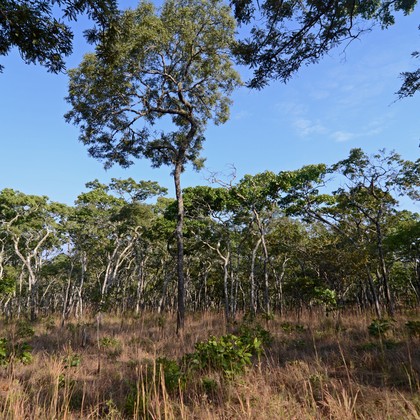
Clearings, edges and the tall canopy of lowland and coastal forest, gallery forest and the edges of tall miombo, also abandoned plantations with large trees. It perches high and upright on a bare branch, catching flying insects in short sallies or gleaning them from leaves and twigs.
Where the bird is most at home, classified by the vegetation units of southern Africa.

Range and movements
Within the region mainly in Mozambique: in the lowlands of the centre and north, with known sites in the forests around Dondo, Inhamitanga and Gorongosa, south to about the Save. Also in northern Angola. From southern Malawi and eastern Zimbabwe there are only a few scattered records. Beyond, widespread in the forests of West, Central and East Africa.
- Resident
- Summer visitor (c. Oct–Mar)
- Winter visitor (c. Apr–Sep)
- dark = core range, pale = thinly spread
How and when to look
Year-round; scarce but conspicuous once you know the call. In the forests around Inhamitanga and Gorongosa, search edges and clearings for a stocky bird on a high, bare branch. In the breeding season the male gives himself away with his display flight and whistled call over the canopy.
Conservation status
Not threatened; widespread in Africa. In Mozambique it is scarce and dependent on lowland forest, which is becoming heavily fragmented by farming and logging. Away from forest the species hardly occurs.
Scientific name
Bias musicus | (Vieillot, 1818)
Vieillot described the species in 1818 as Platyrhynchos musicus; because it was later moved to another genus, the author and year stand in brackets. The genus Bias was introduced in 1831 by Lesson. Bias comes from the Greek buas, a bird of evil omen usually identified with the Eagle Owl. Compare also the mythological Bias, a Greek prince at the siege of Troy. musicus is Latin for 'musical', for the melodious, whistled song. The specimen the first description was based on came from Malembo, Cabinda (Angola).