All species › Passerines › Fairy flycatchers › Fairy Flycatcher
Fairy Flycatcher | Stenostira scita
Elfvliegenvanger | Papamoscas Duende
The Fairy Flycatcher is a small, restless grey bird with a black mask and a tail that is constantly fanned and swung from side to side. Despite its name it is not a true flycatcher but the only member of its genus, related to the crested flycatchers of Elminia. It is endemic to southern Africa.

Voice
A thin, high tsee-tsee-tsee and a short, descending trill. The song is a soft, rapid series of sibilant and chirping notes, often overlooked. It often calls continuously while foraging.
Recording: Dawie de Swardt — CC BY-NC-SA 4.0 · shortened to the first 60 s, mono · xeno-canto
Identification
12 cm. Blue-grey above, with a black mask through the eye and a narrow white eyebrow above it. The wings are black with a conspicuous white stripe along the secondaries. The tail is black with white outer feathers, visible when it is fanned. Throat and breast are pale grey, the belly whiter with a soft pink to reddish patch in the centre, fainter in the female. Bill and legs are black. It moves restlessly through the bushes, taking insects both from foliage and in short sallies.
Confusion species
Chestnut-Vented Warbler Curruca subcoerulea and Layard's Warbler Curruca layardi are larger and grey but lack the black mask and white wing stripe, and have a streaked throat. Grey Tit Melaniparus afer has a black cap and bib. Cape Penduline Tit Anthoscopus minutus is much smaller, with a short tail and yellow underparts. Pririt Batis Batis pririt is patterned black and white with a black breast band or rufous breast and a short tail.
Habitat
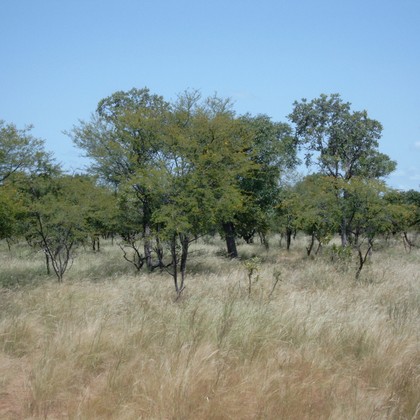
When breeding, low shrubland in the Nama Karoo and Succulent Karoo, dry fynbos and renosterveld, and scrub along dry watercourses, in the east also montane scrub high into Lesotho. In winter in thornveld, forest edge, riverine growth and gardens in the warmer north-east.
Where the bird is most at home, classified by the vegetation units of southern Africa.


Range and movements
Breeds in southern Namibia, the Western, Northern and Eastern Cape, the Free State and Lesotho. After breeding many move east and north-east: KwaZulu-Natal, Eswatini, Mpumalanga, Gauteng, Limpopo and North West Province, with a few reaching south-eastern Botswana. Some birds remain in the Karoo year-round. It does not occur outside southern Africa.
- Resident
- Winter visitor (c. Apr–Sep)
- dark = core range, pale = thinly spread
How and when to look
In the Karoo in spring and summer it is most often found in scrub along dry watercourses and in parks such as Karoo NP and Tankwa. Listen for the thin calls and watch for the swinging, fanned tail with white. In winter in the north-east it also visits gardens and joins mixed parties of small birds.
Conservation status
Not threatened; widespread and locally common. No large-scale threats are known, though overgrazing in the Karoo can locally degrade the shrub layer.
Scientific name
Stenostira scita | (Vieillot, 1818)
Vieillot described the species in 1818 as Muscicapa scita; because it was later moved to another genus, the author and year stand in brackets. The genus Stenostira was introduced in 1850 by Cabanis & Bonaparte. Stenostira comes from the Greek stenos, 'narrow, thin', and steira, 'ship's beak, keel' — for the Fairy Flycatcher's thin, narrow bill. scita comes from the Latin scitus, 'fine, pretty' — for this elegant, delicately built little bird. The specimen the first description was based on came from Lower Orange River.