All species › Kingfishers, bee-eaters and rollers › Bee-eaters › Black Bee-Eater
Black Bee-Eater | Merops gularis
Zwarte bijeneter | Abejaruco Negro
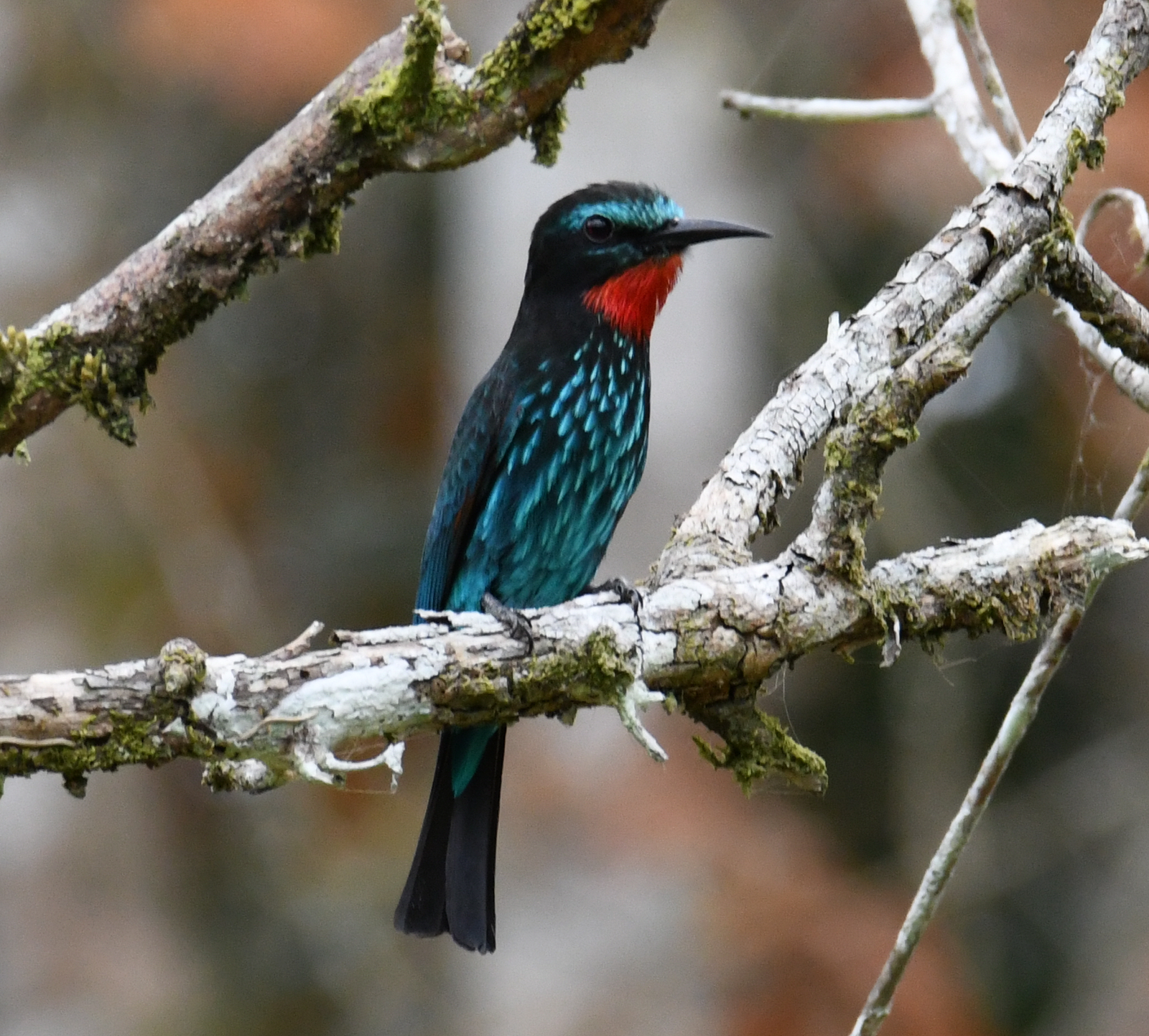
The Black Bee-Eater is a rainforest bee-eater: black with a scarlet throat and a cobalt-blue rump and belly. In the region it occurs only at forest edges in northern Angola, on the southern rim of the Congo Basin.
Voice
A soft, high, metallic tsip or pseep, sometimes run into a short twitter. A rather silent species, more noticeable for its posture and sallies than for its voice.
Recording: Rod Cassidy — CC BY-NC-SA 4.0 · converted to mono · xeno-canto
Identification
About 20 cm, with a square tail lacking streamers. Head, back and tail are dull black, the forehead and a short supercilium glossy pale blue. The throat is bright scarlet. Breast and belly are black with dense pale blue streaking, the rump and undertail coverts plain cobalt-blue. In flight the flight feathers are strikingly rufous with a black trailing edge. The sexes are alike. Juveniles are duller and blackish-brown, with a drab throat lacking red and less blue streaking.
Confusion species
No confusion is possible within the region: no other bee-eater is mainly black. In silhouette, high on a dead tree against the sky, it may suggest a Blue-Throated Roller (Eurystomus gularis), but that is larger, cinnamon, with a yellow bill. Blue-Breasted Bee-Eater (Merops variegatus) is green above with a yellow throat.
Habitat
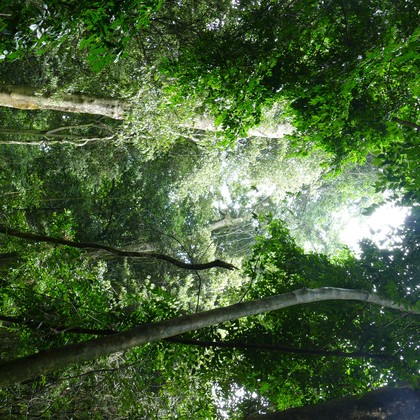
Edges and clearings of lowland rainforest, old clearings, secondary forest, forested riverbanks and open ground around villages in forest country. It hunts from a high, exposed dead branch at the forest edge, often in pairs, for bees, wasps and other flying insects. It nests in a tunnel in a steep bank or earth wall.
Where the bird is most at home, classified by the vegetation units of southern Africa.

Range and movements
In the region only in northern Angola: Cabinda and the forested parts of Zaire, Uíge, Cuanza Norte and Lunda Norte provinces, on the southern edge of the Congo Basin. Beyond the region through the West and Central African rainforest from Sierra Leone via Nigeria, Cameroon and DR Congo to western Uganda.
- Resident
- dark = core range, pale = thinly spread
How and when to look
In northern Angola, for example in the Mayombe forest of Cabinda and the forest areas of Uíge and Cuanza Norte, search forest edges and river courses for dead trees standing proud of the canopy. The birds return again and again to the same branch; the red throat and blue belly show well only through a telescope or in side light.
Conservation status
Not threatened and fairly common in the rainforest zone of West and Central Africa. In Angola it is limited to a small marginal area where forest is cleared for farming and charcoal, but the species tolerates clearings and secondary forest well.
Scientific name
Merops gularis | Shaw, 1798
Shaw described the species in 1798 and placed it straight away in the genus where it still stands. The genus Merops was introduced in 1758 by Linnaeus. Merops is Greek and means 'bee-eater'. gularis comes from the Latin gula, 'throat' — for the scarlet throat that contrasts sharply with the black plumage. The specimen the first description was based on came from Sierra Leone.