All species › Kingfishers, bee-eaters and rollers › Bee-eaters › Böhm's Bee-Eater
Böhm's Bee-Eater | Merops boehmi
Böhms bijeneter | Abejaruco de Böhm
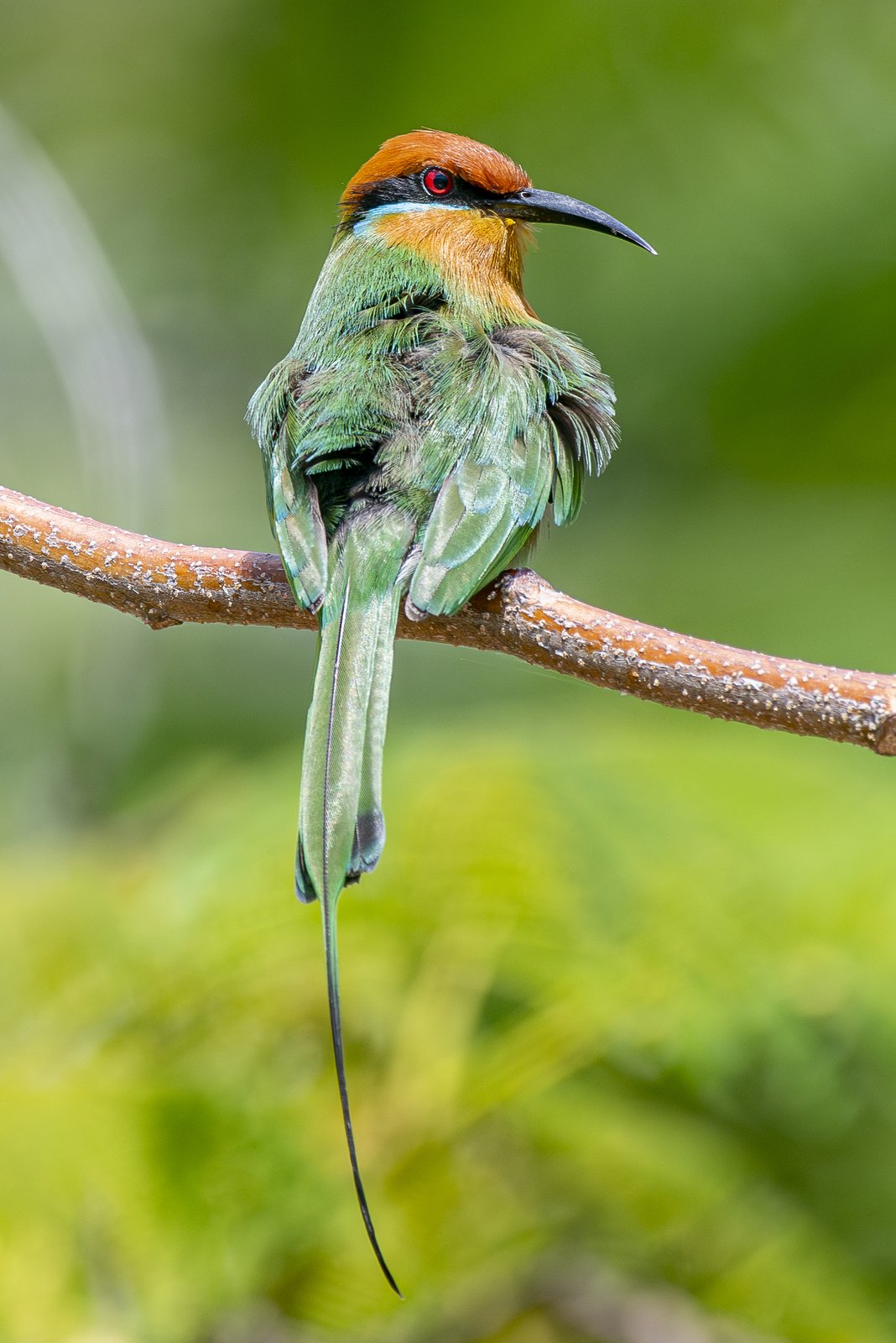
Böhm's Bee-Eater is a slim green bee-eater with a rufous crown and throat and long thin streamers, confined to the valleys and riverine forests of the north-east of the region. It sits unobtrusively in shade at woodland edges and draws attention mainly with its sallies over clearings.
Voice
A soft, high, whistled swee or psiup, and among groups a quiet fine twitter. Much quieter than other bee-eaters of its size.
Recording: Magnus Wadstein — CC BY-NC-SA 4.0 · converted to mono · xeno-canto
Identification
About 17 cm, plus 3 to 4 cm of elongated, wire-thin central tail feathers. Crown and hindcrown rufous, throat also rufous and merging into the breast. A black mask with a narrow pale blue cheek stripe below it. Upperparts, breast and belly green, the underparts slightly paler and washed bluish towards the undertail. In flight the flight feathers are rufous with a dark trailing edge. The sexes are alike. Juveniles are duller, with a drab crown and shorter streamers.
Confusion species
Little Bee-Eater (Merops pusillus) has a yellow throat with a black gorget, an ochre-brown breast and no streamers. Swallow-Tailed Bee-Eater (Merops hirundineus) has a yellow throat, a blue collar and a forked tail. Olive Bee-Eater (Merops superciliosus) is much larger, with an olive-brown crown, a white and rufous throat and blue underwings.
Habitat
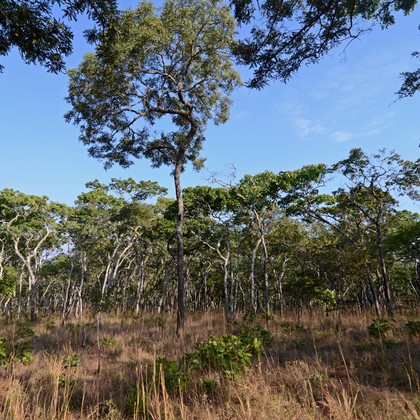
Riverine forest and dense thickets along rivers, clearings and edges in moist miombo, and transitions from woodland to dambos and vleis, usually near water. It hunts from a shaded low branch for flying insects over a clearing or track. It nests solitarily, not in colonies, in a tunnel in flat ground or a low bank.
Where the bird is most at home, classified by the vegetation units of southern Africa.

Range and movements
Confined to the north-east of the region: northern and eastern Zambia (the Luangwa Valley, the Zambezi escarpment, around the Bangweulu and Mweru areas), Malawi (especially the Shire valley and the shores of Lake Malawi) and north-western and central Mozambique (mainly the Zambezi valley). Beyond the region in south-eastern DR Congo and southern Tanzania.
- Resident
- dark = core range, pale = thinly spread
How and when to look
Liwonde in Malawi and South Luangwa in Zambia are the most reliable sites: search the edges of riverine forest, especially where a sandy track or small clearing lets light into the trees. Birds often sit for long periods on the same low branch and make short, swooping flights.
Conservation status
Not threatened and fairly common in suitable habitat. It has a small global range and depends on riverine forest, which is cleared locally for fields and firewood.
Scientific name
Merops boehmi | Reichenow, 1882
Reichenow described the species in 1882 and placed it straight away in the genus where it still stands. The genus Merops was introduced in 1758 by Linnaeus. Merops is Greek and means 'bee-eater'. boehmi honours the German zoologist and explorer Richard Böhm (1854–1884), who collected in East and Central Africa. The specimen the first description was based on came from Bumi, Tanzania.