All species › Kingfishers, bee-eaters and rollers › Bee-eaters › White-Fronted Bee-Eater
White-Fronted Bee-Eater | Merops bullockoides
Witkapbijeneter | Abejaruco Frentiblanco
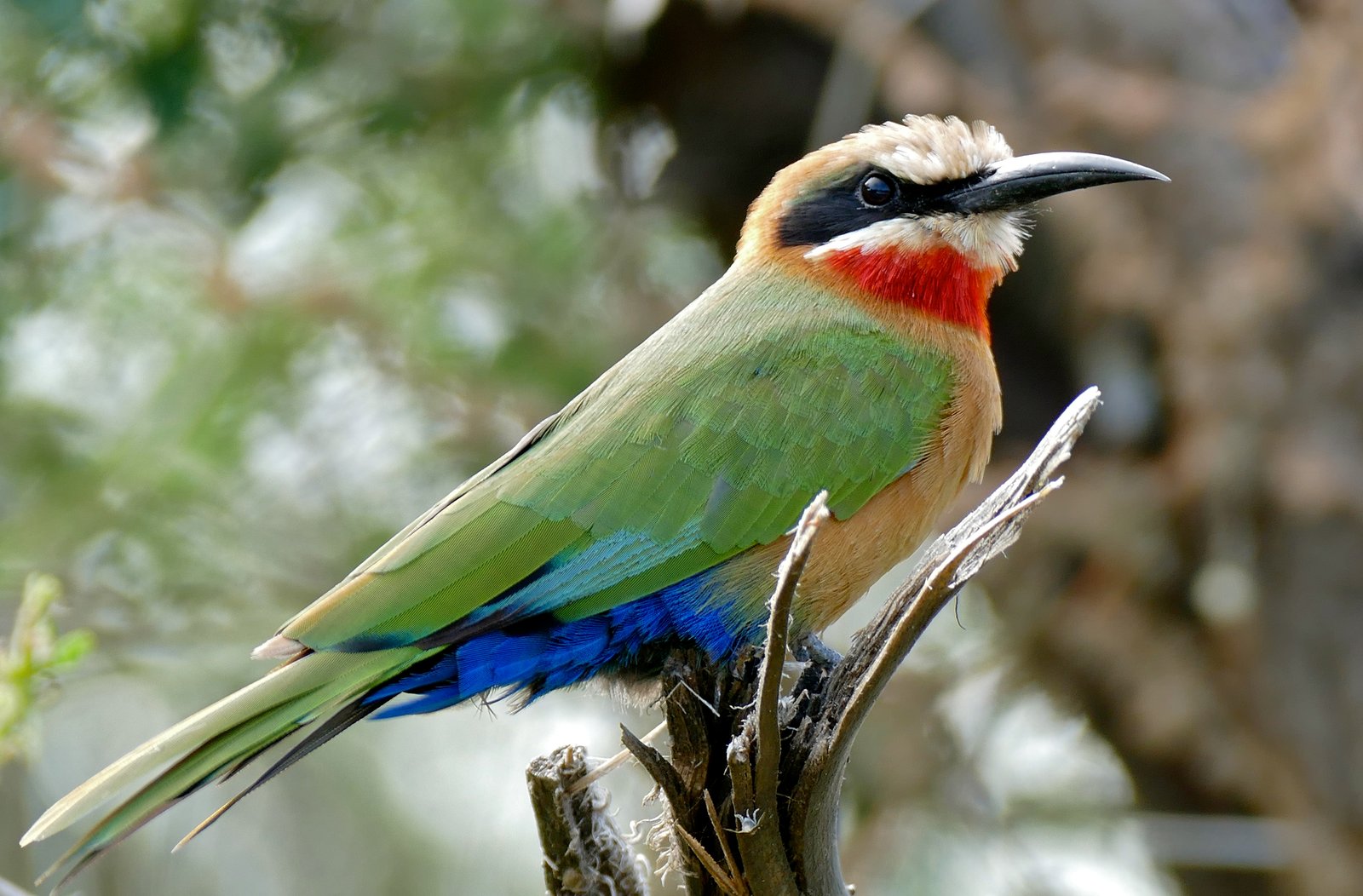
The White-Fronted Bee-Eater is a medium-sized bee-eater with a white forehead and a scarlet throat that nests in colonies in steep sand banks along rivers. Its social life is exceptionally complex: family clans with helpers at the nest together form colonies of sometimes hundreds of birds.
Voice
A nasal, grating and somewhat husky gau-uu or kwerr, often repeated and heard constantly around the colony; a sharper kwaark in alarm. Short gurgling contact calls in flight.
Recording: Matthew L. Brady — CC BY-NC-SA 4.0 · converted to mono · xeno-canto
Identification
About 23 cm, with a square tail lacking elongated central feathers. Forehead and chin are white, the throat bright scarlet, and a broad black mask runs from the bill to behind the eye. Crown and nape are cinnamon-brown, back, wings and tail grass-green. Breast and belly are warm cinnamon-buff, the undertail coverts cobalt-blue and conspicuous in flight. The sexes are alike. Juveniles are duller, with a paler orange-red throat and a less pure white forehead.
Confusion species
The combination of white forehead, red throat and blue undertail is unique in the region. Little Bee-Eater (Merops pusillus) is much smaller, with a yellow throat and a black collar. Swallow-Tailed Bee-Eater (Merops hirundineus) has a yellow throat, a blue collar and a forked tail. Juvenile Southern Carmine Bee-Eaters (Merops nubicoides) are larger and lack the white forehead.
Habitat
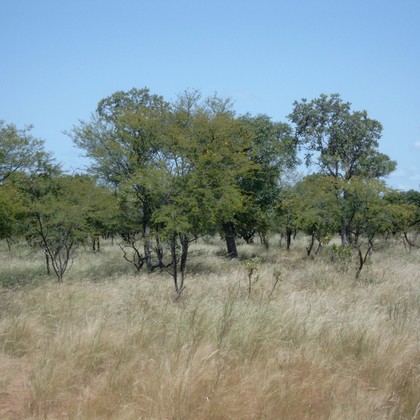
Rivers and larger streams with steep sand or loam banks, and the surrounding open savanna and thornveld, also at dams, gravel pits and pan margins. It hunts from a perch for flying insects, especially bees, wasps and flying ants, up to a few hundred metres from the colony.
Where the bird is most at home, classified by the vegetation units of southern Africa.

Range and movements
North-eastern South Africa (Limpopo, the Mpumalanga lowveld, northern KwaZulu-Natal), Eswatini, Zimbabwe, northern and eastern Botswana, northern Namibia, Zambia, southern and central Mozambique and southern Angola; rare in Malawi. Beyond the region it extends north to Gabon, southern DR Congo, Kenya and Tanzania.
- Resident
- Summer visitor (c. Oct–Mar)
- Winter visitor (c. Apr–Sep)
- Passage (Mar–Apr, Oct–Nov)
- dark = core range, pale = thinly spread
How and when to look
The colony is the place to go: birds sit in rows on branches above the bank and fly constantly in and out of the nest holes. Good sites are the Olifants and Letaba rivers in Kruger, the Limpopo and the banks of the Zambezi and Chobe. Breeding runs from August to November; outside the breeding season groups roost in reedbeds and dense riverside scrub.
Conservation status
Not threatened and locally common. Colonies are vulnerable to bank collapse, sand mining and trampling by livestock, and sometimes disappear after floods. Because bees form an important part of the diet, beekeepers do not always welcome the species.
Scientific name
Merops bullockoides | Smith, 1834
Smith described the species in 1834 and placed it straight away in the genus where it still stands. The genus Merops was introduced in 1758 by Linnaeus. Merops is Greek and means 'bee-eater'. bullockoides means 'resembling bullockii', the Red-throated Bee-eater, which was named after the English naturalist and museum owner William Bullock (c. 1773–1849). The specimen the first description was based on came from Marico district, South Africa.