All species › Kingfishers, bee-eaters and rollers › Kingfishers › Giant Kingfisher
Giant Kingfisher | Megaceryle maxima
Afrikaanse reuzenijsvogel | Martín Gigante Africano
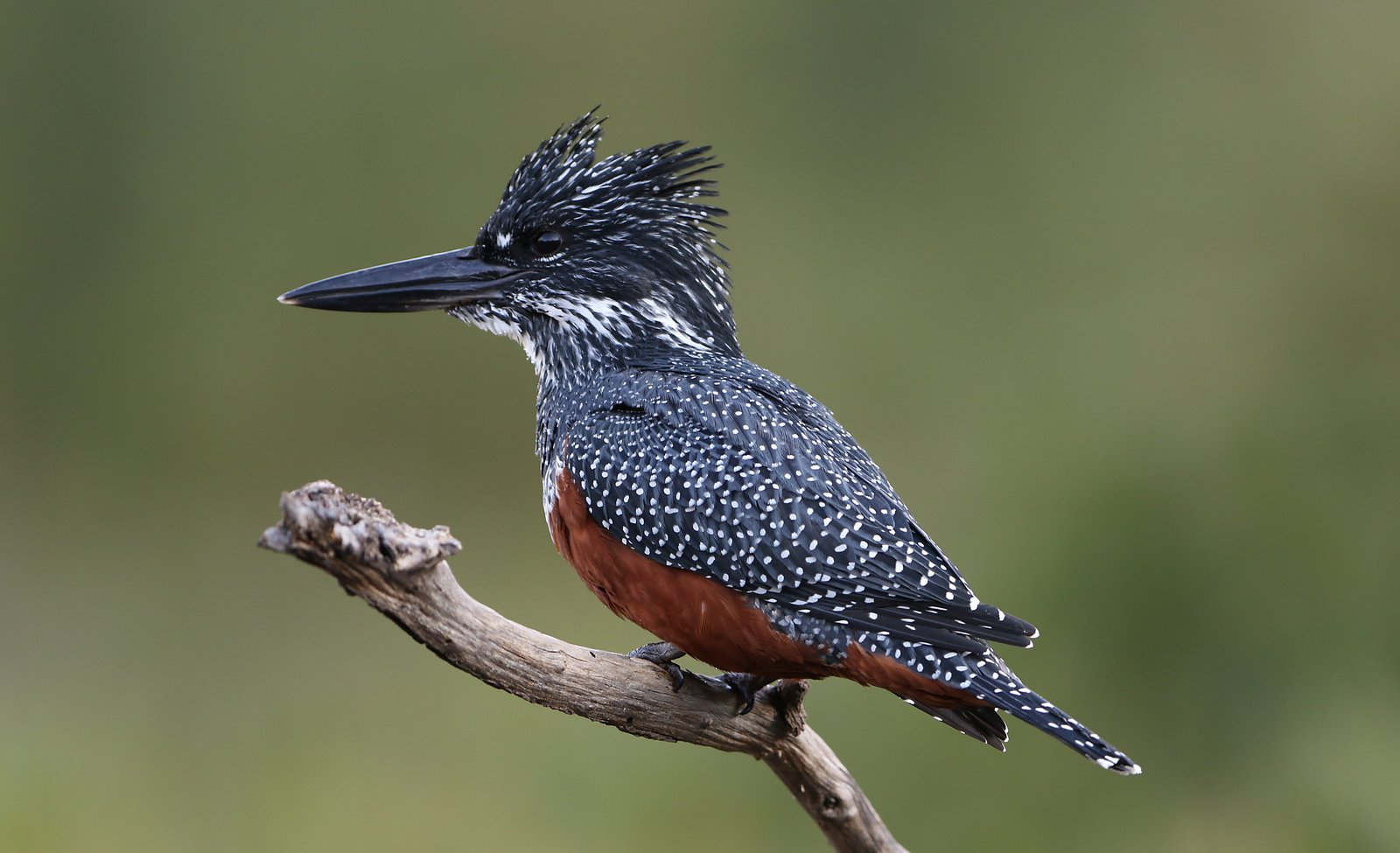
The Giant Kingfisher is the largest kingfisher in Africa: a heavy, slate-grey bird spotted with white, with a shaggy crest, a huge black dagger bill and much chestnut on the breast or belly. It is tied to wooded waterways and fishes from a high, sheltered branch.
Voice
A loud, harsh, grating kah-kah-kah or kek-kek-kek, often in flight along the river; also a soft growling krrk and, from pairs, a long, strident calling sequence.
Recording: isaac kilusu — CC BY-NC-SA 4.0 · converted to mono · xeno-canto
Identification
About 45 cm. The upperparts are dark slate grey, densely covered with small white spots; the ragged crest is dark and the throat white. The bill is heavy, long and black. The male has a rufous breast and a white, black-barred belly; the female the reverse, a breast spotted black and white and a rufous belly and underwing. Young males already show a rufous breast with black flecks, young females a paler spotted breast. Flight is on heavy, slow wingbeats.
Confusion species
Its size rules out confusion with any other kingfisher. Pied Kingfisher (Ceryle rudis) is much smaller and purely black and white, without chestnut, and often hovers over open water, which Giant seldom does.
Habitat
Rivers and streams with wooded banks, in lowlands and hills alike, also dams, lakes, lagoons, estuaries and quiet coastal waters, even fish ponds and garden ponds. It sits on a high, shaded branch, dives at an angle into the water and takes mainly fish and crabs, also frogs. The nest is at the end of a long tunnel in a steep bank.
Where the bird is most at home, classified by the vegetation units of southern Africa.


Range and movements
Over most of the region wherever suitable water occurs: in South Africa mainly in the east, the south and the Western Cape, and along the Orange River far to the west, also in Lesotho, Eswatini, Zimbabwe, Mozambique, Malawi, Zambia, Angola, northern and eastern Botswana and northern Namibia. Absent from the driest areas without permanent water. Beyond the region over most of sub-Saharan Africa, from Senegal to Ethiopia.
- Resident
- Summer visitor (c. Oct–Mar)
- Winter visitor (c. Apr–Sep)
- Passage (Mar–Apr, Oct–Nov)
- dark = core range, pale = thinly spread
How and when to look
Along a wooded river listen for the harsh grating call; the bird usually flies off low upstream and lands on a big branch over the water. It often sits still for long periods, partly hidden in the foliage. It is also regular at fish ponds and dams in the suburbs of, for example, Cape Town, Johannesburg and Harare.
Conservation status
Not threatened and fairly common over most of the region, although densities are low everywhere. Locally it suffers from the loss of riparian forest, siltation of rivers and pollution; dam building has created new habitat elsewhere.
Scientific name
Megaceryle maxima | (Pallas, 1769)
Pallas described the species in 1769 as Alcedo maxima; because it was later moved to another genus, the author and year stand in brackets. The genus Megaceryle was introduced in 1848 by Kaup. Megaceryle combines Greek megas 'great' with the genus name Ceryle, setting the large kingfishers apart from the smaller ones. maxima is Latin for 'largest' — it is the largest kingfisher in Africa. The specimen the first description was based on came from Cape of Good Hope.