All species › Kingfishers, bee-eaters and rollers › Kingfishers › African Pygmy Kingfisher
African Pygmy Kingfisher | Ispidina picta
Afrikaanse dwergijsvogel | Martín Pigmeo Africano
The African Pygmy Kingfisher is a tiny, colourful kingfisher of woodland and thickets that does not depend on water and mainly catches insects. In the south of the region it is a summer visitor that migrates at night; on passage birds regularly fly into windows of houses.
Voice
A high, thin tseep or tsit, often in flight; when excited a rapid series of high squeaks, tseep-tseep-tseep. The call is weak and easily lost in woodland.
Recording: Jonathan Onongo — CC BY-NC-SA 4.0 · converted to mono · xeno-canto
Identification
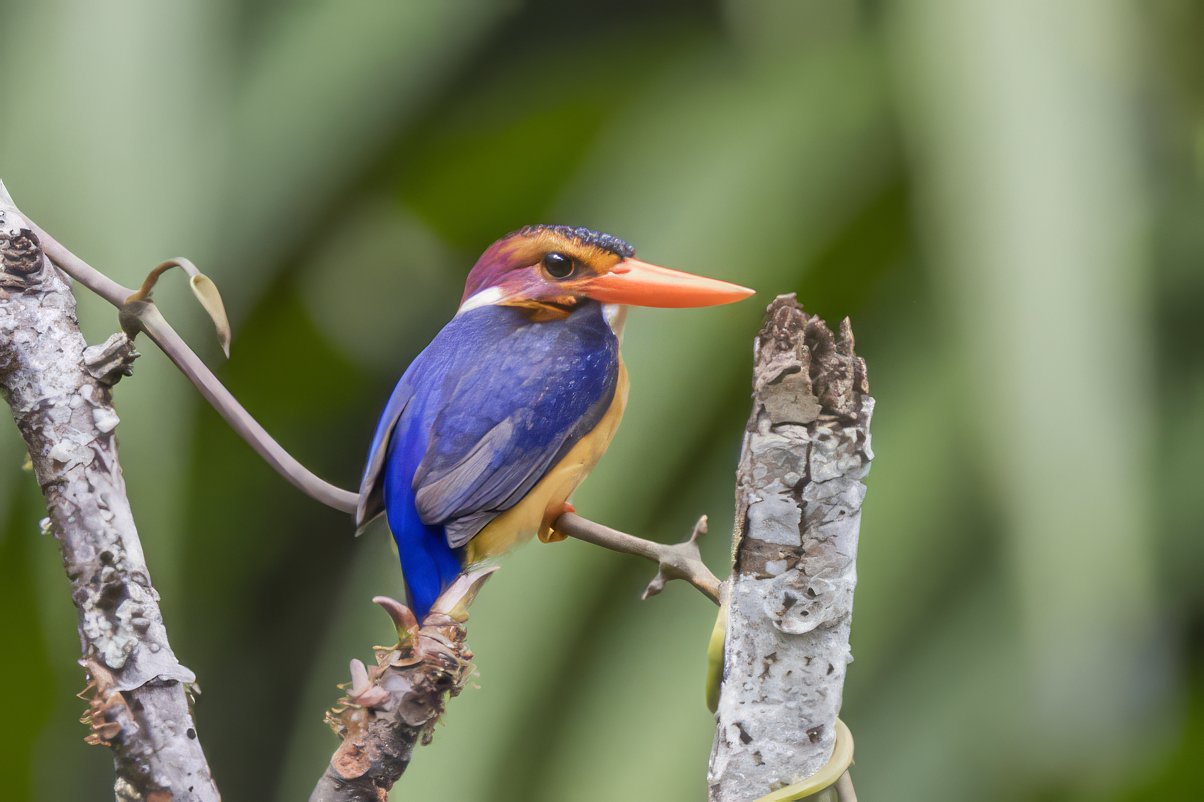
About 12 cm, with a large head, short tail and a bright red, relatively broad bill. The crown is ultramarine with fine black barring, without a crest, separated from the eye by an orange-pink supercilium. The ear coverts have a striking violet-lilac patch; the throat is white and there is a white neck patch behind the cheek. Back and rump are bright cobalt-blue, the wings darker blue. Underparts and cheeks are orange-rufous. Legs red. The sexes are alike. Juveniles are duller, with a blackish bill and a darker back.
Confusion species
Most similar is Malachite Kingfisher (Corythornis cristatus), which has a turquoise, black-barred crest reaching the eye and the bill, no violet ear patch and no orange supercilium, and nearly always sits near water. White-Bellied Kingfisher (Corythornis leucogaster) has a white belly stripe and darker upperparts. In northern Angola, African Dwarf Kingfisher (Ispidina lecontei) looks similar, but has a rufous-orange head with a black forecrown.
Habitat
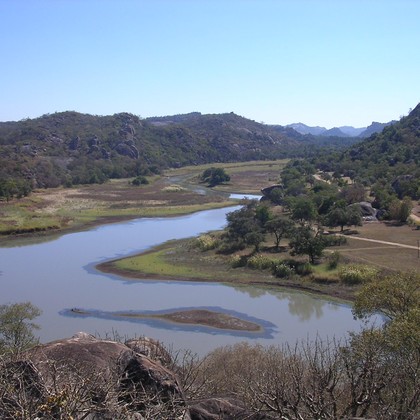
Moist woodland, riverine forest, forest edges, dense thickets and coastal forest, also overgrown gardens; often far from water. It sits motionless low on a thin twig and drops to the ground for grasshoppers, beetles, spiders and small lizards. It nests in a burrow dug in a sandy bank, an aardvark hole or the wall of a termite mound.
Where the bird is most at home, classified by the vegetation units of southern Africa.


Range and movements
Widespread in the north and east of the region: Angola, Zambia, Malawi, Mozambique, Zimbabwe, northern Botswana, the Caprivi and northern Namibia, and in South Africa in Limpopo, Mpumalanga, KwaZulu-Natal and the Eastern Cape. Absent from the dry west and the Highveld. Beyond the region in sub-Saharan Africa from Senegal to Ethiopia and south to Tanzania and DR Congo.
- Resident
- Summer visitor (c. Oct–Mar)
- Winter visitor (c. Apr–Sep)
- Passage (Mar–Apr, Oct–Nov)
- dark = core range, pale = thinly spread
How and when to look
Best found from November to March in woodland with a shrubby understorey, by spotting a small blue-and-orange bird sitting low and still before it suddenly drops to the ground. Listen for the thin tseep in flight. On passage, in October and March–April, birds sometimes turn up in gardens and even in towns.
Conservation status
Not threatened and common over a large range. Many birds die on nocturnal migration by striking windows; clearing of woodland and riverine forest reduces the habitat locally.
Scientific name
Ispidina picta | (Boddaert, 1783)
Boddaert described the species in 1783 as Todus pictus; because it was later moved to another genus, the author and year stand in brackets. The genus Ispidina was introduced in 1848 by Kaup. Ispidina is a diminutive of the Late Latin ispida, 'kingfisher' — thus 'little kingfisher', fitting for these tiny African kingfishers. picta comes from the Latin pictus, 'painted, colourful' — for the colourful blue, orange and violet plumage. The specimen the first description was based on came from Saint-Louis, Senegal.