All species › Kingfishers, bee-eaters and rollers › Kingfishers › African Dwarf Kingfisher
African Dwarf Kingfisher | Ispidina lecontei
Bruinkopdwergijsvogel | Martín Pigmeo del Congo
The African Dwarf Kingfisher is the smallest kingfisher in the world: an insect-eating bird of the understorey of Central and West African rainforest. In the region it reaches only the far north of Angola, where it is difficult to find in dense forest.

Voice
A very high and thin tseee or tsip, often in flight, easily missed among the insect sounds of the forest.
Recording: Jonathan Onongo — CC BY-NC-SA 4.0 · converted to mono · xeno-canto
Identification
About 10 cm, compact, with a short tail and a red bill that is broad at the base. The head is rufous-orange, with a black forecrown and a small blue-violet patch behind the ear. Back, rump and wings are dark violet-blue, the rump slightly brighter. Throat white to pale orange-yellow, the rest of the underparts uniform orange-rufous. Legs red. The sexes are alike. Juveniles are duller, with a dark bill and less black on the forecrown.
Confusion species
African Pygmy Kingfisher (Ispidina picta) is slightly larger and has a blue, black-barred crown, an orange supercilium and a violet-lilac ear patch; it occurs in open woodland, not in closed rainforest. Malachite Kingfisher (Corythornis cristatus) and White-Bellied Kingfisher (Corythornis leucogaster) have blue crowns and sit near water.
Habitat
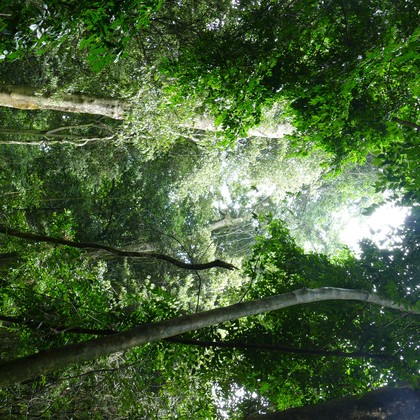
Understorey of primary and mature secondary lowland rainforest, also gallery forest; not tied to water. It perches low on a branch or liana in the gloom of the forest and drops on insects and spiders on the ground or on leaves. It nests in a self-excavated burrow in an earth bank, for instance in the root plate of a fallen tree.
Where the bird is most at home, classified by the vegetation units of southern Africa.
Range and movements
In the region only in the far north of Angola: Cabinda and the forested areas of the north, such as Uíge and Lunda Norte. Beyond the region in rainforest from Sierra Leone and Guinea east to Uganda and South Sudan, and south to southern DR Congo.
How and when to look
A challenge for anyone searching for forest birds in Cabinda or northern Angola: walk slowly along forest trails and watch for a flying orange spark low between the trunks. The call is often the first clue; with patience the bird may return to a favoured perch. Mist-netting studies produce most records.
Conservation status
Not threatened and widespread over a large range, although rainforest is declining in parts of its range through logging and agriculture. In the region the species is rare and poorly studied.
Scientific name
Ispidina lecontei | Cassin, 1856
Cassin described the species in 1856 and placed it straight away in the genus where it still stands. The genus Ispidina was introduced in 1848 by Kaup. Ispidina is a diminutive of the Late Latin ispida, 'kingfisher' — thus 'little kingfisher', fitting for these tiny African kingfishers. lecontei honours the American entomologist John Lawrence LeConte (1825–1883). The specimen the first description was based on came from Moonda River, Gabon.