All species › Kingfishers, bee-eaters and rollers › Kingfishers › Grey-Headed Kingfisher
Grey-Headed Kingfisher | Halcyon leucocephala
Grijskopijsvogel | Alción Cabeciblanco
The Grey-Headed Kingfisher is a colourful tree kingfisher with a grey head, a chestnut belly and bright blue tail and wings. It arrives in the north-east of the region to breed in the rainy season and moves north to East Africa in the dry season.

Voice
A weak, high, descending chi-chi-chi-chrrr or a series of fast whistled notes, less loud than Woodland Kingfisher. In display a pair sits facing each other with spread wings and calls with open bills.
Recording: Mischa Keijmel — CC BY-NC-SA 4.0 · converted to mono · xeno-canto
Identification
About 20 cm, with a red dagger bill and red legs. Head, neck and breast are pale grey to grey-brown, the mantle and scapulars black. Belly and undertail coverts are deep chestnut. Flight feathers, rump and tail are bright cobalt to turquoise. The sexes are alike; juveniles have a dark bill, a paler orange-brown belly and fine barring on the breast.
Confusion species
Brown-Hooded Kingfisher (Halcyon albiventris) has a streaked brown crown and a pale, streaked belly without chestnut. Woodland Kingfisher (Halcyon senegalensis) lacks the chestnut belly and black mantle and has a black lower mandible. No other Halcyon in the region has a chestnut belly.
Habitat
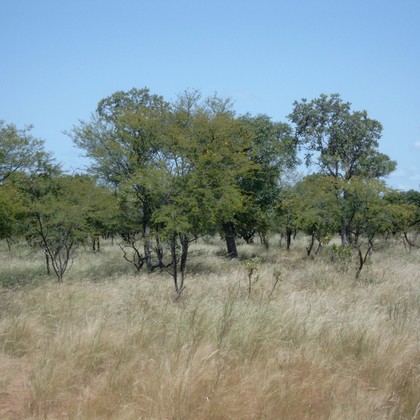
Riverine forest and woodland along rivers and dry watercourses, mopane woodland and open savanna with tall trees, usually close to steep banks. It hunts from a branch mainly for grasshoppers and other large insects on the ground, rarely for fish. It nests in a self-excavated tunnel in a river bank or earth bank.
Where the bird is most at home, classified by the vegetation units of southern Africa.


Range and movements
Breeds in the north-east and north of the region: Limpopo, the Mpumalanga lowveld and north-eastern KwaZulu-Natal in South Africa, also Eswatini, Mozambique, Zimbabwe, northern Botswana, north-eastern Namibia, Zambia, Malawi and Angola. Southern birds winter in East Africa. Beyond the region it is widespread in the savannas of sub-Saharan Africa, on the Cape Verde Islands and in south-western Arabia.
- Resident
- Summer visitor (c. Oct–Mar)
- Winter visitor (c. Apr–Sep)
- Passage (Mar–Apr, Oct–Nov)
- dark = core range, pale = thinly spread
How and when to look
From September along the rivers of Kruger (Sabie, Olifants, Letaba) and in the Zambezi Valley; search low riverside trees next to an eroded sandy bank. The bird often perches low and gives good views; the chestnut belly may only show well in good light.
Conservation status
Not threatened and spread over a large range. Its reliance on steep banks for nesting makes it locally vulnerable to bank erosion and river engineering.
Scientific name
Halcyon leucocephala | (Müller, 1776)
Müller described the species in 1776 as Alcedo leucocephala; because it was later moved to another genus, the author and year stand in brackets. The genus Halcyon was introduced in 1821 by Swainson. Halcyon goes back to Greek alkyon, the bird of legend that nested at sea and calmed the waves; the name later came to be used for kingfishers generally. leucocephala is Greek, from leukos, 'white', and kephalē, 'head' — for the pale grey, almost white head. The specimen the first description was based on came from Senegal.