All species › Kingfishers, bee-eaters and rollers › Kingfishers › Brown-Hooded Kingfisher
Brown-Hooded Kingfisher | Halcyon albiventris
Bruinkapijsvogel | Alción Cabecipardo
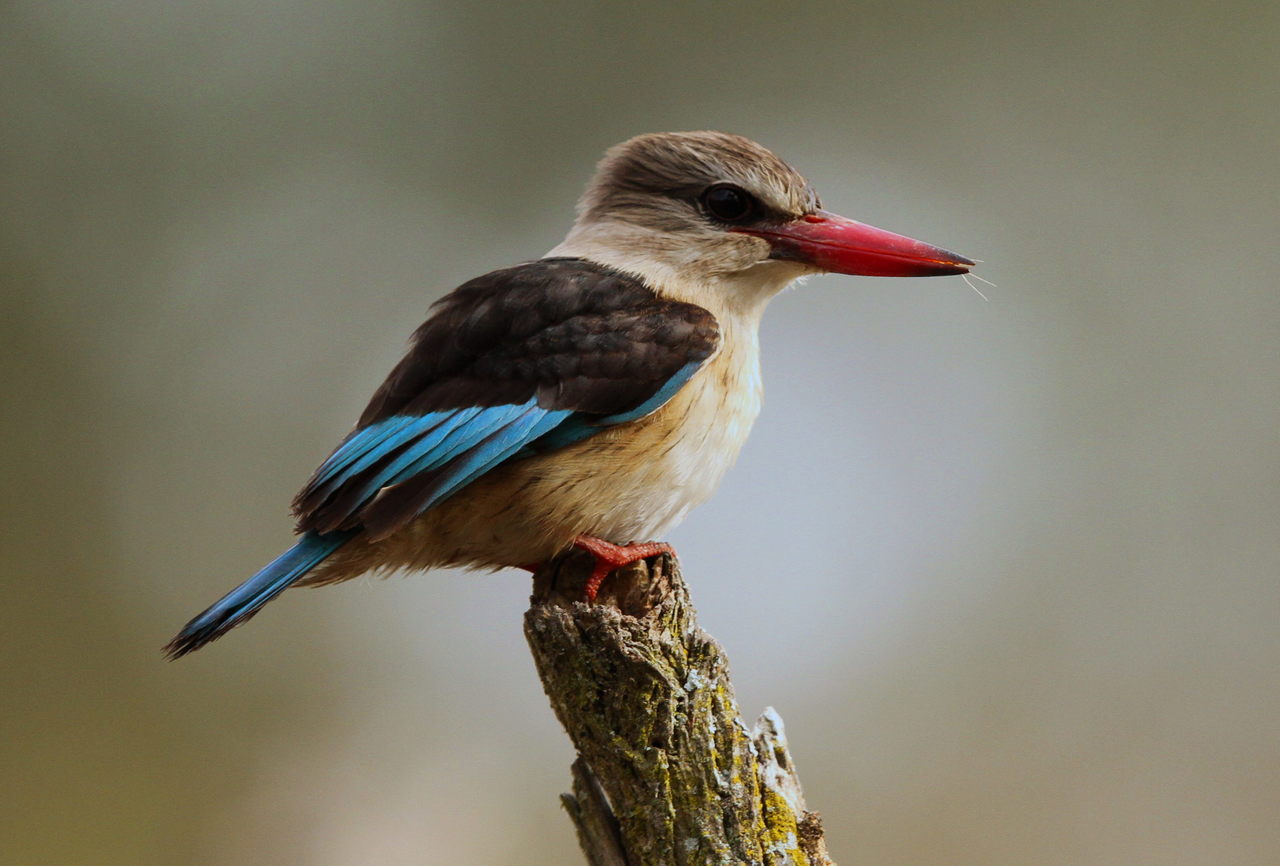
The Brown-Hooded Kingfisher is the tree kingfisher most often met in gardens and parks in eastern South Africa. It hunts insects and small vertebrates on land and often sits patiently on a low branch, a wire or a fence post.
Voice
A loud, fast, descending whistled kik-kik-kik-kik, often from a perch and repeated frequently in the breeding season. When disturbed a hard, high tchik; in display the birds spread their wings and show the blue.
Recording: Walter Wallner — CC BY-NC-SA 4.0 · converted to mono · xeno-canto
Identification
About 24 cm, with a heavy, all-red bill and red legs. The crown is brown with fine dark streaks, the cheeks buffy-brown with a pale supercilium. The mantle is black in the male and brown in the female; in both it contrasts with the turquoise-blue wing panels, rump and tail. Throat white, breast and flanks buff with fine dark streaks. Juveniles have a duller, partly dark bill and a somewhat scaly breast.
Confusion species
Grey-Headed Kingfisher (Halcyon leucocephala) has a grey, unstreaked head and a chestnut belly. Striped Kingfisher (Halcyon chelicuti) is smaller, with a two-toned bill, a white collar and a brown rather than black back. Woodland Kingfisher (Halcyon senegalensis) is mainly blue with a blue-grey head.
Habitat
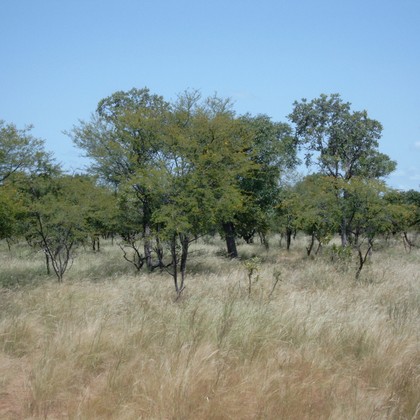
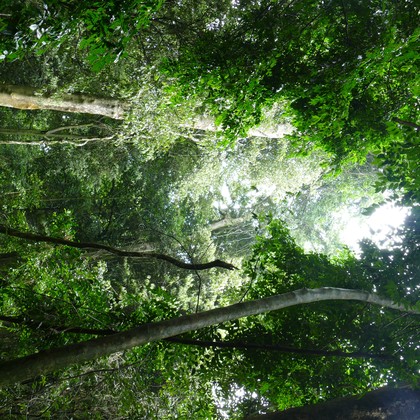
Forest edges, coastal bush, thornveld, riverine growth and copses in farmland, and increasingly gardens, parks and golf courses in towns. It hunts large insects, lizards, small snakes, frogs and occasionally nestling birds, rarely fish. It nests in a self-excavated tunnel in a steep bank, ditch or road cutting.
Where the bird is most at home, classified by the vegetation units of southern Africa.

Range and movements
The east and north of the region: the Eastern Cape, KwaZulu-Natal, Mpumalanga, Limpopo and Gauteng in South Africa, also Eswatini, Mozambique, Zimbabwe, northern and eastern Botswana, north-eastern Namibia (the Zambezi strip), Zambia, Malawi and Angola. Beyond the region from East Africa (Tanzania, Kenya, Somalia) to DR Congo and Gabon.
- Resident
- Summer visitor (c. Oct–Mar)
- Winter visitor (c. Apr–Sep)
- Passage (Mar–Apr, Oct–Nov)
- dark = core range, pale = thinly spread
How and when to look
Often seen year-round in leafy suburbs of Durban, Pietermaritzburg and the lowveld towns. Search low branches along a lawn or forest edge; the bird sits for minutes, then drops quickly to the ground. The contrast of red bill and black back is the best field mark.
Conservation status
Not threatened and common; the species has adapted well to suburban gardens and parks and appears, if anything, to be increasing there. Locally it loses nesting banks to development.
Scientific name
Halcyon albiventris | (Scopoli, 1786)
Scopoli described the species in 1786 as Alcedo albiventris; because it was later moved to another genus, the author and year stand in brackets. The genus Halcyon was introduced in 1821 by Swainson. Halcyon goes back to Greek alkyon, the bird of legend that nested at sea and calmed the waves; the name later came to be used for kingfishers generally. albiventris is Latin for 'white-bellied', from albus, 'white', and venter, 'belly' — for the pale underparts. The specimen the first description was based on came from Cape of Good Hope (originally given in error as 'New Guinea').