All species › Kingfishers, bee-eaters and rollers › Kingfishers › Striped Kingfisher
Striped Kingfisher | Halcyon chelicuti
Gestreepte ijsvogel | Alción Estriado
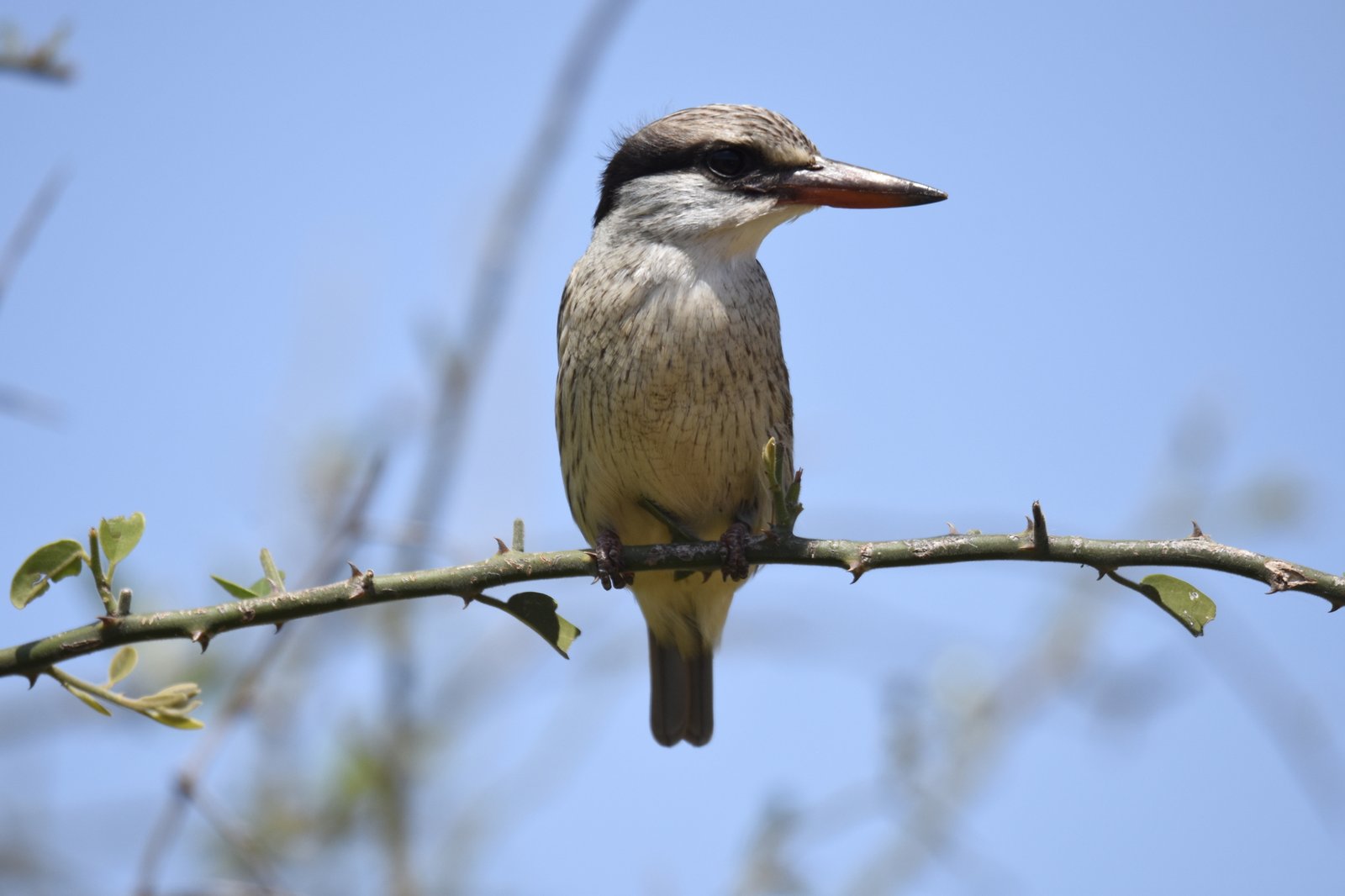
The Striped Kingfisher is a small, unobtrusive grey-brown tree kingfisher of dry woodland, often far from water. Only in flight, or when it spreads its wings in display, does the turquoise of rump and tail appear.
Voice
A high, fast trill that drops at the end, tirrrrrr, and a continuous kiri-kiri-kiri, often in duet and especially at dawn and dusk. While calling the birds rhythmically half-open their wings, flashing the black-and-white underwing.
Recording: Dries Van de Loock — CC BY-NC-SA 4.0 · converted to mono · xeno-canto
Identification
About 18 cm, with a relatively small head and a bill with a dark upper and a red lower mandible. The crown is grey-brown with fine dark streaks, separated from the brown mantle by a white collar; a black stripe runs from the bill through the eye to the nape. The underparts are white to pale buff with fine dark streaks on breast and flanks. Rump, tail and the bases of the flight feathers are blue to turquoise. The male has a black band across the underwing, conspicuous in display; in the female it is grey. Juveniles are duller with a dark bill.
Confusion species
Brown-Hooded Kingfisher (Halcyon albiventris) is larger, with an all-red bill and a black or brown back contrasting strongly with the blue wings. Woodland Kingfisher (Halcyon senegalensis) is far bluer and has a red upper mandible. The combination of streaked crown, white collar and two-toned bill is diagnostic.
Habitat
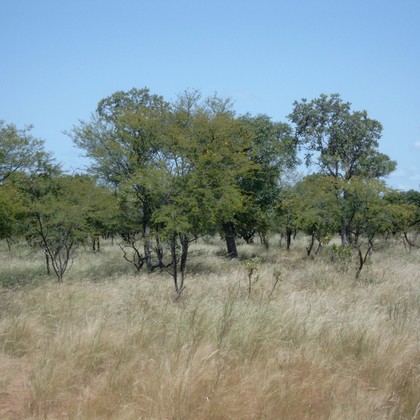
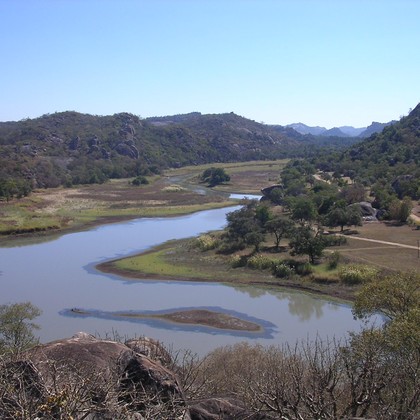
Dry open woodland, thorn savanna and miombo edges with scattered trees, often far from water. It hunts from a branch for grasshoppers, beetles and the occasional lizard on the ground. It nests in a tree cavity, often an old barbet or woodpecker hole.
Where the bird is most at home, classified by the vegetation units of southern Africa.
Range and movements
The northern and eastern parts of the region: north-eastern South Africa (Limpopo, the Mpumalanga lowveld and northern KwaZulu-Natal), Eswatini, Mozambique, Zimbabwe, northern and eastern Botswana, northern Namibia, Zambia, Malawi and Angola. Beyond the region it occupies savannas across much of sub-Saharan Africa, from Senegal to Ethiopia and Tanzania.
- Resident
- Summer visitor (c. Oct–Mar)
- Winter visitor (c. Apr–Sep)
- Passage (Mar–Apr, Oct–Nov)
- dark = core range, pale = thinly spread
How and when to look
At dusk, listen for the trill and watch for the wing-spreading of a pair in the canopy. The bird often sits still and upright on a low side branch in the shade and is then easily overlooked; only when it flies off does the blue show.
Conservation status
Not threatened and common in suitable woodland. There is no evidence of a clear decline; retaining old trees with nest cavities matters most for the species.
Scientific name
Halcyon chelicuti | (Stanley, 1814)
Stanley described the species in 1814 as Alaudo Chelicuti; because it was later moved to another genus, the author and year stand in brackets. The genus Halcyon was introduced in 1821 by Swainson. Halcyon goes back to Greek alkyon, the bird of legend that nested at sea and calmed the waves; the name later came to be used for kingfishers generally. chelicuti refers to Chelicut (Chelekot) in Tigray, Ethiopia, where the first specimen was collected. The specimen the first description was based on came from Chelicut, Ethiopia.