All species › Kingfishers, bee-eaters and rollers › Kingfishers › Woodland Kingfisher
Woodland Kingfisher | Halcyon senegalensis
Senegal-ijsvogel | Alción Senegalés
The Woodland Kingfisher is a brilliant blue tree kingfisher that does not depend on fish but drops from a perch onto insects and lizards on the ground. Its loud descending trill is the sound of the rainy season in the woodlands of the north-eastern half of the region.

Voice
A loud, piercing tchip-trrrrrrrrrrr, a sharp introductory note followed by a long descending trill, repeated tirelessly and heard all day in the breeding season. In display the bird spreads its wings on the perch and pivots from side to side, flashing the black-and-white underwing.
Recording: Jonathan Onongo — CC BY-NC-SA 4.0 · converted to mono · xeno-canto
Identification
About 23 cm, with a large head and a heavy dagger-shaped bill, the upper mandible red and the lower black. Head and breast are pale grey washed blue; back, rump, tail and flight feathers bright sky-blue, the shoulders and the underwing coverts black. A short black stripe runs from the bill base to just behind the eye. Legs red. The sexes are alike; juveniles are duller, with fine dark vermiculation on the breast and a darker bill with an orange base.
Confusion species
Mangrove Kingfisher (Halcyon senegaloides) has an all-red bill, a greyer head and a darker back, and in the region is chiefly a winter visitor along the coast from the Eastern Cape to Mozambique. Blue-Breasted Kingfisher (Halcyon malimbica), in northern Angola and north-western Zambia, is larger, with a blue breast band and a black loral stripe reaching the bill. Grey-Headed Kingfisher (Halcyon leucocephala) has a chestnut belly and a black mantle.
Habitat
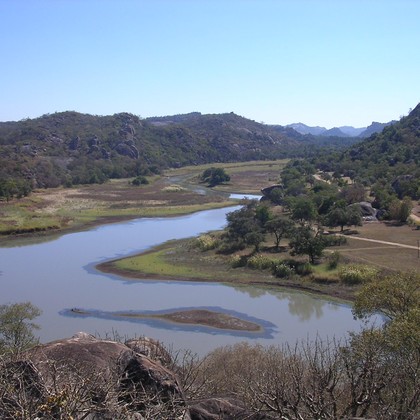
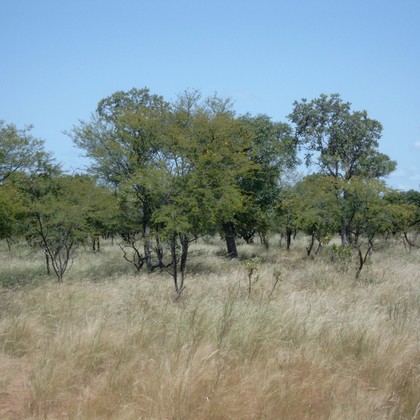
Open woodland with tall trees, especially along rivers and in mopane and mixed broadleaved woodland, also parks and orchards with large trees. It hunts from a low to mid-level branch for grasshoppers, beetles and small lizards on the ground. It nests in tree cavities, often old woodpecker or barbet holes.
Where the bird is most at home, classified by the vegetation units of southern Africa.

Range and movements
Breeds in the north and east of the region: north-eastern South Africa (Limpopo, the Mpumalanga lowveld, northern KwaZulu-Natal), Eswatini, Mozambique, Zimbabwe, northern and eastern Botswana, northern Namibia, Zambia, Malawi and Angola. It winters in the humid tropics of central Africa. Beyond the region it also occurs in West and East Africa to Ethiopia, where part of the population is resident.
- Resident
- Summer visitor (c. Oct–Mar)
- Winter visitor (c. Apr–Sep)
- Passage (Mar–Apr, Oct–Nov)
- dark = core range, pale = thinly spread
How and when to look
From mid-November in the Kruger lowveld or the Okavango Delta: the call gives the bird away, and it often sits in view on a bare branch at a woodland edge. Watch for migrants in October and April in unexpected places, such as gardens outside the breeding range. Dark-billed juveniles are easily taken for another species.
Conservation status
Not threatened and common in suitable woodland. Felling of old trees with cavities locally limits nest sites, and in the south of the range rainfall patterns determine how early and in what numbers the birds arrive.
Scientific name
Halcyon senegalensis | (Linnaeus, 1766)
Linnaeus described the species in 1766 as Alcedo senegalensis; because it was later moved to another genus, the author and year stand in brackets. The genus Halcyon was introduced in 1821 by Swainson. Halcyon goes back to Greek alkyon, the bird of legend that nested at sea and calmed the waves; the name later came to be used for kingfishers generally. senegalensis means 'from Senegal', where the first specimen came from. The specimen the first description was based on came from Senegal.