All species › Kingfishers, bee-eaters and rollers › Kingfishers › Mangrove Kingfisher
Mangrove Kingfisher | Halcyon senegaloides
Mangrove-ijsvogel | Alción de Manglar
The Mangrove Kingfisher is a forest kingfisher of the East African coast, with a grey head, blue back and tail and an all-red bill. It breeds in coastal forest and along rivers inland and after breeding moves to mangroves and estuaries, as far as the Eastern Cape.

Voice
A loud, strident, descending series, chi-chi-chi-chiiiirrr, louder and harsher than that of Woodland Kingfisher and ending in a trill; also a dry chik as an alarm call. Largely silent in its non-breeding quarters.
Recording: isaac kilusu — CC BY-NC-SA 4.0 · converted to mono · xeno-canto
Identification
About 23 cm. Head and neck are dark grey-brown, with black lores and a narrow white line over the eye. Mantle and scapulars are blackish; rump, tail and wings bright turquoise blue, with black primaries. Throat and belly are white, breast and flanks grey, finely vermiculated. The bill is entirely bright red, the legs blackish. The sexes are alike; juveniles are duller, with a brownish bill and fine scalloping on the breast.
Confusion species
Woodland Kingfisher (Halcyon senegalensis) has a red upper and black lower mandible, a paler blue-grey head and a white breast, and is a summer visitor to woodland. Brown-Hooded Kingfisher (Halcyon albiventris) has a red bill with a dark tip, a brown hood and a streaked crown. Grey-Headed Kingfisher (Halcyon leucocephala) has a chestnut belly.
Habitat
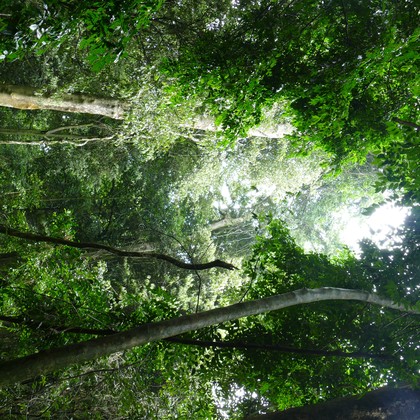
In the breeding season (November–March) coastal forest, riverine forest and dense woodland up to a few tens of kilometres inland; outside the breeding season mangroves, estuaries, tidal creeks and wooded lagoons. It perches low and takes crabs, shrimps, small fish, insects and lizards. It nests in a tree cavity.
Where the bird is most at home, classified by the vegetation units of southern Africa.

Range and movements
In the region along the coastal plain of Mozambique, mainly from the Zambezi delta southwards, and in South Africa in KwaZulu-Natal and the Eastern Cape, in winter south to about the Great Fish and Keiskamma estuaries. Rare inland along the large rivers. Beyond the region along the East African coast through Tanzania and Kenya to Somalia, and on Zanzibar.
- Resident
- Summer visitor (c. Oct–Mar)
- Winter visitor (c. Apr–Sep)
- Passage (Mar–Apr, Oct–Nov)
- dark = core range, pale = thinly spread
How and when to look
Best in the winter months in the mangroves and estuaries of KwaZulu-Natal and the Eastern Cape, for example the Mngazana mangroves, near Durban (Beachwood Mangroves) and at Umlalazi. The bird sits still in the shade and only draws attention when it drops onto a crab on the mud; in the breeding season it gives itself away in coastal forest with its loud call.
Conservation status
Not threatened on the Red List, but regarded as regionally Endangered in South Africa because of the small population and the loss and disturbance of mangroves and coastal forest. In Mozambique too, mangroves and coastal forest are under pressure from wood-cutting and development.
Scientific name
Halcyon senegaloides | Smith, 1834
Smith described the species in 1834 and placed it straight away in the genus where it still stands. The genus Halcyon was introduced in 1821 by Swainson. Halcyon goes back to Greek alkyon, the bird of legend that nested at sea and calmed the waves; the name later came to be used for kingfishers generally. senegaloides means 'resembling senegalensis' — for its close resemblance to Woodland Kingfisher. The specimen the first description was based on came from Durban area, South Africa.