All species › Tubenoses › Albatrosses › Black-Browed Albatross
Black-Browed Albatross | Thalassarche melanophris
Wenkbrauwalbatros | Albatros Ojeroso
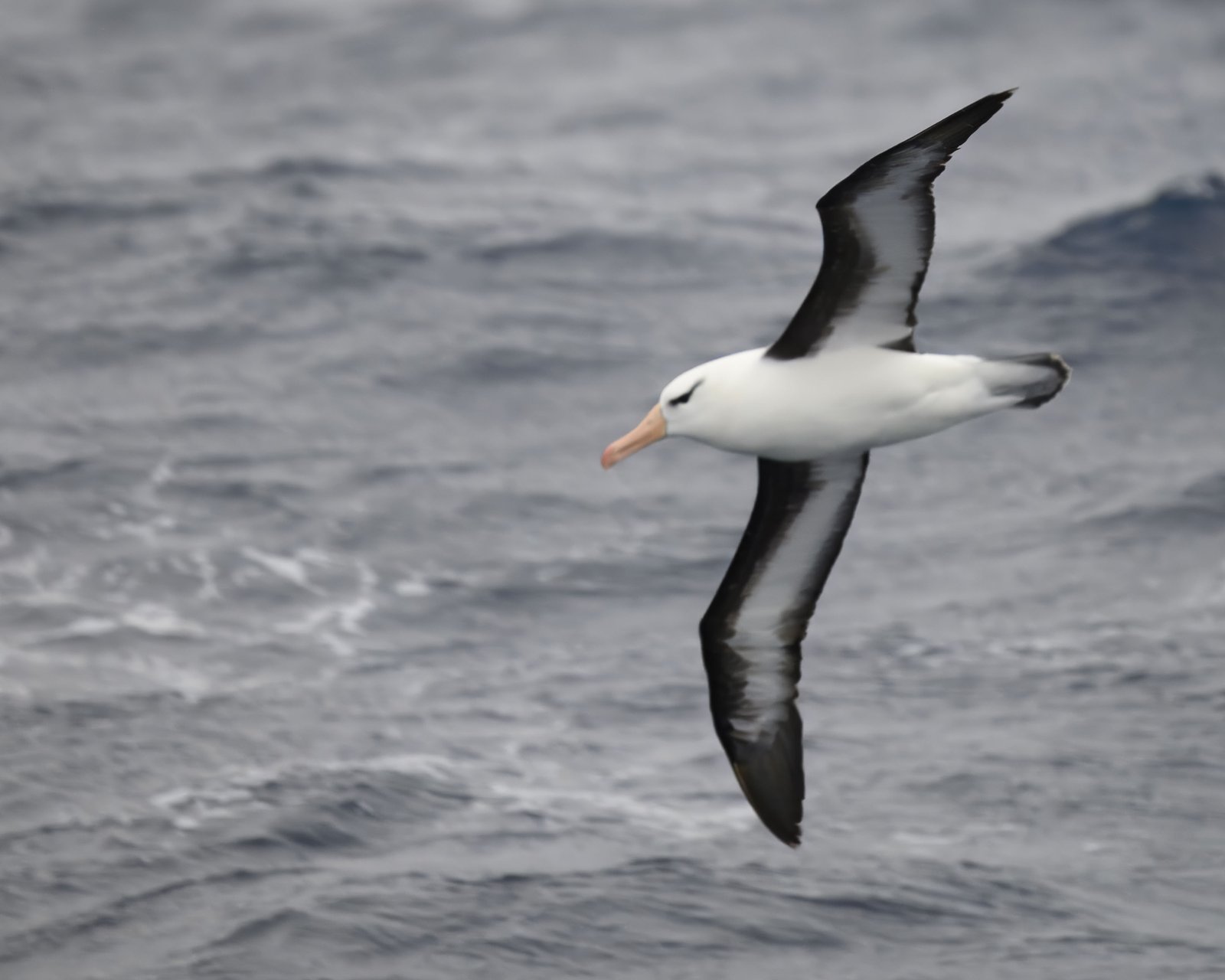
The Black-Browed Albatross is the commonest albatross in southern African waters: in winter hundreds follow the trawlers off the Western and Southern Cape. A large, robust mollymawk with a white head, a black stripe through the eye like a frowning eyebrow and a bright orange-yellow bill.
Voice
Noisy at trawlers: harsh cackling, grunting and croaking calls in the scramble for offal. At the colony braying calls with bill-clapping and a fanned tail during display.
Recording: Meena Haribal — CC BY-NC-SA 4.0 · shortened to the first 60 s, mono · xeno-canto
Identification
80–95 cm, wingspan 2.1–2.5 m. Large and sturdy, with a white head and a short black stripe above and behind the eye that gives it a stern expression. Mantle, upperwing and tail are blackish, rump and underparts white. The underwing is white with a very broad black leading edge and a broad black trailing edge, so that the white forms a narrow central band. Adults have an all orange-yellow bill with a pinkish-red tip. Juveniles have a grey collar, a dark grey bill with a black tip and a mainly dark underwing; over several years the bill turns horn-coloured and then yellow.
Confusion species
The Shy Albatross (Thalassarche cauta) is larger, with a grey-washed bill with a yellow tip and an almost white underwing with narrow black margins and a small black 'thumbprint' at the axilla. The Grey-Headed Albatross (Thalassarche chrysostoma) has a leaden grey head and a black bill with yellow edges; immatures of both species are tricky, but a Black-browed shows a paler bill base and a whiter forehead. The yellow-nosed albatrosses are smaller and slimmer, with a black bill with a yellow ridge and a narrow black margin to the underwing.
Habitat
Open sea and especially the continental shelf and shelf edge, where large numbers follow trawlers and longliners. It eats fish, squid, krill and fishery discards. It breeds in dense colonies on cliffs and steep slopes close to the sea.
Where the bird is most at home, classified by the vegetation units of southern Africa.
Range and movements
From April to October common at sea off the west coast of South Africa and Namibia and along the south coast to the Eastern Cape; less common off KwaZulu-Natal and southern Mozambique, and in small numbers north to off Angola. Some immatures stay all year. It does not breed in the region; the birds off southern Africa come mainly from South Georgia, with a few from the Falkland Islands. Circumpolar; the largest colonies are on the Falklands, with others on South Georgia, Kerguelen, Heard and islands off Chile.
- Resident
- Winter visitor (c. Apr–Sep)
- Passage (Mar–Apr, Oct–Nov)
- dark = core range, pale = thinly spread
How and when to look
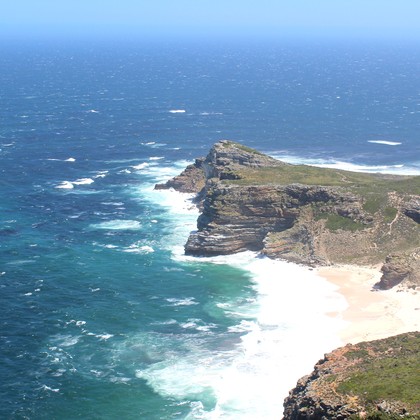
A winter trip to the trawlers off Cape Town almost always produces tens to hundreds of birds, often close enough to see bill and underwing well. Use Black-Browed Albatross as the reference for size and underwing pattern when searching for the rarer mollymawks. It can be seen from land in strong north-westerly winds from Cape Point and other headlands.
Conservation status
Not threatened, after its status was revised thanks to the recovery of the large colonies on the Falkland Islands. Elsewhere, especially on South Georgia, it is still declining. Bycatch in longline and trawl fisheries was long the main threat; in South African waters it has been greatly reduced by mandatory bird-scaring lines.
Scientific name
Thalassarche melanophris | (Temminck, 1828)
Temminck described the species in 1828 as Diomedea melanophris; because it was later moved to another genus, the author and year stand in brackets. The genus Thalassarche was introduced in 1853 by Reichenbach. Thalassarche comes from the Greek thalassa, 'sea', and arkhos, 'ruler' — 'ruler of the sea', for these masterly gliders of the open ocean. melanophris comes from the Greek melas, 'black', and ophrus, 'eyebrow' — for the dark stripe above and through the eye. The specimen the first description was based on came from Cape of Good Hope.