All species › Tubenoses › Albatrosses › Grey-Headed Albatross
Grey-Headed Albatross | Thalassarche chrysostoma
Grijskopalbatros | Albatros Cabecigrís
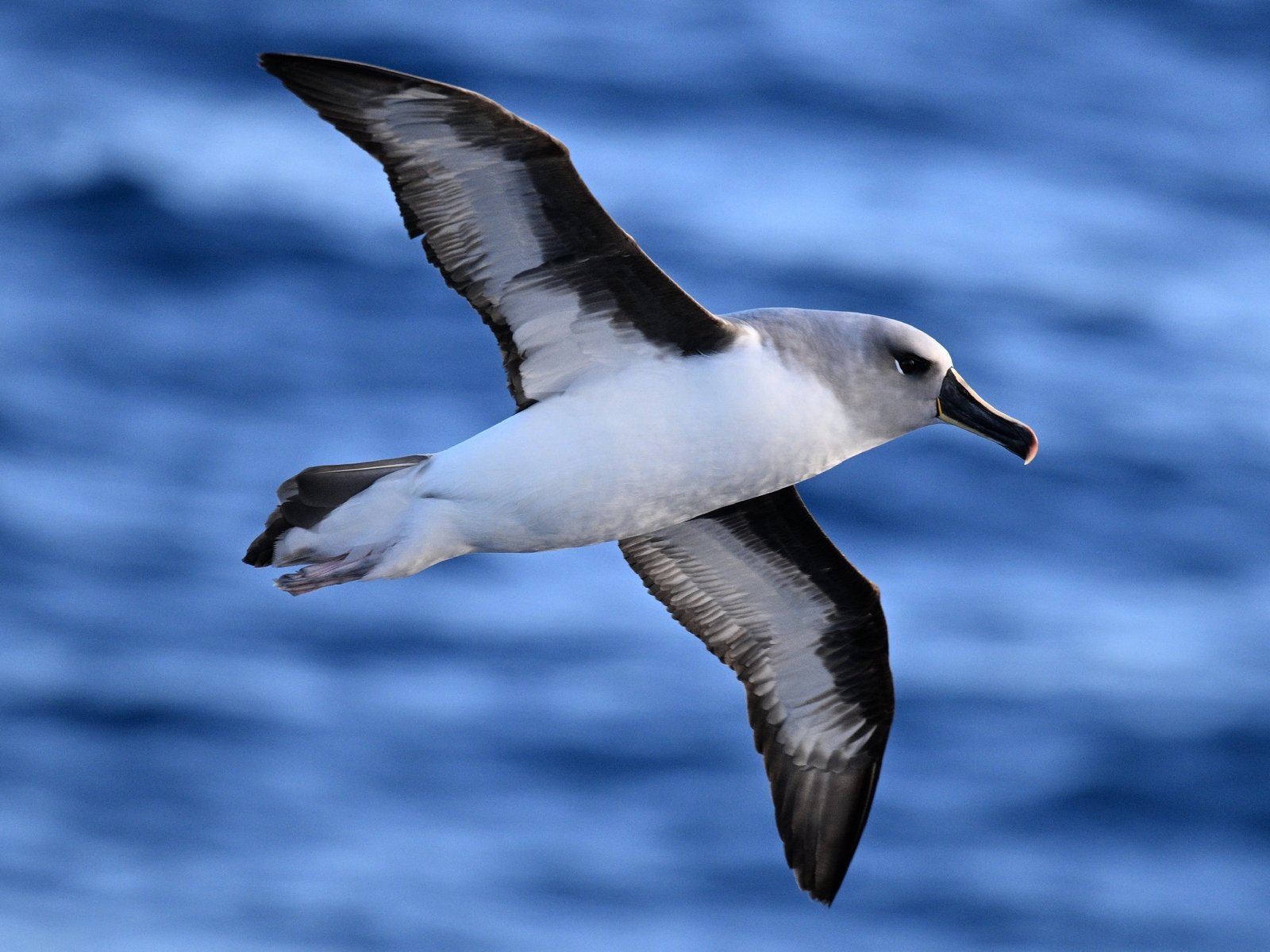
The Grey-Headed Albatross is a medium-sized mollymawk of the cold southern oceans, with a leaden grey head and a black bill edged with yellow above and below. It breeds on the Prince Edward Islands and reaches the mainland shelf only in winter, and then in small numbers.
Voice
Mostly silent at sea. At the colony a hoarse, gurgling braying and bill-clapping, especially during display.
Recording: Santiago Imberti — CC BY-NC-SA 4.0 · shortened to the first 60 s, mono · xeno-canto
Identification
70–81 cm, wingspan 1.8–2.2 m. Solidly built, with a shorter neck than the yellow-nosed albatrosses. Adults have the head and neck uniform leaden grey, with a white crescent behind the eye and a dark patch in front of it; mantle, upperwing and tail are blackish grey, rump and underparts white. The underwing is white with a broad black leading edge, especially on the inner hand, and a narrower trailing edge. The bill is black with a yellow upper ridge ending in a pinkish-orange tip and a narrow yellow strip along the lower edge. Juveniles have a dark grey head, an almost wholly dark bill and a mainly dark underwing; the head and underwing lighten only after several years.
Confusion species
The Black-Browed Albatross (Thalassarche melanophris) has a white head with a black eyebrow and an all orange-yellow bill in adults; immature Black-Browed Albatrosses with a grey collar closely resemble young Grey-headed, but have a paler, horn-coloured bill base with a dark tip and a whiter forehead. The Atlantic Yellow-Nosed Albatross (Thalassarche chlororhynchos) is smaller and slimmer, with a paler grey head, no yellow along the lower edge of the bill and a narrower black leading edge to the underwing.
Habitat
Cold, deep waters of the Southern Ocean around and south of the Antarctic Polar Front, where it takes mainly squid, supplemented by fish and krill. It follows ships less often than Black-Browed Albatross. It breeds on steep vegetated slopes and cliffs.
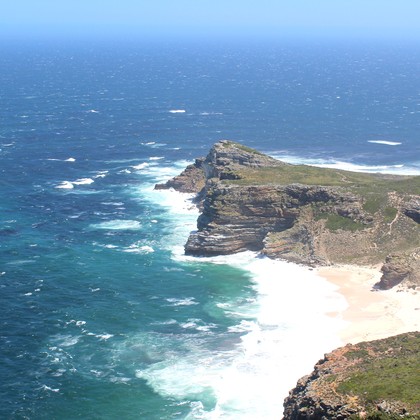
Where the bird is most at home, classified by the vegetation units of southern Africa.
Range and movements
Breeds on Marion and Prince Edward (Prince Edward Islands). Off the mainland scarce, mainly from May to October, usually far offshore over deep water off the Western and Eastern Cape; after winter storms birds sometimes come closer inshore, also off KwaZulu-Natal. Circumpolar, with colonies on South Georgia, Crozet, Kerguelen, Campbell and the Diego Ramírez Islands among others.
How and when to look
The best chance off the mainland is a winter pelagic trip from Cape Town to the deeper waters beyond the shelf, after a cold front. Immatures need care: check the bill of every grey-collared mollymawk, because immature Black-Browed Albatrosses often show a grey collar too.
Conservation status
Endangered. The species breeds only every second year and grows slowly, so longline bycatch weighs heavily; the large colonies on South Georgia have declined sharply. The population on the Prince Edward Islands is more stable and protected as a nature reserve, but there too changes in food supply and disease pose a risk.
Scientific name
Thalassarche chrysostoma | (Forster, 1785)
Forster described the species in 1785 as Diomedea chrysostoma; because it was later moved to another genus, the author and year stand in brackets. The genus Thalassarche was introduced in 1853 by Reichenbach. Thalassarche comes from the Greek thalassa, 'sea', and arkhos, 'ruler' — 'ruler of the sea', for these masterly gliders of the open ocean. chrysostoma comes from the Greek khrusos, 'gold', and stoma, 'mouth' — 'golden mouth', for the yellow edges of the bill. The specimen the first description was based on came from Near the Antarctic Circle and in the Pacific (not specified).