All species › Tubenoses › Albatrosses › Indian Yellow-Nosed Albatross
Indian Yellow-Nosed Albatross | Thalassarche carteri
Indische geelneusalbatros | Albatros Clororrinco Pacífico
The Indian Yellow-Nosed Albatross is the mollymawk of the Indian Ocean and the only yellow-nosed albatross that breeds within the region, on the Prince Edward Islands. Off the mainland it is the commonest albatross along the east coast, where in winter it may come close inshore.
Voice
Seldom heard at sea; throaty, cackling calls when competing for food. At the colony a hoarse braying and bill-clapping during display.
Recording: Morgan Pickering — CC BY-NC-SA 4.0 · converted to mono · xeno-canto
Identification
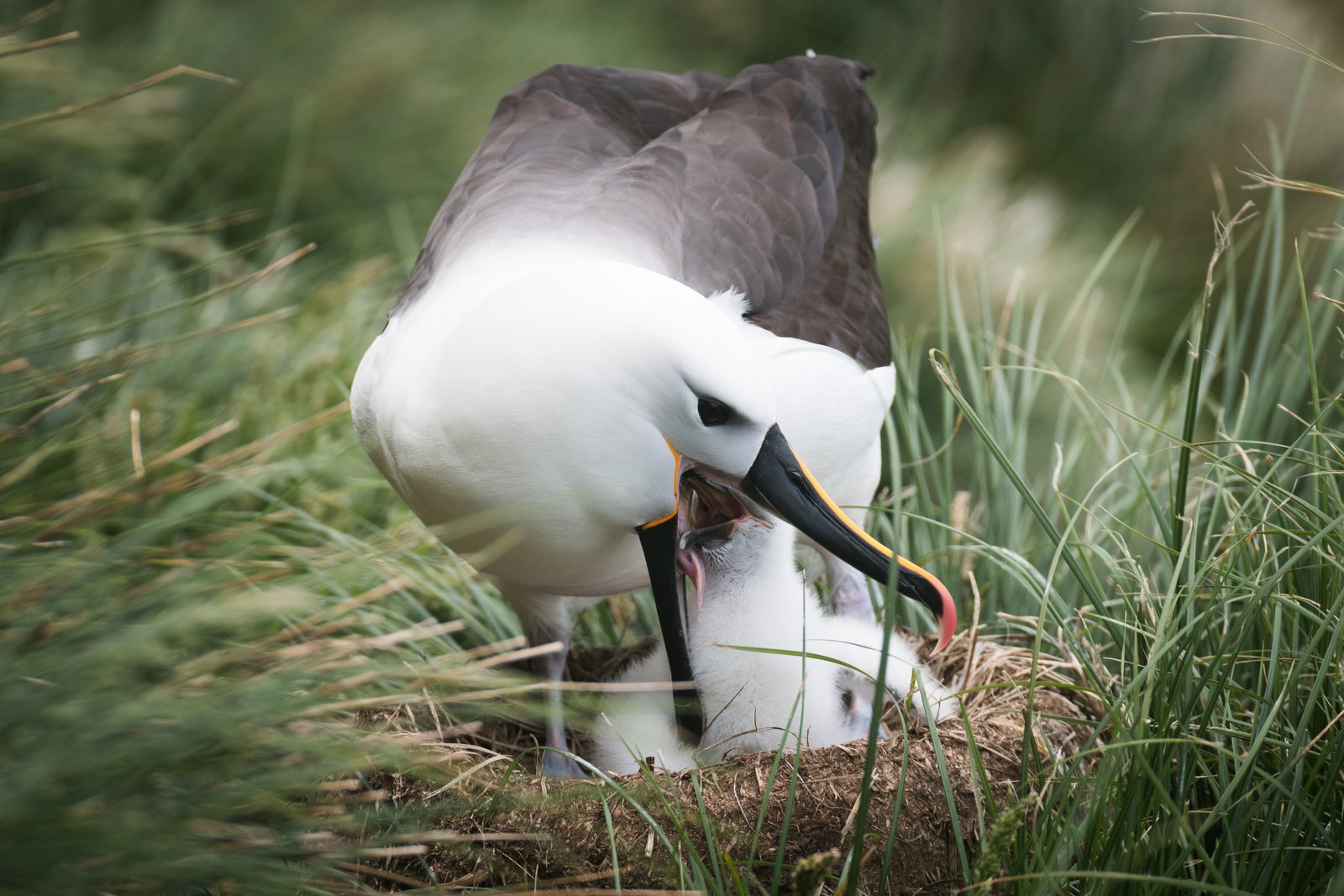
71–82 cm, wingspan about 2 m. Small and slender, with long narrow wings. Adults have an almost white head, sometimes with a very faint grey wash on the cheeks, and a dark patch in front of the eye; mantle, upperwing and tail are blackish, rump and underparts white. The underwing is white with a narrow black leading and trailing edge. The bill is black with a yellow upper ridge ending in a reddish tip; at the base the yellow stripe is broad and bluntly rounded. Juveniles have a white head and an all-black bill. It glides lightly and nimbly low over the waves.
Confusion species
The Atlantic Yellow-Nosed Albatross (Thalassarche chlororhynchos) has a clearly grey head in adults and a yellow bill ridge that tapers to a point at the base; juveniles of the two species are almost impossible to separate in the field. The Grey-Headed Albatross (Thalassarche chrysostoma) is bulkier, with a dark grey head and yellow along both the upper and lower edges of the bill. The Black-Browed Albatross (Thalassarche melanophris) is larger, with an all orange-yellow bill, a dark 'eyebrow' and a much broader black margin to the underwing.
Habitat
Open ocean, especially subtropical and warm-temperate waters of the Indian Ocean; in winter it comes over the shelf and sometimes to the surf zone, and follows trawlers and longliners. It feeds on squid, fish and crustaceans taken from the surface. It breeds on steep vegetated slopes and rocky ridges.
Where the bird is most at home, classified by the vegetation units of southern Africa.
Range and movements
Breeds on Marion and Prince Edward (Prince Edward Islands). Off the mainland present year-round, but numerous mainly from April to October off the east coast of South Africa, from the Eastern Cape to KwaZulu-Natal and southern Mozambique; off the west coast in smaller numbers among Atlantic Yellow-Nosed Albatrosses. It also breeds on Crozet, Kerguelen, Amsterdam and St Paul and forages across the southern Indian Ocean to off Australia and New Zealand.
- Resident
- dark = core range, pale = thinly spread
How and when to look
From the coast of KwaZulu-Natal and the Eastern Cape this is the albatross most likely to be seen: watch in winter during strong south-westerly winds from a high headland or pier, or join a pelagic trip from Durban or Port Elizabeth (Gqeberha). Off the west coast separating it from Atlantic Yellow-Nosed Albatross requires a good view of the head and the bill base.
Conservation status
Endangered. The largest colony, on Amsterdam Island, is declining sharply through avian cholera and a bacterial disease that kills chicks; many birds also die as bycatch in longline fisheries. The Prince Edward Islands are a protected nature reserve, and bycatch measures in South African waters reduce mortality.
Scientific name
Thalassarche carteri | (Rothschild, 1903)
Rothschild described the species in 1903 as Thalassogeron carteri; because it was later moved to another genus, the author and year stand in brackets. The genus Thalassarche was introduced in 1853 by Reichenbach. Thalassarche comes from the Greek thalassa, 'sea', and arkhos, 'ruler' — 'ruler of the sea', for these masterly gliders of the open ocean. carteri honours the English-Australian ornithologist and pastoralist Thomas Carter (1863–1931), who collected the type specimen near Point Cloates, Western Australia. The specimen the first description was based on came from Point Cloates, Western Australia.