All species › Tubenoses › Albatrosses › Atlantic Yellow-Nosed Albatross
Atlantic Yellow-Nosed Albatross | Thalassarche chlororhynchos
Atlantische geelneusalbatros | Albatros Clororrinco Atlántico
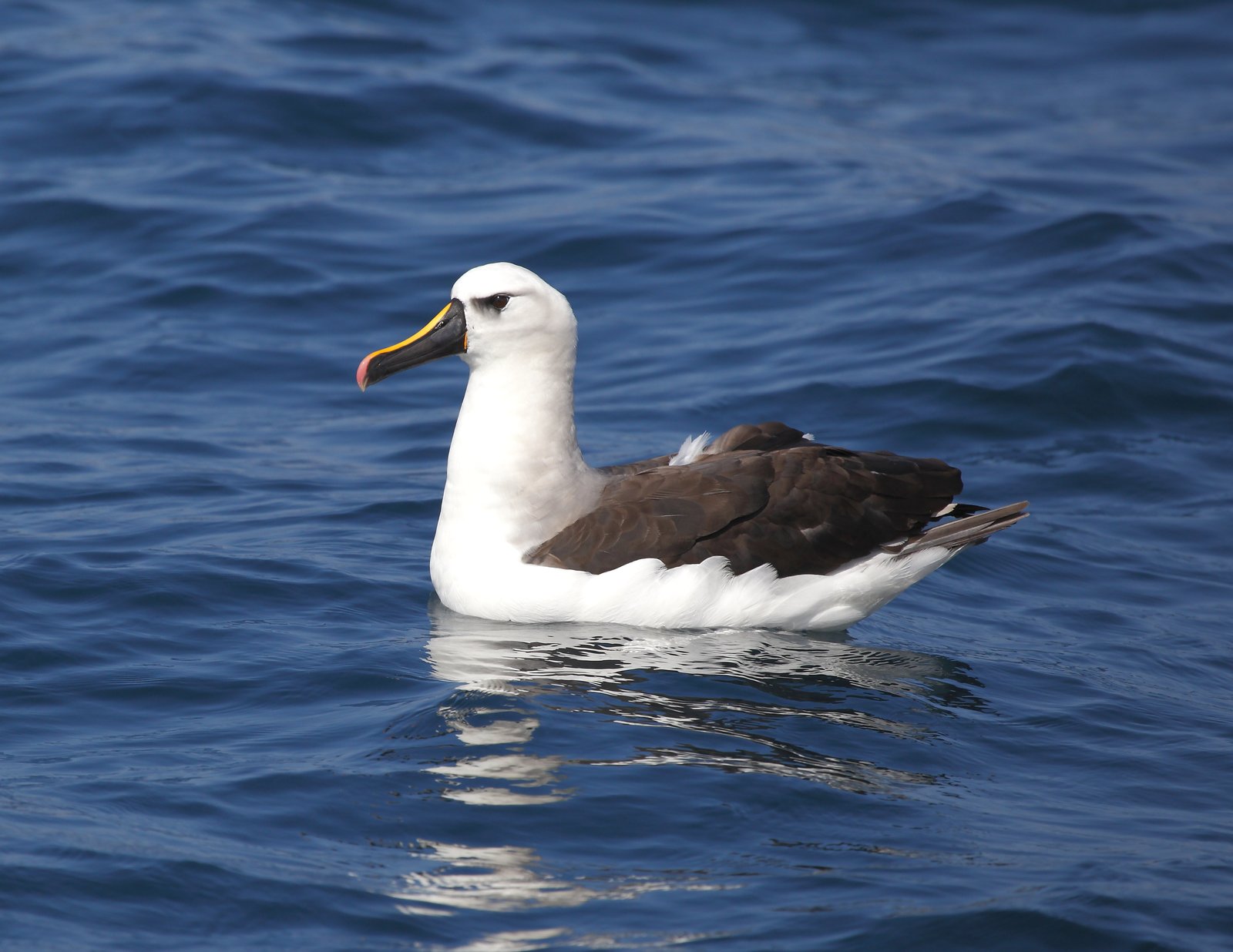
The Atlantic Yellow-Nosed Albatross is the smallest and slimmest albatross in southern African waters: a mollymawk with a grey-washed head and a black bill with a narrow yellow ridge. It breeds on Tristan da Cunha and Gough in the middle of the South Atlantic and forages as far as the shelf off Namibia and the Western Cape.
Voice
Mostly silent at sea; at trawlers and around offal it gives cackling, throaty calls and a dry kek-kek. At the colony a hoarse braying waa-waa with bill-clapping during display.
Recording: Guilherme Melo — CC BY-NC-SA 4.0 · converted to mono · xeno-canto
Identification
71–82 cm, wingspan about 2 m. Small and slender, with long narrow wings. Adults have the head and neck washed pale blue-grey, with a white forehead and a dark triangular patch in front of the eye; mantle, upperwing and tail are blackish, rump and underparts white. The underwing is white with a narrow, sharply defined black leading and trailing edge. The bill is glossy black with a bright yellow upper ridge (culminicorn) ending in an orange-red tip; the yellow stripe tapers to a point at the base. Juveniles have a white head and an all-black bill. Flight is light and agile, with much gliding on stiff wings.
Confusion species
The Indian Yellow-Nosed Albatross (Thalassarche carteri) has an almost white head in adults, at most a pale grey cheek, and the yellow bill ridge ends bluntly rounded at the base rather than pointed; juveniles are barely separable in the field. The Grey-Headed Albatross (Thalassarche chrysostoma) is bulkier, with a darker grey head, yellow along both the upper and lower edges of the bill and a broader black leading edge to the underwing. The Black-Browed Albatross (Thalassarche melanophris) is larger, with an all orange-yellow bill in adults and a much broader black margin to the underwing.
Habitat
Open ocean, especially warmer subtropical waters and the edge of the continental shelf, where in the Benguela Current it often attends trawlers and longliners. It takes squid, fish and crustaceans at the surface and sometimes makes short dives. It breeds in loose colonies on vegetated slopes and plateaus of Tristan da Cunha and Gough.
Where the bird is most at home, classified by the vegetation units of southern Africa.
Range and movements
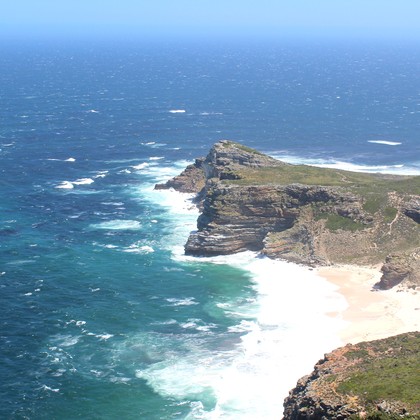
Common at sea off the west coast of South Africa and Namibia, north to off Angola; less numerous along the south coast and scarce off KwaZulu-Natal and Mozambique. Almost never seen from land, except after storms at the Cape of Good Hope. It breeds only in the Tristan da Cunha group and on Gough; outside the breeding season it ranges across the South Atlantic to off Brazil and Argentina, with vagrants reaching the North Atlantic.
- Resident
- dark = core range, pale = thinly spread
How and when to look
Pelagic trips from Cape Town to the trawlers beyond the shelf give the best chance, all year but especially from May to September. With every small, slim mollymawk check the head colour and the shape of the yellow bill ridge at the base: pointed in this species, rounded in Indian Yellow-Nosed Albatross. Good photographs of the bill settle doubtful birds.
Conservation status
Endangered. The population is declining through bycatch in South Atlantic longline fisheries and through predation of chicks by introduced house mice on Gough. Eradication of mice on Gough and better bycatch measures, such as bird-scaring lines and weighted lines, are intended to reverse the decline.
Scientific name
Thalassarche chlororhynchos | (Gmelin, 1789)
Gmelin described the species in 1789 as Diomedea chlororhynchos; because it was later moved to another genus, the author and year stand in brackets. The genus Thalassarche was introduced in 1853 by Reichenbach. Thalassarche comes from the Greek thalassa, 'sea', and arkhos, 'ruler' — 'ruler of the sea', for these masterly gliders of the open ocean. chlororhynchos comes from the Greek khlōros, 'yellowish green', and rhunkhos, 'bill' — for the yellow stripe along the top of the black bill. The specimen the first description was based on came from Cape of Good Hope.