All species › Tubenoses › Albatrosses › Sooty Albatross
Sooty Albatross | Phoebetria fusca
Zwarte albatros | Albatros Ahumado
The Sooty Albatross is a slender, wholly dark albatross with long, narrow wings and a wedge-shaped tail. It breeds on the cliffs of the Prince Edward Islands and forages in warmer waters than its closest relative, the Light-Mantled Albatross.

Voice
Silent at sea. At the breeding site a piercing two-syllable call, pee-ah, given with the head raised and the throat inflated, as well as bill clapping; pairs perform synchronised display flights along the cliffs.
No recording with a suitable Creative Commons licence is available for this species yet.
Identification
About 84 to 89 cm, with a wingspan of about 2 m. The whole plumage is dark sooty brown; head and wings are darkest and the back is barely paler, so that the bird looks uniformly dark even in good light. The primaries have white shafts. A narrow, broken white crescent surrounds the eye. The bill is black with a yellow to orange stripe along the groove of the lower mandible. The tail is long and pointed. Juveniles have a pale, scaly nape and mantle and a duller, greyish-yellow bill stripe, making them harder to separate from Light-Mantled Albatross.
Confusion species
The Light-Mantled Albatross (Phoebetria palpebrata) has a clearly paler, ash-grey mantle and back contrasting with the dark head and wings, and a blue to lilac stripe on the lower mandible. Dark young giant petrels, Southern (Macronectes giganteus) and Northern (Macronectes halli), are bulkier, with broad wings and a heavy pale bill. The White-Chinned Petrel (Procellaria aequinoctialis) is much smaller, with a pale bill and a short, rounded tail.
Habitat
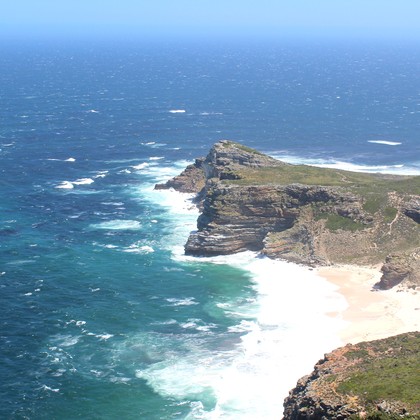
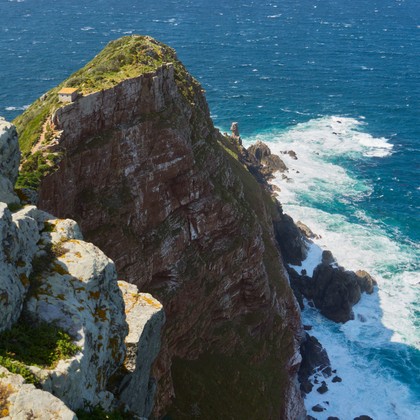
Open ocean in subtropical and cool temperate waters north of the Subantarctic Front, especially over deep water. It eats squid, fish, crustaceans and carrion, and follows ships less often than other albatrosses. It breeds scattered in small groups on ledges and in niches of steep cliffs and rock faces, sometimes far inland.
Where the bird is most at home, classified by the vegetation units of southern Africa.
Range and movements
Within the region it breeds on Marion and Prince Edward, scattered along the coastal cliffs. At sea it is a scarce visitor over deep water off the Western and Southern Cape, mainly in winter, and rare off the east coast. Elsewhere it breeds on Tristan da Cunha, Gough, Crozet, Kerguelen and Amsterdam and Saint-Paul, and ranges over the Atlantic and Indian Oceans between roughly 30° and 50° south.
- Passage (Mar–Apr, Oct–Nov)
- dark = core range, pale = thinly spread
How and when to look
Most likely on winter pelagic trips to deep water off Cape Town, where it usually passes singly and at a distance. Look for the contrast between back and head: no contrast points to this species. The coloured bill stripe can be seen only at close range or on a photograph.
Conservation status
Endangered. Populations on Gough and elsewhere have declined steeply, mainly through bycatch on tuna longlines in subtropical waters. The species breeds only every second year and matures late, so losses are made up only slowly. On Marion introduced mice pose an additional threat to chicks.
Scientific name
Phoebetria fusca | (Hilsenberg, 1822)
Hilsenberg described the species in 1822 as Diomedea fusca; because it was later moved to another genus, the author and year stand in brackets. The genus Phoebetria was introduced in 1853 by Reichenbach. Phoebetria comes from the Greek phoibētria, 'prophetess, soothsayer' — according to Coues (1882) fitting for albatrosses, whose ominous presaging is familiar from Coleridge's The Rime of the Ancient Mariner. fusca is Latin for 'dark, dusky' — for the uniformly dark plumage. The specimen the first description was based on came from Mozambique Channel.