All species › Tubenoses › Albatrosses › Light-Mantled Albatross
Light-Mantled Albatross | Phoebetria palpebrata
Roetkopalbatros | Albatros Manto Claro
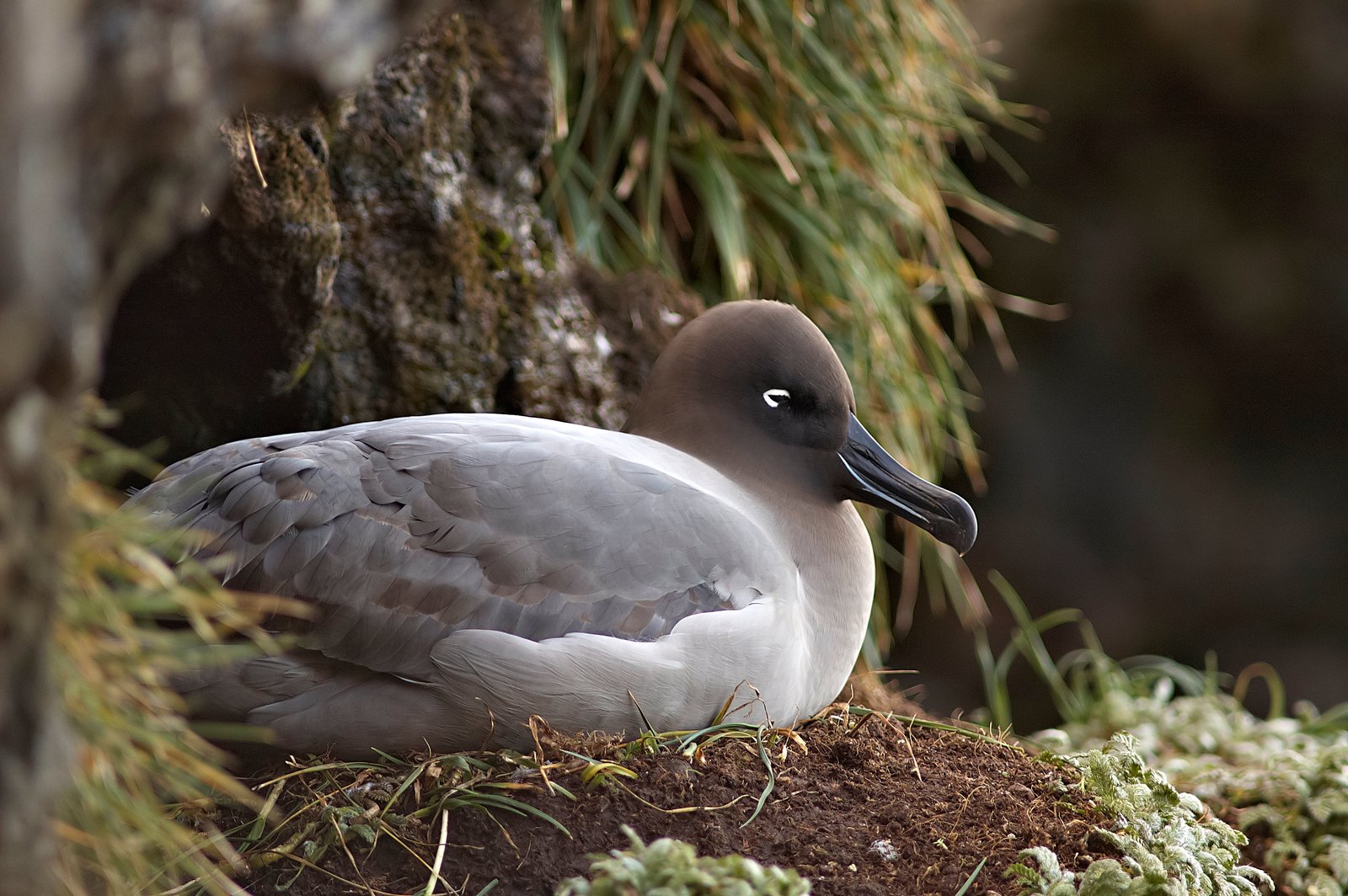
The Light-Mantled Albatross is a dark albatross with a pale ash-grey back that makes its dark head stand out like a hood. It lives in the cold waters of the southern ocean as far as the pack ice and within the region breeds only on the Prince Edward Islands.
Voice
Silent at sea. At the breeding site a loud, plaintive two-syllable call, pee-oo, given with inflated throat and bill raised, echoing between the cliffs; pairs perform synchronised display flights.
Recording: Kevin Guille — CC BY-NC-SA 4.0 · shortened to the first 60 s, mono · xeno-canto
Identification
About 79 to 89 cm, with a wingspan of 1.8 to 2.2 m. Head, wings and tail are dark sooty brown; nape, mantle, back and underparts are pale ash grey, so that the dark head and wings contrast sharply. A broken white crescent surrounds the eye. The bill is black with a pale blue to lilac stripe along the groove of the lower mandible. The wings are long and narrow, the tail long and wedge-shaped, and the primaries have white shafts. Juveniles show less contrast, with a scaly mantle and a dull bill stripe.
Confusion species
The Sooty Albatross (Phoebetria fusca) is wholly dark with no pale back and has a yellow to orange bill stripe; young Sooty Albatrosses with a pale, scaly nape can, however, be confusing. Dark young giant petrels, Southern (Macronectes giganteus) and Northern (Macronectes halli), are bulkier, with broad wings, a short tail and a heavy pale bill.
Habitat
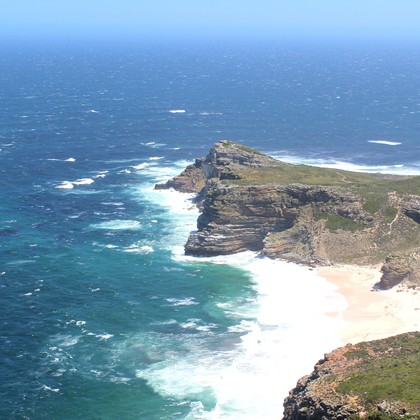
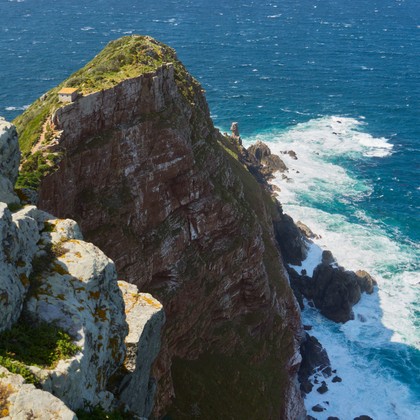
Open ocean in cold subantarctic and Antarctic waters, south of the Subantarctic Front to the edge of the pack ice. It eats mainly squid, also krill, fish and carrion. It breeds singly or in loose groups on vegetated ledges of steep slopes and cliffs, often inland.
Where the bird is most at home, classified by the vegetation units of southern Africa.
Range and movements
Within the region it breeds on Marion and Prince Edward, in small numbers scattered over the inland cliffs. Very rare off the mainland coast, with a few records over deep water off the Western Cape, mainly in winter. Elsewhere circumpolar in the southern ocean, with breeding sites on South Georgia, Crozet, Kerguelen, Heard, Macquarie and the New Zealand subantarctic islands.
How and when to look
A rarity from the mainland; a voyage to Marion or a crossing of the southern ocean gives the best chance. With a dark albatross at sea look at the back first: a pale grey mantle with a dark head points to this species, a uniformly dark bird to Sooty Albatross.
Conservation status
Near threatened. The world population is incompletely counted because the nests are scattered, and there are signs of decline. Longline bycatch and introduced predators on the breeding islands are the main threats, and changes in sea ice may affect food supply.
Scientific name
Phoebetria palpebrata | (Forster, 1785)
Forster described the species in 1785 as Diomedea palpebrata; because it was later moved to another genus, the author and year stand in brackets. The genus Phoebetria was introduced in 1853 by Reichenbach. Phoebetria comes from the Greek phoibētria, 'prophetess, soothsayer' — according to Coues (1882) fitting for albatrosses, whose ominous presaging is familiar from Coleridge's The Rime of the Ancient Mariner. palpebrata is Latin for 'with eyelids', from palpebra, 'eyelid' — for the conspicuous white half eye-ring. The specimen the first description was based on came from Southern Ocean south of the Prince Edward Islands.