All species › Passerines › Bulbuls › Black-Browed Mountain Greenbul
Black-Browed Mountain Greenbul | Arizelocichla fusciceps
Zwartbrauwbuulbuul | Bulbul Cabecioscuro
The Black-Browed Mountain Greenbul is the common mountain greenbul of the highlands of Malawi, north-eastern Zambia and northern Mozambique. In montane forest and at forest edges it is often the most numerous greenbul, noisy and present in small groups at fruiting trees.
Voice
A noisy species. A dry, rapidly repeated chuk-chuk, a grating chrrr and a short bubbling song of rolling notes, chook-chirrirrip-chook-weep. Groups often call over one another at a fruiting tree.
Recording: Murray Christian — CC BY-NC-SA 4.0 · converted to mono · xeno-canto
Identification
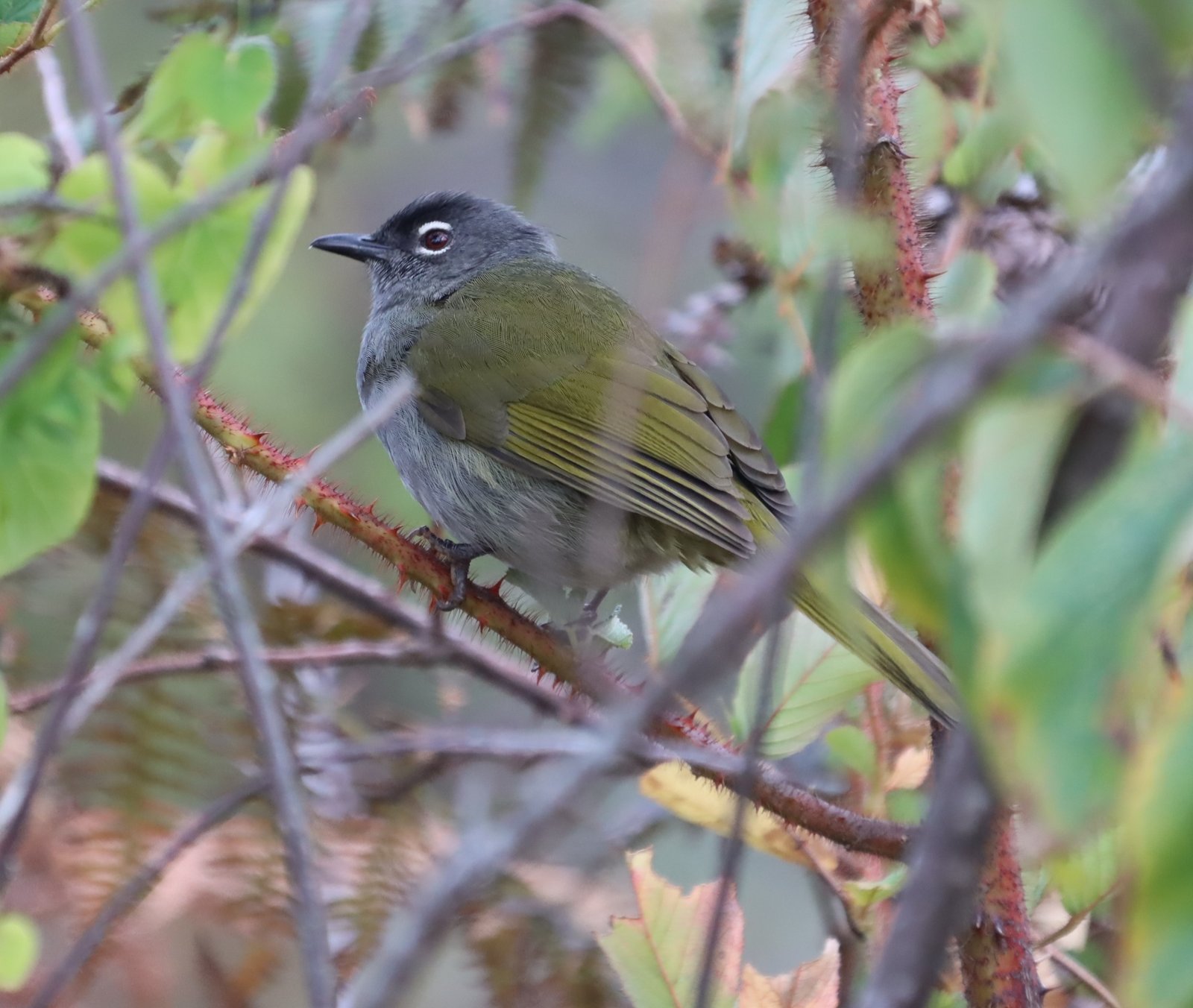
18–19 cm. The crown is dark sooty brown, with a blackish line above and in front of the eye that gives the species its name. Cheeks and throat are grey, the throat paler. The upperparts are bright olive-green, the underparts olive-yellow, yellowest on the belly and undertail-coverts. Wings and tail olive-green. The bill is black, the eyes dark, the legs grey-brown. The sexes are alike; juveniles have a duller head with less contrast. The combination of dark head, grey throat and yellow belly is easy to see in the field.
Confusion species
Shelley's Greenbul Arizelocichla masukuensis (only in the far north of Malawi) is smaller, with a grey head lacking a dark brow and a narrow white eye-ring; it is quieter and more solitary. Olive-Headed Greenbul Arizelocichla striifacies has an olive head with fine pale streaks on the cheeks. Stripe-Cheeked Greenbul Arizelocichla milanjensis on Mulanje has a grey head with white streaks on the ear-coverts. Little Greenbul Eurillas virens is smaller and uniformly dark olive and stays low in the undergrowth.
Habitat
Montane forest in all its forms, including small forest patches in ravines, forest edges, bramble and bracken scrub and exotic plantations bordering forest, from about 1200 m to above 2500 m. It feeds mainly on fruit and berries, supplemented by insects, taken in the mid-stratum and canopy.
Where the bird is most at home, classified by the vegetation units of southern Africa.

Range and movements
In Malawi in virtually every highland with montane forest, from the Misuku Hills and the Nyika Plateau across the Viphya and Dedza to Zomba and Mulanje. In Zambia in the north-east, in the Mafinga Mountains and on the Zambian side of the Nyika Plateau. In Mozambique in the highlands of the north and west bordering Malawi. Beyond the region only in the mountains of south-western Tanzania.
- Resident
- dark = core range, pale = thinly spread
How and when to look
All year and easy to find in suitable forest. Wait at a fruiting tree at the forest edge on the Nyika Plateau, the Viphya or Zomba Plateau; groups arrive there repeatedly with much calling. Because it is so common, this is the yardstick against which to judge the scarcer Shelley's, Olive-headed and Stripe-Cheeked Greenbuls.
Conservation status
Not threatened; common in montane forest. The species tolerates disturbed forest and forest edges, but loss and fragmentation of montane forest through logging, fire and cultivation shrink its habitat.
Scientific name
Arizelocichla fusciceps | (Shelley, 1893)
Shelley described the species in 1893 as Xenocichla fusciceps; because it was later moved to another genus, the author and year stand in brackets. The genus Arizelocichla was introduced in 1905 by Oberholser. Arizelocichla comes from the Greek arizēlos, 'conspicuous, distinct', and kikhlē, 'thrush'. fusciceps comes from the Latin fuscus, 'dusky', and -ceps, '-headed' — for the dark head. The specimen the first description was based on came from Mulanje Plateau, Malawi.