All species › Passerines › Bulbuls › Olive-Headed Greenbul
Olive-Headed Greenbul | Arizelocichla striifacies
Streepkopbuulbuul | Bulbul Cabecioliva
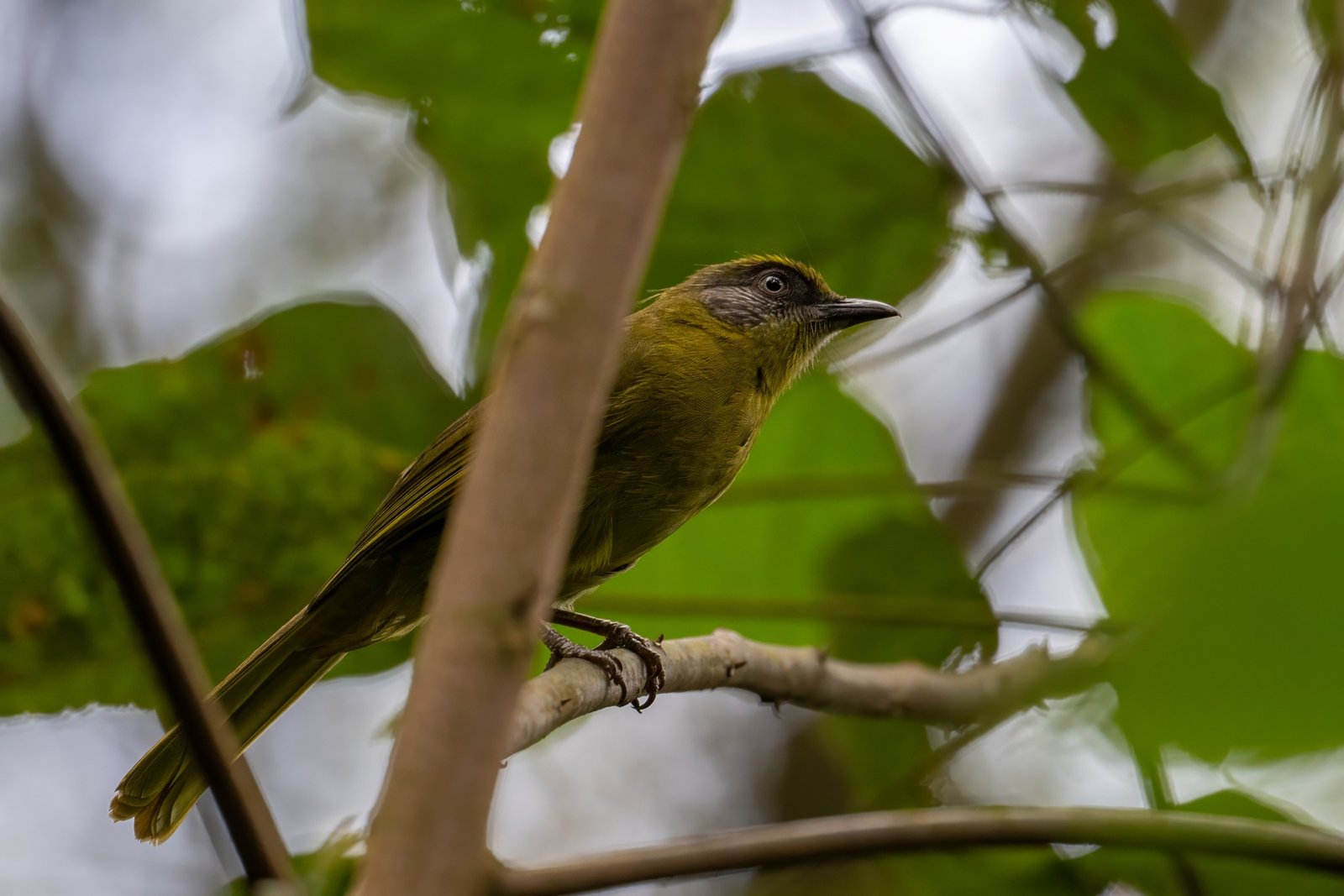
The Olive-Headed Greenbul is a mountain greenbul of the eastern Afromontane forests, from Kenya to Malawi and northern Mozambique. In the region it is represented by the subspecies olivaceiceps, a scarce bird of a few montane forests that differs from the commoner Black-Browed Mountain Greenbul in its olive head and streaked cheeks.
Voice
A loud grating chrrr and a series of short jerky notes, chook-chook-chirrip, lower and less bubbling than in Black-Browed Mountain Greenbul. It often calls from hidden spots in the canopy.
Recording: isaac kilusu — CC BY-NC-SA 4.0 · converted to mono · xeno-canto
Identification
19–20 cm. Crown and nape are olive-green, barely set off from the back; the cheeks and ear-coverts are grey with fine white or pale grey streaks, and a narrow, broken white eye-ring surrounds the eye. The throat is grey, the breast greyish olive, grading into an olive-yellow belly and yellow undertail-coverts. Upperparts, wings and tail are olive-green. The bill is black, the eyes dark. The sexes are alike; juveniles are duller, with less distinct cheek streaking.
Confusion species
Black-Browed Mountain Greenbul Arizelocichla fusciceps has a dark, sooty-brown crown with a blackish brow and no streaked cheeks. Stripe-Cheeked Greenbul Arizelocichla milanjensis has a grey, not olive, crown with stronger contrast between head and back; the two are largely separated geographically. Shelley's Greenbul Arizelocichla masukuensis is smaller, with a plain grey head without streaks. Yellow-Streaked Greenbul Phyllastrephus flavostriatus has a long thin bill, yellow breast streaks and a characteristic wing-flicking.
Habitat
Moist montane forest, especially the mid-stratum and canopy of closed forest, also forest edges and mature secondary forest, roughly between 1200 and 2300 m. It eats fruit and insects and forages alone, in pairs or in mixed flocks.
Where the bird is most at home, classified by the vegetation units of southern Africa.

Range and movements
In the region scarce and local in the highlands of northern Malawi and in a few montane forests of northern Mozambique, such as the Njesi Plateau. Beyond the region from south-eastern Kenya (Taita) through the mountains of Tanzania, with Rungwe as the northern limit of the subspecies olivaceiceps.
- Resident
- dark = core range, pale = thinly spread
How and when to look
All year, but tricky: the species occurs alongside the much commoner Black-Browed Mountain Greenbul. Check every mountain greenbul with an olive rather than a dark head and look for the fine streaks on the cheeks. Recordings help: the low grating calls separate it from the higher, bubbling calls of Black-browed.
Conservation status
Not threatened; locally common in Tanzania. In the region the population is small and scattered over a few montane forests that are shrinking through logging, fire and cultivation.
Scientific name
Arizelocichla striifacies | (Reichenow & Neumann, 1895)
Reichenow & Neumann described the species in 1895 as Xenocichla striifacies; because it was later moved to another genus, the author and year stand in brackets. The genus Arizelocichla was introduced in 1905 by Oberholser. Arizelocichla comes from the Greek arizēlos, 'conspicuous, distinct', and kikhlē, 'thrush'. striifacies comes from the Latin stria, 'streak', and facies, 'face' — for the finely streaked cheeks. The specimen the first description was based on came from Marangu, Kilimanjaro, Tanzania.