All species › Passerines › Cuckooshrikes › Black Cuckooshrike
Black Cuckooshrike | Campephaga flava
Kaapse rupsvogel | Oruguero Hombroamarillo
The Black Cuckooshrike is an inconspicuous inhabitant of woodland and forest edge, in which the sexes look completely different: the male glossy blue-black, the female olive-brown with yellow and heavily barred. It specialises in hairy caterpillars that most other birds avoid.

Voice
A prolonged, high, insect-like trill, trrrrrrrrr, reminiscent of a cricket and sustained for long periods; the male calls from the canopy. Also soft, high tsee calls.
Recording: Ehren Eksteen — CC BY-NC-SA 4.0 · converted to mono · xeno-canto
Identification
20–22 cm, with a fairly long, rounded tail. The male is wholly black with a blue gloss; some males have a yellow shoulder patch, others lack it entirely. A small orange-yellow wattle sits at the gape. The female is olive-brown above with fine dark barring, bright yellow edges to the flight feathers and yellow outer tail feathers; the underparts are white to yellowish with heavy black barring. Immature males are a mixture of both. It moves slowly through the foliage and often sits still for long spells.
Confusion species
Fork-Tailed Drongo Dicrurus adsimilis has a forked tail, a red eye and perches upright on open lookouts. Square-Tailed Drongo Dicrurus ludwigii is smaller, with a red eye and a notched tail. Southern Black Flycatcher Melaenornis pammelaina lacks the gape wattle and yellow shoulder and hunts from a perch onto the ground. Purple-Throated Cuckooshrike Campephaga quiscalina has a purple gloss; its female is unbarred yellow below.
Habitat
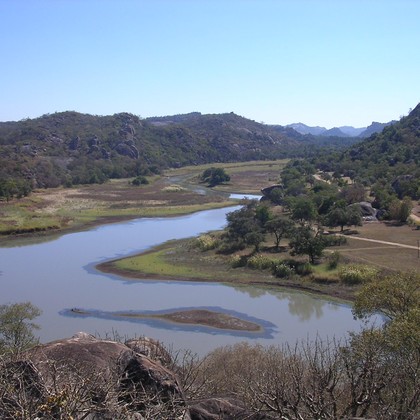
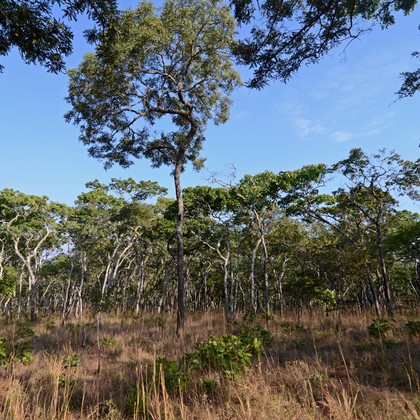
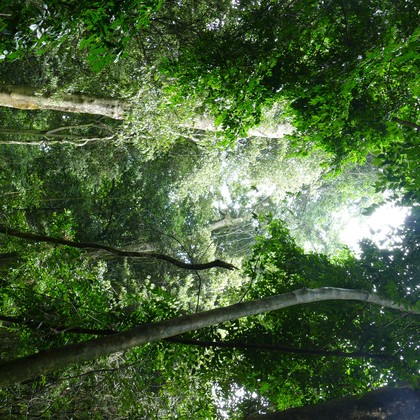
Mixed and broadleaved woodland, miombo, forest edge, coastal forest and thicket, riverine woodland and old gardens with tall trees. It forages in the mid-stratum and canopy, mainly on hairy and toxic caterpillars, whose hairs it shakes off or whose gut it squeezes out before swallowing. It joins mixed foraging flocks.
Where the bird is most at home, classified by the vegetation units of southern Africa.
Range and movements
Breeds in eastern and northern South Africa (from the Eastern Cape through KwaZulu-Natal to Mpumalanga and Limpopo), Eswatini, Zimbabwe, Mozambique, Zambia, Malawi, northern and eastern Botswana, north-eastern Namibia and Angola; rare in the western Cape. Southern breeders move north in winter. Beyond the region to East Africa and eastern Congo.
- Resident
- Summer visitor (c. Oct–Mar)
- Winter visitor (c. Apr–Sep)
- Passage (Mar–Apr, Oct–Nov)
- dark = core range, pale = thinly spread
How and when to look
From October to March in Kruger National Park, the coastal forests of KwaZulu-Natal or miombo in Zimbabwe. Listen for the cricket-like trill from the canopy, then follow the bird with binoculars, as it moves so slowly that it disappears among the leaves. Females are often mistaken for a cuckoo.
Conservation status
Not threatened and fairly common in suitable woodland. Loss of indigenous forest on the coast and of woodland reduces numbers locally, but the species also occurs in older gardens and parks.
Scientific name
Campephaga flava | Vieillot, 1817
Vieillot described the species in 1817 and placed it straight away in the genus where it still stands. The genus Campephaga was introduced in 1816 by Vieillot. Campephaga comes from the Greek kampē, 'caterpillar', and -phagos, '-eating': 'caterpillar-eater', for these birds' main food. flava is Latin for 'yellow' — for the male's yellow shoulder patch and the yellow-tinged female. The specimen the first description was based on came from unknown (not stated).