All species › Passerines › Cuckooshrikes › Petit's Cuckooshrike
Petit's Cuckooshrike | Campephaga petiti
Congolese rupsvogel | Oruguero de Petit
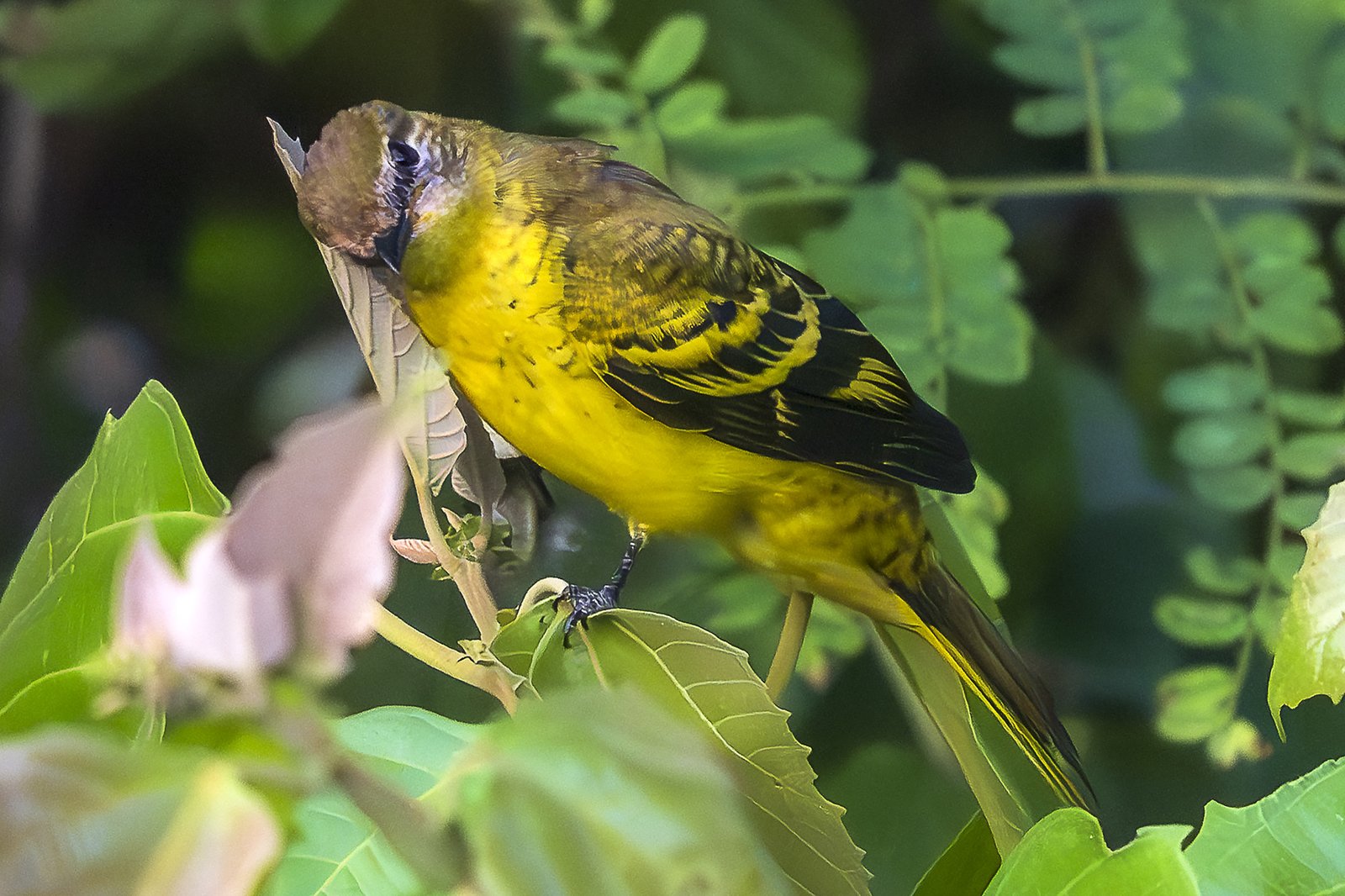
Petit's Cuckooshrike is a forest bird of Central Africa that reaches the region only in the escarpment forests of western Angola. The male is striking for its large orange-yellow gape wattles; the female is one of the yellowest cuckooshrikes in Africa.
Voice
A high, thin tseeee and a soft, high trill; poorly known and not often heard.
Recording: András Schmidt — CC BY-NC-SA 4.0 · converted to mono · xeno-canto
Identification
20–21 cm. The male is wholly glossy blue-black, without a shoulder patch, with conspicuously large, orange-yellow fleshy wattles at the gape. The female is olive-yellow above with yellow edges to the wing and tail feathers, and bright lemon-yellow below with at most a few dark bars on the breast sides. The eye is dark, bill and legs black. Immatures resemble the female with more barring.
Confusion species
Black Cuckooshrike Campephaga flava has much smaller gape wattles, often a yellow shoulder patch, and the female is white to pale yellow below with heavy black barring. Purple-Throated Cuckooshrike Campephaga quiscalina has a purple gloss on the head and throat; its female has a grey head.
Habitat
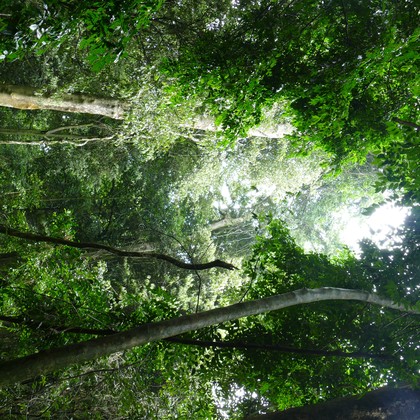
Edges and clearings of moist mid-altitude and montane forest, secondary forest and forest edge with creepers, often at 1000–2000 m. It forages in the mid-stratum and canopy for caterpillars and other insects, sometimes in mixed foraging flocks.
Where the bird is most at home, classified by the vegetation units of southern Africa.

Range and movements
Within the region only in western Angola, in the forests of the western escarpment from Cuanza Sul north to Uíge. Beyond the region from Cameroon and Gabon through Congo and eastern DR Congo to Uganda and western Kenya.
- Resident
- dark = core range, pale = thinly spread
How and when to look
In Angola look for it in the escarpment forests around Kumbira and Gabela, where it joins mixed flocks with other special forest birds. Watch for a black bird with orange 'cheeks' in the canopy or a bright yellow female shuffling slowly through the foliage.
Conservation status
Not threatened across its range as a whole. In Angola its habitat is heavily fragmented by clearance and farming in the escarpment zone, and the species is locally vulnerable there.
Scientific name
Campephaga petiti | Oustalet, J-FÉ, 1884
Oustalet, J-FÉ described the species in 1884 and placed it straight away in the genus where it still stands. The genus Campephaga was introduced in 1816 by Vieillot. Campephaga comes from the Greek kampē, 'caterpillar', and -phagos, '-eating': 'caterpillar-eater', for these birds' main food. petiti honours the French naturalist Louis Petit (1856–1943), who collected in the Cabinda Enclave and on the lower Congo from 1876 to 1884. The specimen the first description was based on came from Landana, Cabinda (Angola).