All species › Passerines › Cuckooshrikes › Purple-Throated Cuckooshrike
Purple-Throated Cuckooshrike | Campephaga quiscalina
Purperrupsvogel | Oruguero Purpúreo
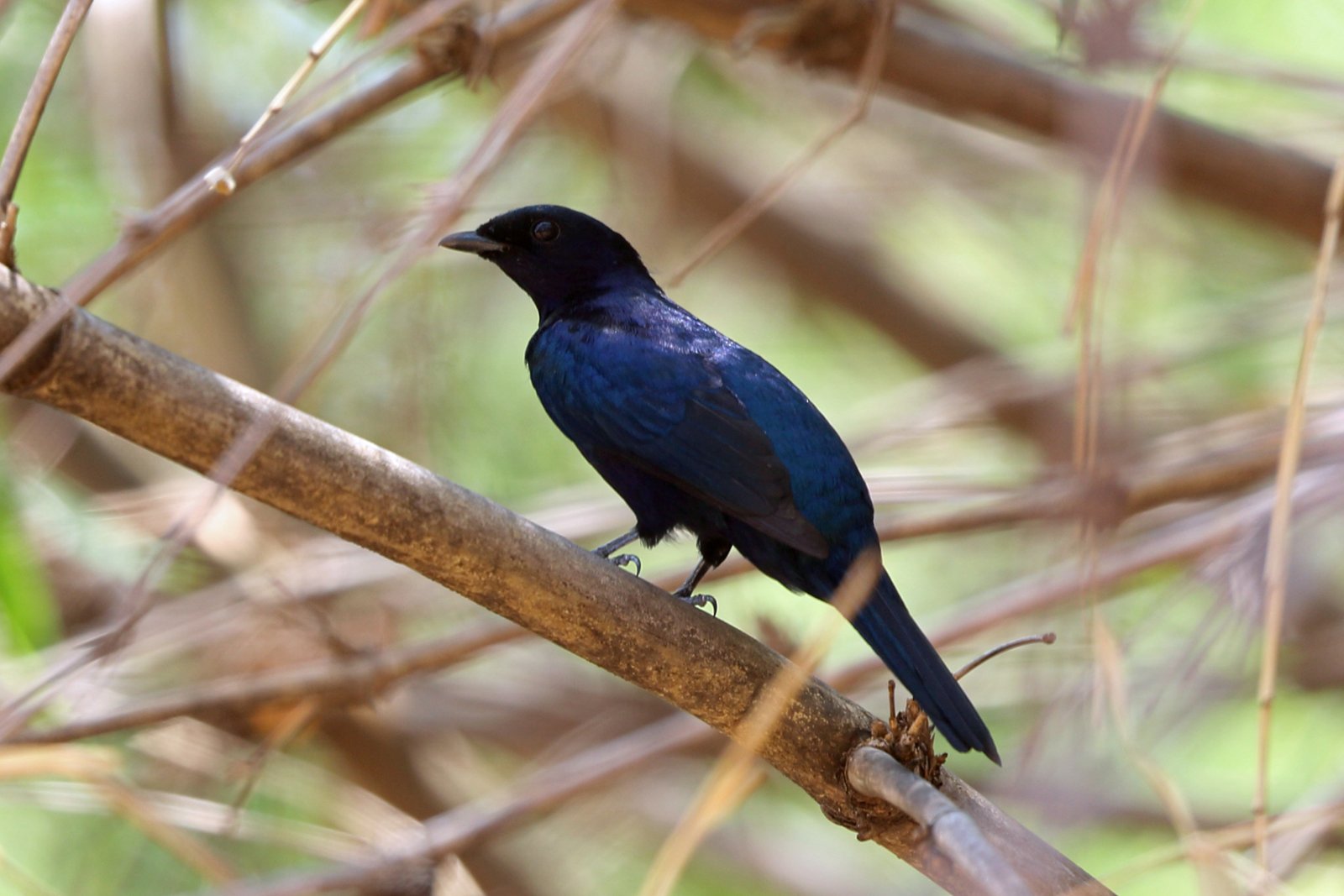
The Purple-Throated Cuckooshrike is a canopy cuckooshrike of tropical forest that occurs in the region only in northern Angola and north-western Zambia. The male is black with a deep purple gloss on the head and throat; the female is yellow-green with a grey head and no barring.
Voice
Soft, high, thin whistles, tseeu or tsee-tsee, and a short trill; a quiet bird that calls little.
Recording: Dries Van de Loock — CC BY-NC-SA 4.0 · converted to mono · xeno-canto
Identification
20–22 cm. The male is glossy black, with a purple gloss on the head, throat and breast and a green-blue gloss on the back and wings; there is no shoulder patch and the gape wattles are small or absent. The female has a grey head and nape, olive-green back and wings with yellow edges, and is bright yellow below without barring, with a greyish throat. Juveniles are finely barred below.
Confusion species
Black Cuckooshrike Campephaga flava has a blue rather than purple gloss and often a yellow shoulder patch; its female is heavily barred below. The female Petit's Cuckooshrike Campephaga petiti has an olive-yellow rather than grey head. Orioles such as Western Oriole Oriolus brachyrynchus have a pink bill and a black head.
Habitat
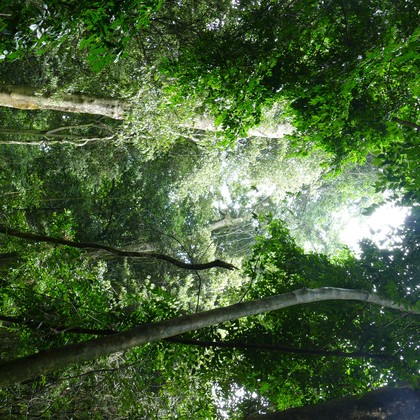
The canopy and mid-stratum of moist lowland forest, gallery forest along rivers (in Zambia the 'mushitu' forests) and forest edge. It forages quietly among the leaves for caterpillars and other insects and joins mixed foraging flocks in the treetops.
Where the bird is most at home, classified by the vegetation units of southern Africa.

Range and movements
Within the region in northern Angola (Cuanza Norte, Uíge, the Lunda provinces) and in north-western Zambia (Mwinilunga). Beyond the region from Sierra Leone through the forest belt of West and Central Africa to Uganda and western Kenya.
- Resident
- dark = core range, pale = thinly spread
How and when to look
In Zambia, Mwinilunga, especially the gallery forests at the Zambezi source and the Salujinga forests, is the place to look. Follow mixed flocks in the canopy and watch for a black bird that flashes purple in sunlight, or a yellow female with a conspicuously grey head.
Conservation status
Not threatened across its range as a whole. In the region the species is restricted to small, fragmented forest patches; clearance of gallery forest in north-western Zambia and northern Angola is the main local threat.
Scientific name
Campephaga quiscalina | Finsch, 1869
Finsch described the species in 1869 and placed it straight away in the genus where it still stands. The genus Campephaga was introduced in 1816 by Vieillot. Campephaga comes from the Greek kampē, 'caterpillar', and -phagos, '-eating': 'caterpillar-eater', for these birds' main food. quiscalina means 'grackle-like', after the genus Quiscalus — for the male's glossy purplish-black colour. The specimen the first description was based on came from near Cape Coast, Ghana.