All species › Passerines › Finches › Black-Eared Seedeater
Black-Eared Seedeater | Crithagra mennelli
Zwartwangkanarie | Serín Orejinegro
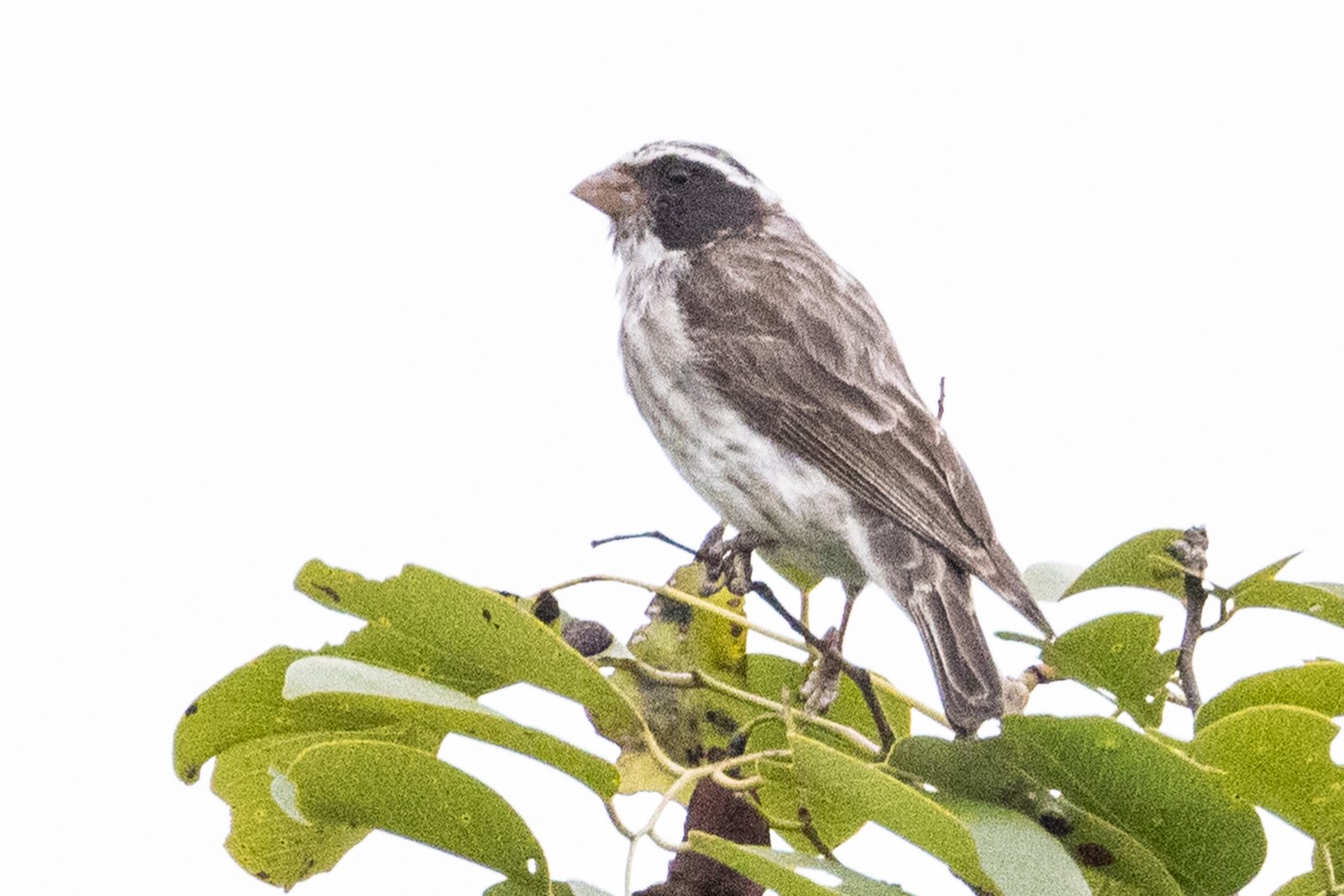
The Black-Eared Seedeater is a small grey-brown seedeater of miombo and other broad-leaved woodland, recognised by black ear-coverts below a broad white supercilium. It often feeds high in the trees and is noticed more for its clear, descending song than for its plumage.
Voice
A clear, descending series of whistles, tsee-tsee-tsoo-tsoo or twee-twee-tyoo, often repeated from a high branch. The call is a soft tswee.
Recording: Dries Van de Loock — CC BY-NC-SA 4.0 · converted to mono · xeno-canto
Identification
13–14 cm. The crown is black with fine white streaks, the supercilium broad and white, the ear-coverts black in the male and blackish-brown in the female. The back is grey-brown with dark streaking. The throat is white; breast and flanks are off-white with fine dark streaking. The bill is small and horn-coloured. Juveniles are browner, with a less contrasting head.
Confusion species
The Streaky-Headed Seedeater (Crithagra gularis) is larger, with brown rather than black ear-coverts, a grey-brown, finely streaked crown and an unstreaked breast; it feeds lower more often. Reichard's Seedeater (Crithagra reichardi) also has a streaked breast, but brown ear-coverts and a dark moustachial stripe. The black cheeks between white supercilium and white throat are the best feature.
Habitat
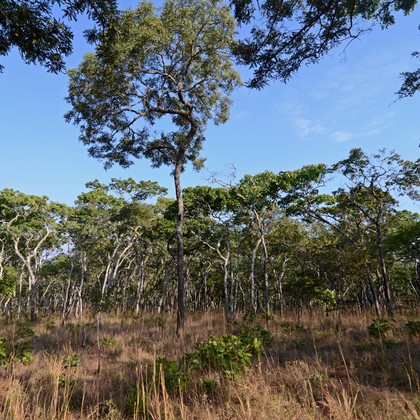
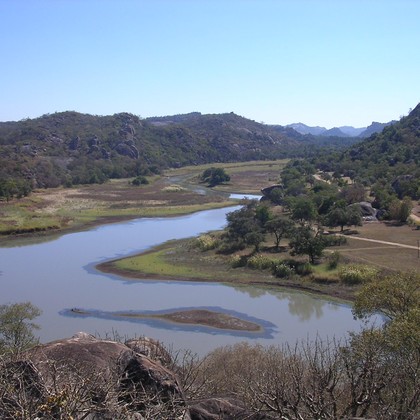
Miombo and other broad-leaved woodland, especially with Brachystegia and Julbernardia, also woodland on rocky hills and plantation edges. It feeds in the canopy and on the ground on seeds, buds and insects, often in mixed foraging flocks.
Where the bird is most at home, classified by the vegetation units of southern Africa.
Range and movements
Within the region in northern, central and eastern Zimbabwe, Zambia, Malawi, central and northern Mozambique and the extreme east of Angola. Beyond the region in south-eastern DR Congo and southern Tanzania.
- Resident
- Summer visitor (c. Oct–Mar)
- Passage (Mar–Apr, Oct–Nov)
- dark = core range, pale = thinly spread
How and when to look
Search miombo in Zimbabwe, Zambia and Malawi for mixed flocks of woodland birds. Listen for the high, clear, descending song; the singer usually sits on a bare branch high in a tree and from below shows mainly its streaked breast. Only when it turns its head does the black cheek appear.
Conservation status
Not threatened. Common in miombo, but declining locally through clearing for agriculture and charcoal.
Scientific name
Crithagra mennelli | (Chubb, 1908)
Chubb described the species in 1908 as Poliospiza mennelli; because it was later moved to another genus, the author and year stand in brackets. The genus Crithagra was introduced in 1827 by Swainson. Crithagra comes from the Greek krithē, 'barley', and agra, 'hunting' — a 'barley hunter', for the seed-eating diet of these canaries and seedeaters. mennelli honours the British mineralogist and geologist Frederic Philip Mennell (1880–1966), founding curator of the Rhodesia Museum in Southern Rhodesia (Zimbabwe) from 1901 to 1908, later a politician. The specimen the first description was based on came from Tjoko's Kraal, Shangani River, Zimbabwe.