All species › Birds of prey › Hawks, eagles and kites › Black Harrier
Black Harrier | Circus maurus
Zwarte kiekendief | Aguilucho Negro
The Black Harrier is a raptor endemic to southern Africa and one of the rarest harriers in the world, with an estimated fewer than a thousand mature birds. It breeds in fynbos and renosterveld in the Western and Northern Cape and wanders over grassland and semi-desert in the interior outside the breeding season.
Voice
Mostly silent outside the breeding season. During display flights over the territory a fast pee-pee-pee-pee and a chattering chek-ek-ek-ek; the female begs for prey from the male with a high peeuw.
Recording: Murray Christian — CC BY-NC-SA 4.0 · converted to mono · xeno-canto
Identification
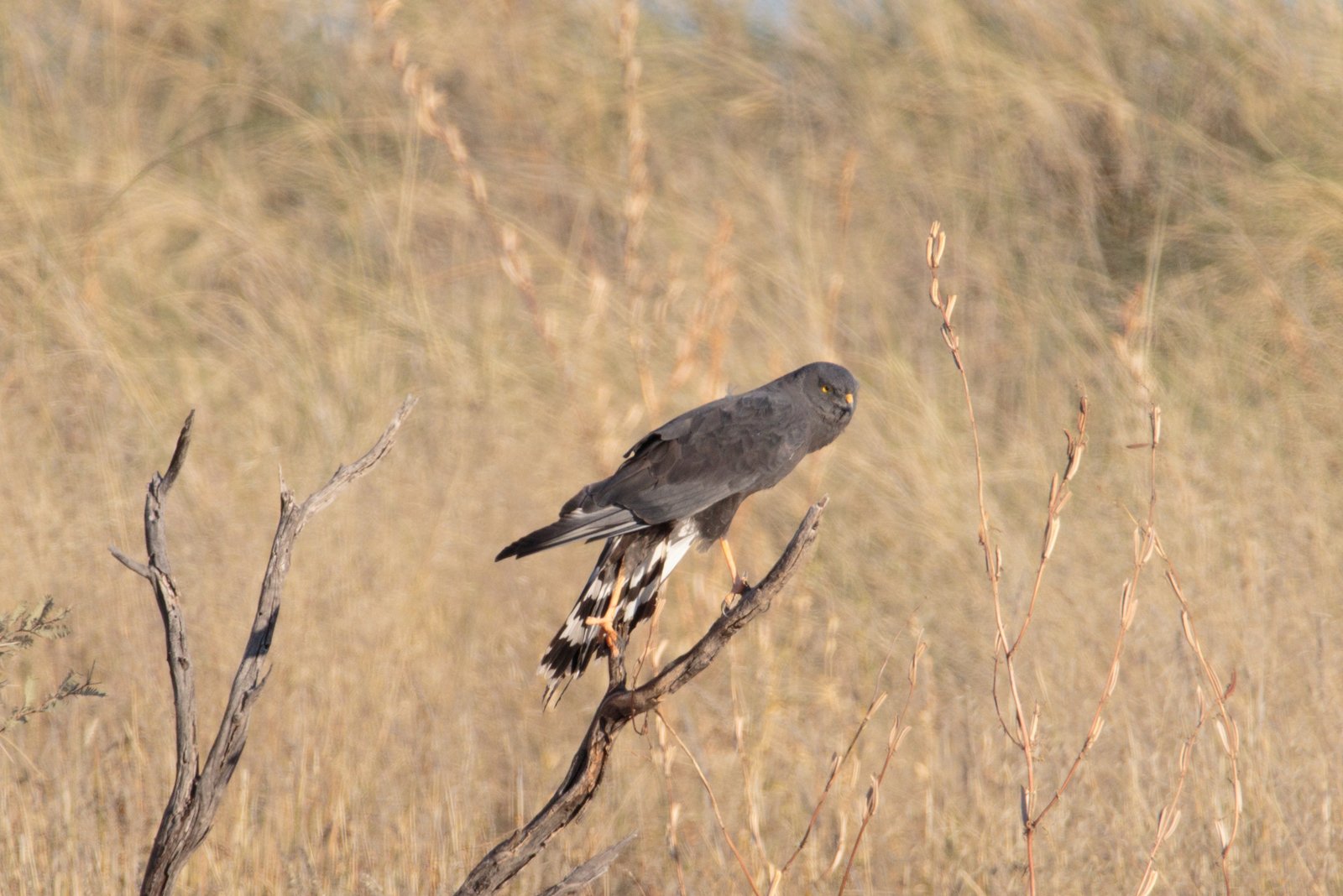
48–53 cm, wingspan 105–115 cm. Adults are wholly black with a bright white rump and a tail with broad black and silvery-white bands. Below, the flight feathers are white with black tips and narrow black bars, giving a striking black-and-white underwing in flight; from above, too, the pale primary bases form a silvery panel. Iris, cere and legs are yellow. The sexes are alike, the female slightly larger. Juveniles are dark brown above, with cream to pale brown, dark-streaked underparts, a white rump and the same strongly barred tail. It flies low and rocking with the wings in a shallow V.
Confusion species
The black-and-white pattern of wings, rump and tail makes the adult unmistakable. The rare dark morph of Montagu's Harrier Circus pygargus lacks the white rump and the silvery-barred tail. Juveniles can resemble females and juveniles of Montagu's Harrier and Pallid Harrier Circus macrourus, but are bulkier, darker and have a more heavily barred tail. African Marsh Harrier Circus ranivorus is brown, without a white rump, and hunts over marshes.
Habitat
In the breeding season in fynbos, renosterveld and strandveld, especially on lowland plains and in hills with low, dense shrubs and remnants of natural vegetation among wheatfields. Outside the breeding season also in the Karoo, montane grassland in the Drakensberg and Lesotho, and highveld grassland. It hunts low over the vegetation for rodents, especially the four-striped grass mouse, and for small birds and reptiles. It nests on the ground in dense shrubs.
Where the bird is most at home, classified by the vegetation units of southern Africa.


Range and movements
Largely confined to South Africa and Lesotho. It breeds mainly in the Western Cape, along the west coast to Namaqualand in the Northern Cape and locally in the Eastern Cape and the Karoo. Outside the breeding season it moves north and east to the Free State, KwaZulu-Natal, Mpumalanga and Lesotho, rarely to southern Namibia and Botswana. Unknown outside southern Africa.
- Resident
- Summer visitor (c. Oct–Mar)
- Winter visitor (c. Apr–Sep)
- Passage (Mar–Apr, Oct–Nov)
- dark = core range, pale = thinly spread
How and when to look
The Western Cape is the best area: West Coast National Park, the Overberg around Bredasdorp and De Hoop, and the Tankwa margins between July and November, when males display and bring prey to the nest. The white rump and the silver-and-black barred tail are visible from far off as the bird rocks low over the scrub.
Conservation status
Endangered on the Red List. The world population probably numbers fewer than a thousand mature birds and is declining. Causes are the loss and fragmentation of renosterveld and fynbos through cultivation and development, a shortage of rodents in fragmented remnants, collisions with wind turbines and low genetic diversity.
Scientific name
Circus maurus | (Temminck, 1828)
Temminck described the species in 1828 as Falco maurus; because it was later moved to another genus, the author and year stand in brackets. The genus Circus was introduced in 1799 by De Lacépède. Circus comes from the Greek kirkos, a partly mythical hawk named for its circling flight (from kirkos, 'circle'). maurus is Latin for 'Moorish', in the sense of 'dark, black' — for the largely black plumage. The specimen the first description was based on came from Cape of Good Hope.