All species › Passerines › Weavers › Black-Necked Weaver
Black-Necked Weaver | Ploceus nigricollis
Zwartnekwever | Tejedor Cuellinegro
The Black-Necked Weaver is a stocky yellow-and-olive weaver of forest edges and scrub in north-western Angola. The male has a yellow head with a black eye-mask and a black bib. It gleans insects in foliage like a warbler and builds a nest with a long entrance tunnel.

Click a thumbnail to switch the photo above.
Voice
A wheezy, thin song, dew-dew-twee, as well as sharp chik calls and a dry chatter. Pairs keep in touch with short calls.
Recording: Alain Malengreau — CC BY-NC-SA 4.0 · converted to mono · xeno-canto
Identification
15–16 cm, compact, with a strong, pointed black bill and a pale yellow eye. The male has a yellow head with a black eyestripe or narrow mask and a black chin and throat, olive-green upperparts and wings and yellow underparts. The female has the same black eyestripe but no black throat, and a more olive crown. Outside the breeding season the male becomes duller, with an olive crown and a greyer back. Juveniles are duller, with a darker eye.
Confusion species
Black-Chinned Weaver (Ploceus nigrimentus) of the Angolan highlands has a black back and a yellow rump; the female has an all-black hood. Spectacled Weaver (Ploceus ocularis) has a finer bill, an orange-yellow head and in the male only a small black throat patch. Village Weaver (Ploceus cucullatus) is larger, with a red eye, a black-blotched back and a large black mask. Slender-Billed Weaver (Ploceus pelzelni) is much smaller and thinner-billed, with a dark eye.
Habitat
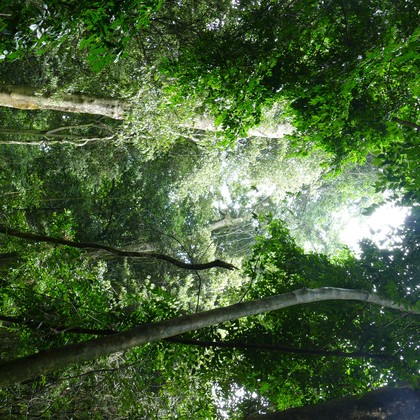
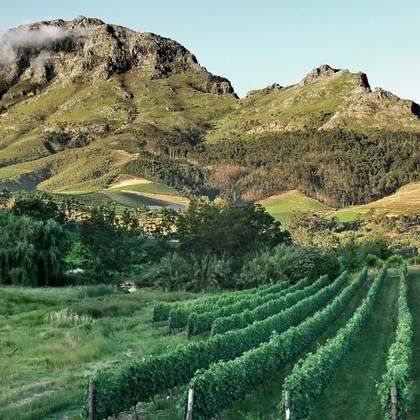
Edges of lowland and gallery forest, secondary forest, rank thickets, overgrown plantations and gardens with dense shrubbery, mostly below 1,500 metres. It lives in pairs and nests solitarily; outside the breeding season it sometimes joins small groups or mixed foraging flocks. It gleans insects in foliage, including from the undersides of leaves. The large, coarsely woven nest of grass and tendrils has an entrance tunnel up to about 15 cm long.
Where the bird is most at home, classified by the vegetation units of southern Africa.

Range and movements
Within the region only in north-western and western Angola: Cabinda, Zaire, Uíge, Bengo, Luanda, Cuanza Norte, Cuanza Sul and Malanje. A single report from South Africa is almost certainly erroneous. Beyond the region from Cameroon and Bioko east through DR Congo and the Central African Republic to South Sudan, Uganda, Kenya and Tanzania; a separate subspecies in Ethiopia and Somalia.
- Resident
- Winter visitor (c. Apr–Sep)
- Passage (Mar–Apr, Oct–Nov)
- dark = core range, pale = thinly spread
How and when to look
Readily found in the shrubby forest edges of Cuanza Sul, for example around Kumbira and the escarpment forests, and in overgrown gardens around Luanda. Watch for a yellow-green weaver clambering through dense scrub in pairs rather than colonies, and for the nest with its long hanging tunnel.
Conservation status
Not threatened; widespread and locally common, and tolerates secondary growth and gardens well.
Scientific name
Ploceus nigricollis | (Vieillot, 1808)
Vieillot described the species in 1808 as Malimbus nigricollis; because it was later moved to another genus, the author and year stand in brackets. The genus Ploceus was introduced in 1816 by Cuvier, GLCFD. Ploceus comes from the Greek plokeus, 'plaiter, weaver', for the tightly woven, ball-shaped nest that gives weavers their name. nigricollis is Latin for 'black-necked', from niger, 'black', and collum, 'neck'. The specimen the first description was based on came from Mayombe, Cabinda (Angola).