All species › Passerines › Weavers › Spectacled Weaver
Spectacled Weaver | Ploceus ocularis
Brilwever | Tejedor de Anteojos
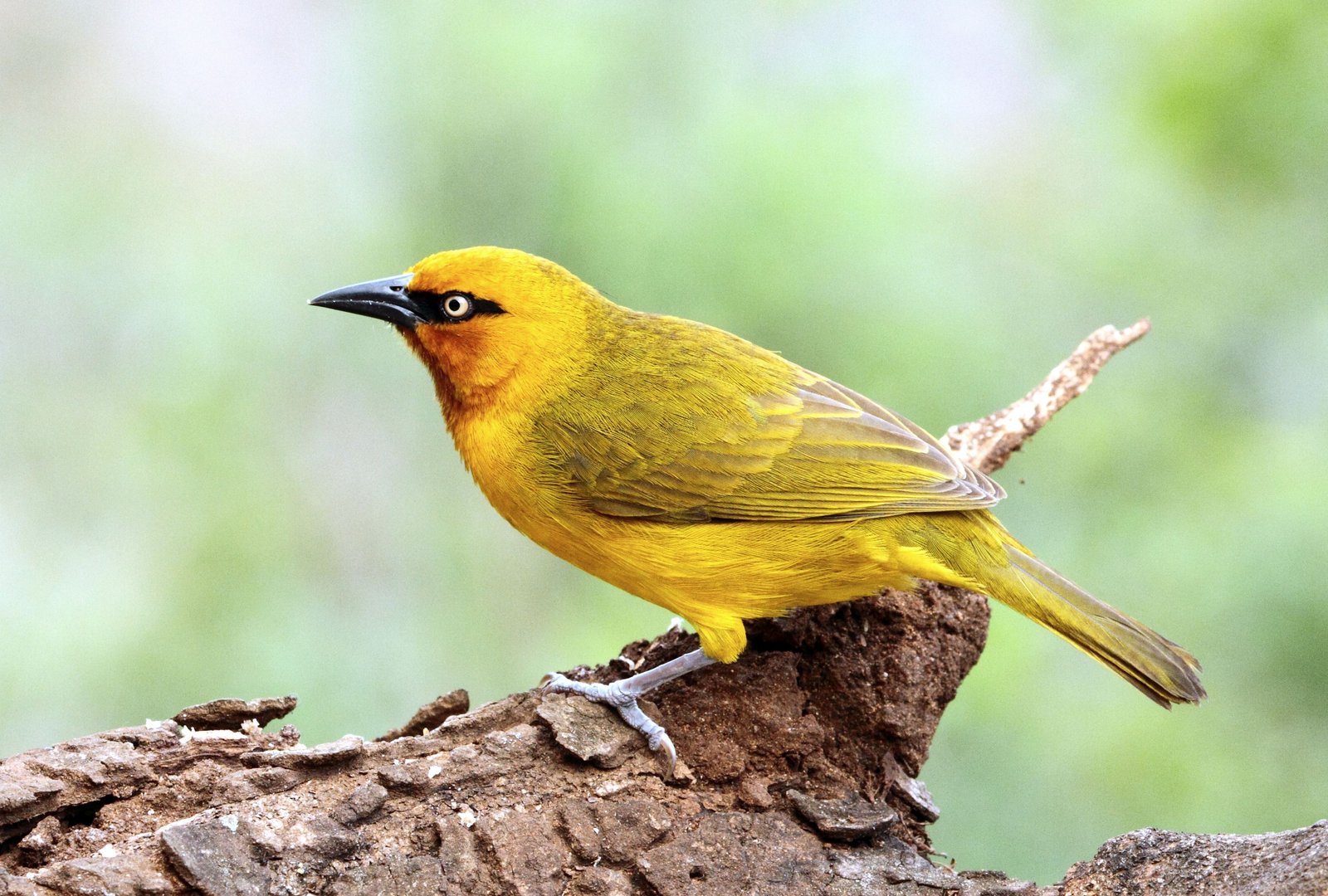
The Spectacled Weaver is a solitary, unobtrusive weaver of dense riverine vegetation and forest edges. Both sexes have a narrow black eye-stripe, the 'spectacles', and a pale yellow eye. Unlike most weavers it lives in permanent pairs all year round and builds a nest with a strikingly long entrance tube.
Click a thumbnail to switch the photo above.
Voice
A clear, descending series of whistles, dee-dee-dee-dee-dee, quite unlike the sizzling of other weavers and often the first sign of the species. There is also a soft chuk contact call and a soft chatter at the nest. Pairs often call to each other in alternation.
Recording: Lynette Rudman — CC BY-NC-SA 4.0 · converted to mono · xeno-canto
Identification
15–16 cm. Head and underparts golden yellow, the head with an orange-brown wash on forehead and cheeks; back and wings olive-green. A narrow black line runs from the bill base through the eye and behind it. The eye is pale yellow to cream, the bill black and fairly slender. The male has a small black throat patch or 'bib', lacking in the female. There is no separate eclipse plumage: both sexes wear the same plumage all year. Juveniles are duller, with a shorter eye-stripe, a dark eye and a horn-coloured bill. It gleans insects among leaves and along branches like a tit.
Confusion species
Black-Necked Weaver (Ploceus nigricollis) of Angola and Zambia also has a black eye-stripe, but a black or dark mantle and nape and a dark eye. Holub's Golden Weaver (Ploceus xanthops) is larger and uniformly golden yellow, with a heavy bill and no eye-stripe. Eastern Golden Weaver (Ploceus subaureus) also lacks the eye-stripe and breeds colonially in reeds. The combination of narrow black eye-stripe, pale eye and a life in pairs is decisive.
Habitat
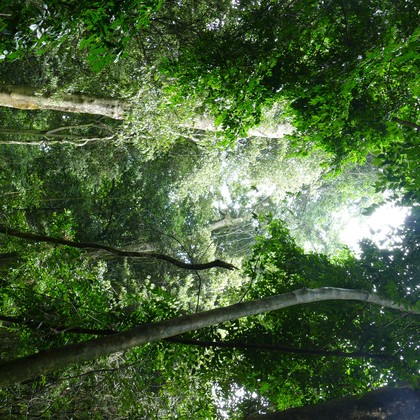
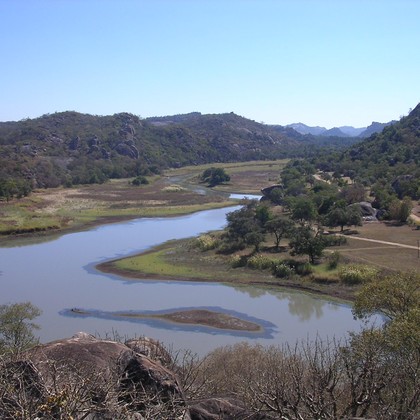
Dense, evergreen vegetation: riverine forest and thicket, forest edges, coastal forest, creeper tangles and overgrown gardens with plenty of cover. It avoids open savanna. It eats mainly insects and spiders, as well as seeds, fruit and nectar. The nest is a compact, finely woven ball of thin grass and leaf fibres with an entrance tube 15–30 cm long, usually slung from an overhanging branch or creeper, often above water or a path.
Where the bird is most at home, classified by the vegetation units of southern Africa.

Range and movements
In the east and north of the region: Eastern Cape, KwaZulu-Natal, Mpumalanga and Limpopo in South Africa, Eswatini, eastern and northern Zimbabwe, Mozambique, Malawi, Zambia and Angola, and also the Okavango Delta in Botswana and the Caprivi Strip in Namibia. It is absent from the dry west and the interior of the Highveld. Beyond the region it occurs over much of sub-Saharan Africa, north to Ethiopia and west to Cameroon.
- Resident
- Summer visitor (c. Oct–Mar)
- Winter visitor (c. Apr–Sep)
- Passage (Mar–Apr, Oct–Nov)
- dark = core range, pale = thinly spread
How and when to look
All year, but best found by ear: the descending whistled series gives away a pair that otherwise works hidden in the foliage. In riverine forest look for the characteristic nest with its long tube; it is often repaired and reused for years. The black bib identifies the male, which is useful for telling the partners apart in this pair-living species.
Conservation status
Not threatened; common in suitable habitat and widespread. It is sensitive to the clearing of riverine forest, but adapts well to gardens with dense vegetation. It is occasionally parasitised by the Diederik Cuckoo.
Scientific name
Ploceus ocularis | Smith, 1828
Smith described the species in 1828 and placed it straight away in the genus where it still stands. The genus Ploceus was introduced in 1816 by Cuvier, GLCFD. Ploceus comes from the Greek plokeus, 'plaiter, weaver', for the tightly woven, ball-shaped nest that gives weavers their name. ocularis is Latin for 'of the eye', from oculus, 'eye' — for the black eye-stripe forming the 'spectacles'. The specimen the first description was based on came from Durban, KwaZulu-Natal (South Africa).