All species › Passerines › Weavers › Cape Weaver
Cape Weaver | Ploceus capensis
Kaapse wever | Tejedor del Cabo
The Cape Weaver is a large, long-billed weaver found almost exclusively in South Africa, Lesotho and Eswatini. The breeding male is yellow with an orange-brown face and a pale, cream-coloured eye. Colonies hang in trees and reeds by water, often in tall alien trees on farms.

Click a thumbnail to switch the photo above.
Voice
A loud, rasping, grating chatter with a characteristic azweet-azweet and a harsh chrrr, delivered while the male hangs at the nest with quivering wings. The contact call is a hard chak. A colony can be heard from far away.
Recording: Walter Wallner — CC BY-NC-SA 4.0 · shortened to the first 60 s, mono · xeno-canto
Identification
16–18 cm; a bulky weaver with a long, pointed, straight bill. The breeding male is bright yellow below, with an orange-brown to rusty wash over forehead, face and throat, an olive-green, faintly streaked back and a black bill; the eye is pale cream to whitish. Outside the breeding season the male is duller with a horn-coloured bill, but the eye stays pale. The female is olive-brown above, dingy yellow on breast and throat and whitish on the belly, with a brown eye and a horn-coloured bill. Juveniles resemble the female.
Confusion species
Southern Masked Weaver (Ploceus velatus) is smaller and shorter-billed; the male has a black mask and a red eye. Eastern Golden Weaver (Ploceus subaureus) in the east is smaller, with a shorter bill; the male has an orange wash on the head and a reddish eye. Holub's Golden Weaver (Ploceus xanthops) is uniformly golden yellow with a heavy bill and a pale eye in both sexes, and lives solitarily. Females are best identified by the long pointed bill and bulky build; the brown eye of the female against the pale eye of the male helps to separate the sexes.
Habitat
Open country near water: grassland, fynbos, renosterveld, farmland, riverbanks and vleis, and increasingly gardens, parks and farmyards. It nests in colonies in reeds, in trees over water and in tall alien trees such as eucalyptus. The nest is a large, coarse kidney-shaped structure of broad grass blades, green at first and later straw-coloured, with the entrance underneath. Males are polygynous. It eats seeds, insects and nectar; it visits aloes and coral trees and then often gets an orange forehead from the pollen.
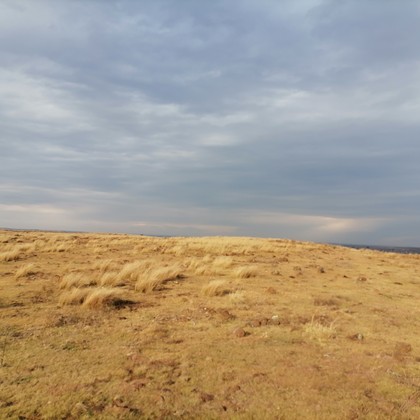
Where the bird is most at home, classified by the vegetation units of southern Africa.


Range and movements
Endemic to the southernmost part of the region: Western, Northern and Eastern Cape, Free State, KwaZulu-Natal, Gauteng, Mpumalanga and southern North West and Limpopo in South Africa, as well as Lesotho and Eswatini, and marginally in southern Namibia along the Orange River. It is absent from the dry Karoo interior except along rivers. It does not occur outside the region.
- Resident
- Summer visitor (c. Oct–Mar)
- Winter visitor (c. Apr–Sep)
- dark = core range, pale = thinly spread
How and when to look
All year, but most conspicuous in the breeding season, which falls earlier in the winter-rainfall Cape than in the east. At dams and rivers in grassland and on farmyards look for colonies in willows, eucalypts and reeds. In winter small parties wander, sometimes with other weavers and bishops; then look for the long pointed bill and bulky build.
Conservation status
Not threatened; common and locally increased through dams, irrigation and planted trees. It is parasitised by the Diederik Cuckoo. It is locally damaging in orchards and grain fields.
Scientific name
Ploceus capensis | (Linnaeus, 1766)
Linnaeus described the species in 1766 as Oriolus capensis; because it was later moved to another genus, the author and year stand in brackets. The genus Ploceus was introduced in 1816 by Cuvier, GLCFD. Ploceus comes from the Greek plokeus, 'plaiter, weaver', for the tightly woven, ball-shaped nest that gives weavers their name. capensis is Latin for 'of the Cape' — for the origin of the first specimen at the Cape of Good Hope. The specimen the first description was based on came from Cape of Good Hope.