All species › Passerines › Swallows and martins › Black Saw-Wing
Black Saw-Wing | Psalidoprocne pristoptera
Blauw-zwarte kamzwaluw | Golondrina Negra
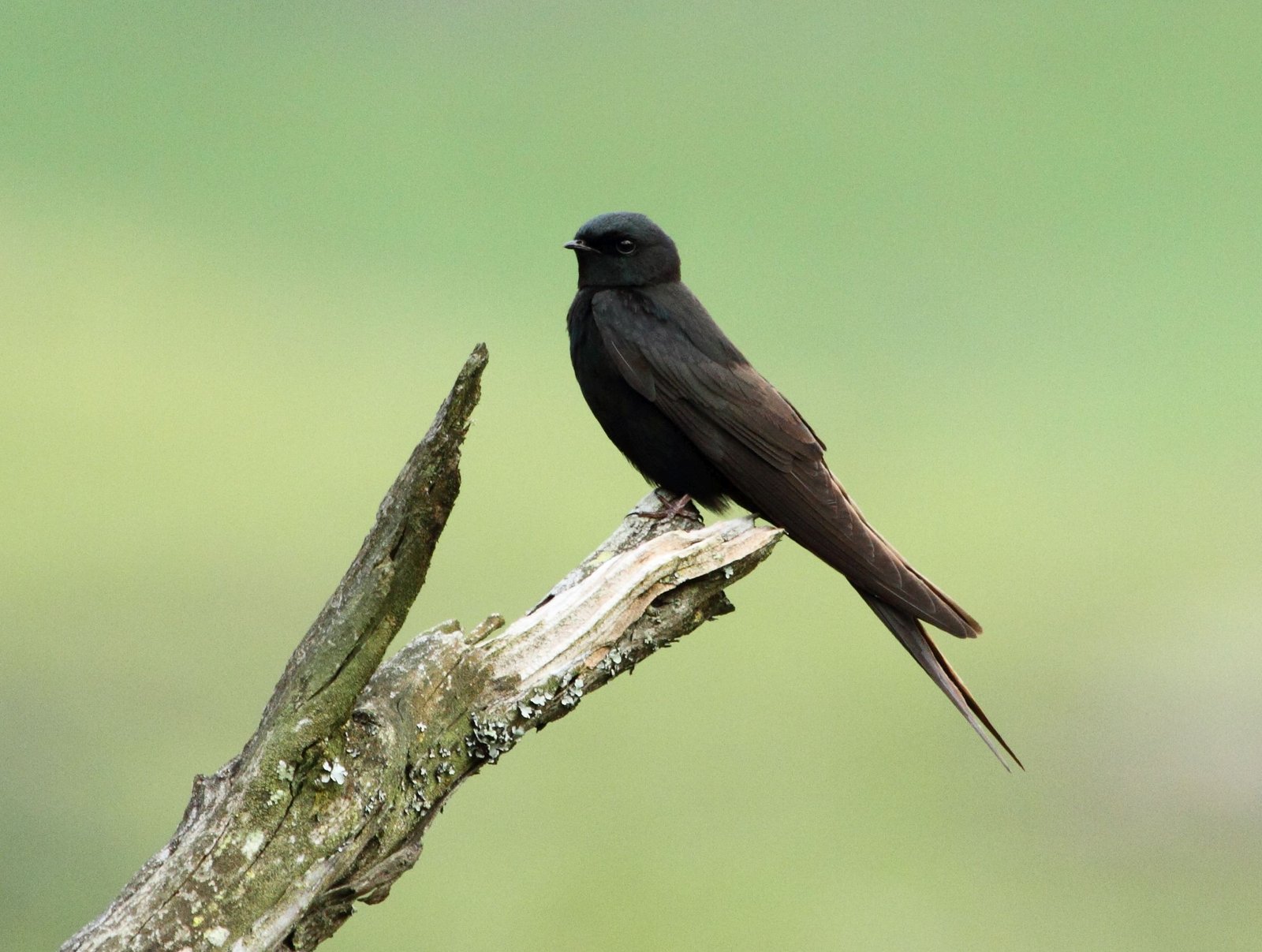
The Black Saw-Wing is an all-black swallow with a deeply forked tail that hunts slowly and flutteringly along forest edges and through wooded gorges. The name saw-wing refers to the fine hooks on the outer web of the outermost primary, which cannot be seen in the field.
Voice
Not very vocal. It gives a soft chip or tsweet; at the nest and in flight sometimes a weak, dry twittering, and a rasping chrrp in alarm.
Recording: Martin St-Michel — CC BY-NC-SA 4.0 · converted to mono · xeno-canto
Identification
14–16 cm, including the long outer tail feathers. Wholly dull black with a faint greenish to oily gloss; in good light the back and wings shine slightly. The tail is deeply forked, more so in the male than the female. The underwing coverts are dark in birds from southern South Africa, but conspicuously whitish in birds from the Eastern Highlands of Zimbabwe, Mozambique and Malawi (often called Eastern Saw-wing). Juveniles are browner black and duller, with a shorter tail. Flight is slow and fluttering, interspersed with glides, often low over the canopy, clearings and roads through forest.
Confusion species
Swifts such as the African Black Swift Apus barbatus are larger, fly much faster on stiff sickle wings and never perch; the saw-wing often sits on dead branches. The Blue Swallow Hirundo atrocaerulea is glossy steel-blue with very long tail streamers and hunts over montane grassland. The White-Bibbed Swallow Hirundo nigrita has a small white throat patch. The White-Headed Saw-Wing Psalidoprocne albiceps has a white throat and, in the male, a white crown. The Large Rock Martin Ptyonoprogne fuligula is brown with white spots in the spread tail.
Habitat
Edges and clearings of montane and coastal forest, wooded gorges and river valleys, pine and eucalyptus plantations, and grassland bordering forest. It nests in a self-excavated tunnel in an earth bank, road cutting, erosion gully or riverbank.
Where the bird is most at home, classified by the vegetation units of southern Africa.


Range and movements
In South Africa from the southern Cape at Knysna eastwards through the Eastern Cape and KwaZulu-Natal to the escarpments of Mpumalanga and Limpopo, and in Eswatini; further in the Eastern Highlands of Zimbabwe, western and central Mozambique, Malawi, much of Zambia and Angola. Beyond the region to East Africa, Ethiopia and Eritrea, and west to Cameroon and Nigeria.
- Resident
- Summer visitor (c. Oct–Mar)
- Winter visitor (c. Apr–Sep)
- Passage (Mar–Apr, Oct–Nov)
- dark = core range, pale = thinly spread
How and when to look
In South Africa mainly seen from September to April along forest edges and roads through forest, as at Magoebaskloof, around Graskop, at Hogsback and in the Tsitsikamma. Look low over the canopy and along road cuttings, where the birds also dig their nest tunnels.
Conservation status
Not threatened and common in suitable habitat. It benefits locally from plantations and road cuttings, which provide feeding areas and nest sites.
Scientific name
Psalidoprocne pristoptera | (Rüppell, 1840)
Rüppell described the species in 1840 as Hirundo (Chelidon) pristoptera; because it was later moved to another genus, the author and year stand in brackets. The genus Psalidoprocne was introduced in 1851 by Cabanis. Psalidoprocne comes from the Greek psalis, 'shears', and Procne, the figure of Greek myth turned into a swallow — for the deeply forked tail. pristoptera comes from the Greek pristēs, 'saw', and pteron, 'wing' — for the serrated edge of the outer primary. The specimen the first description was based on came from Simien, Ethiopia.