All species › Passerines › Swallows and martins › Grey-Rumped Swallow
Grey-Rumped Swallow | Pseudhirundo griseopyga
Grijsstuitzwaluw | Golondrina Culigrís
The Grey-Rumped Swallow is a small, slender swallow with a grey-brown crown and rump and a deeply forked tail. Uniquely among the swallows of the region it breeds in rodent burrows in flat ground, and it does so in the dry season.

Voice
A soft, dry chrrp or cherp in flight; the song is an inconspicuous, soft twittering.
Recording: Dries Van de Loock — CC BY-NC-SA 4.0 · converted to mono · xeno-canto
Identification
13–14 cm, with a deeply forked tail lacking white spots. Crown and nape dull grey-brown, contrasting clearly with the glossy blue-black mantle and wings. The rump and uppertail coverts are pale grey-brown, forming a dull band in flight. Underparts off-white with greyish breast sides; underwing coverts pale grey. The sexes are alike; juveniles are browner, less glossy and shorter-tailed. Flight is light and fluttering, often low over the ground and in small groups.
Confusion species
The Western House Martin Delichon urbicum has a pure white rump, a blue-black crown and a less deeply forked tail. The Pearl-Breasted Swallow Hirundo dimidiata has a blue-black crown without a grey rump and pure white underparts. The Sand Martin Riparia riparia and the Brown-Throated Martin Riparia paludicola are brown above without blue gloss. The White-Rumped Swift Apus caffer has a narrow white rump but is a swift with sickle wings and black underparts. The combination of grey crown, grey rump and fluttering flight low over short grass is distinctive.
Habitat
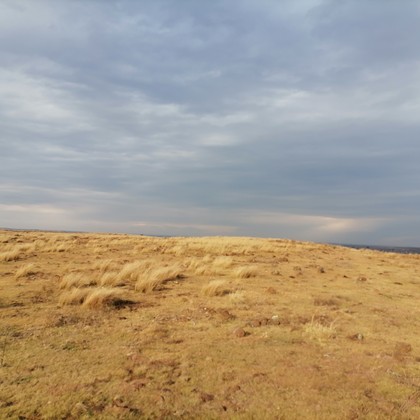
Short grassland near water: floodplains, margins of pans and vleis, dry riverbeds, airstrips, playing fields and freshly burnt grassland. It nests in disused rodent burrows in flat ground, sometimes in holes in a low bank.
Where the bird is most at home, classified by the vegetation units of southern Africa.

Range and movements
In the north and east of the region: Angola, Zambia, Malawi, Mozambique and Zimbabwe, northern Botswana (Okavango Delta and Chobe) and north-eastern Namibia (Kavango and Zambezi Region). In South Africa mainly in northern KwaZulu-Natal and locally in the lowveld of Mpumalanga and Limpopo, where it appears mostly in the winter months. Beyond the region widespread in sub-Saharan Africa, from Senegal to Ethiopia.
- Resident
- dark = core range, pale = thinly spread
How and when to look
Search in the dry season over short grass near water, for example on the floodplains along the Chobe and in the Okavango, or on the coastal plain of northern KwaZulu-Natal. The birds readily settle on the ground or on low stems; with any small swallow fluttering low, check for the grey crown and dull rump.
Conservation status
Not threatened; locally common but nomadic, so numbers vary greatly from year to year. Sensitive to the loss of floodplains and to trampling or ploughing of breeding sites.
Scientific name
Pseudhirundo griseopyga | (Sundevall, 1850)
Sundevall described the species in 1850 as Hirundo griseopyga; because it was later moved to another genus, the author and year stand in brackets. The genus Pseudhirundo was introduced in 1922 by Roberts. Pseudhirundo comes from the Greek pseudos, 'false', and the Latin hirundo, 'swallow' — a 'false swallow' resembling the true swallows but placed apart. griseopyga comes from the Latin griseus, 'grey', and the Greek pugē, 'rump' — for the grey rump. The specimen the first description was based on came from Durban, South Africa.