All species › Passerines › Swallows and martins › Large Rock Martin
Large Rock Martin | Ptyonoprogne fuligula
Kaapse rotszwaluw | Avión Isabel Meridional
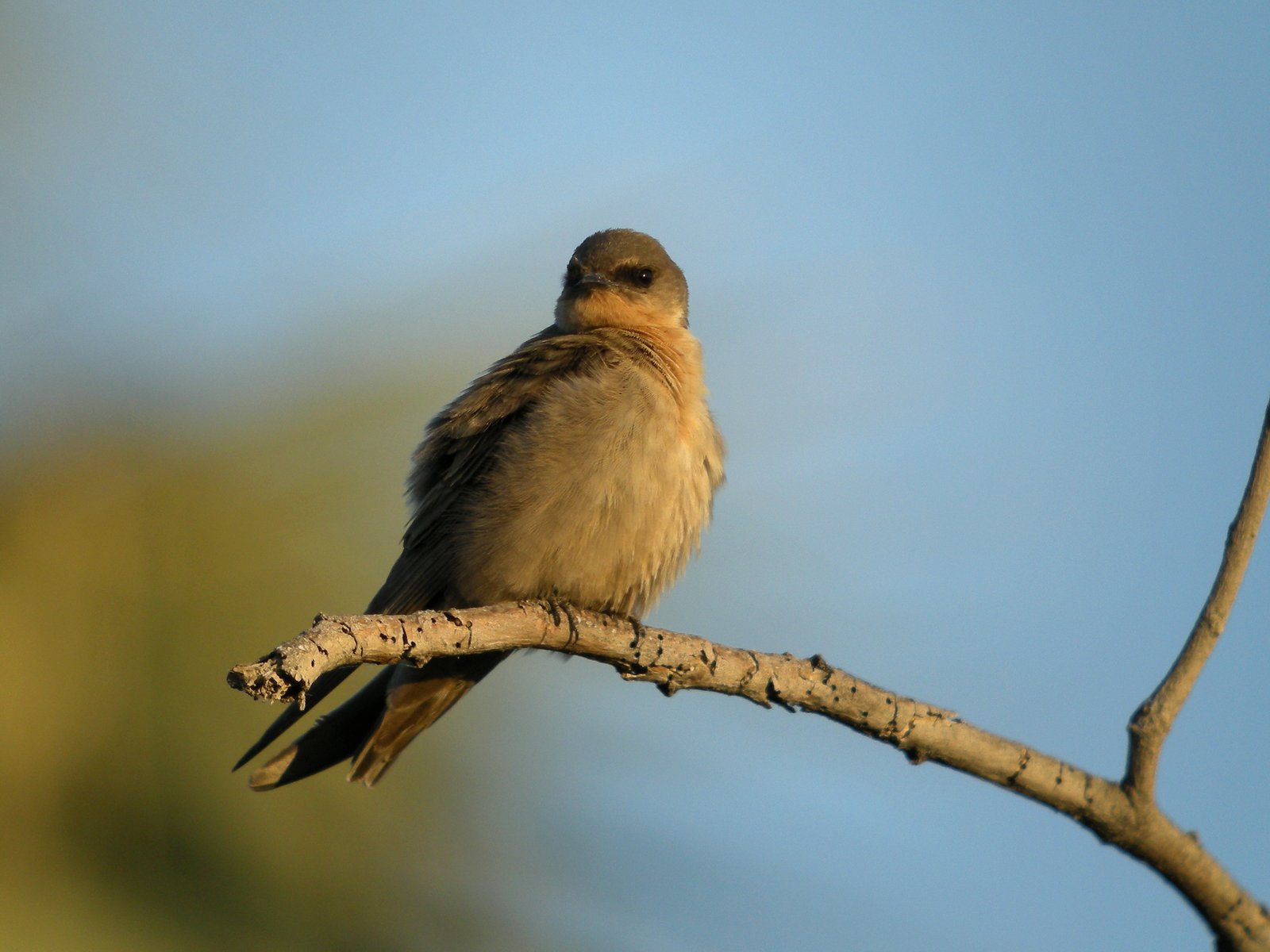
The Large Rock Martin is a stocky, plain brown martin of cliffs, gorges and buildings. It glides unhurriedly back and forth along rock faces and walls, showing the row of white spots in the spread tail at every turn.
Voice
Quiet; a soft twee or trrt, and at the nest a soft, chattering twitter.
Recording: Lynette Rudman — CC BY-NC-SA 4.0 · converted to mono · xeno-canto
Identification
15 cm, sturdily built, with broad wings and a short, almost square tail. The upperparts are plain grey-brown. The throat and breast are warm rufous-brown to cinnamon, the belly slightly darker brown; the underwing coverts are dark. In the spread tail a row of white spots on the inner webs of the tail feathers stands out, except on the central and outermost pairs. The sexes are alike; juveniles have pale fringes on the wing and back. The flight is slow and gliding, with short bursts of wingbeats, much gliding and abrupt turns close to the face.
Confusion species
Brown-Throated Martin Riparia paludicola is smaller and slimmer, lacks white tail spots, flutters faster and hunts over water, not along rocks. Sand Martin Riparia riparia is smaller, with a white throat and a brown breast band. Banded Martin Neophedina cincta is white below with a breast band. Juvenile Barn Swallows Hirundo rustica also have white tail spots, but are blue-black above and white below. In the north-east Mascarene Martin Phedina borbonica may turn up: it is streaked below and lacks white tail spots.
Habitat
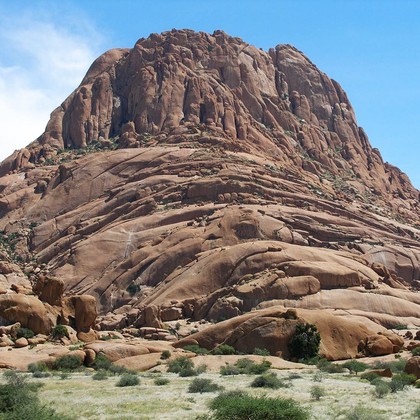
Cliffs, gorges, rocky hills, quarries and dams in hilly country, from sea level to high in the Drakensberg; also in towns and villages, where it breeds under eaves, balconies, bridges and flyovers. It builds an open mud cup against a rock face or wall under an overhang. It hunts flying insects along rock faces and walls, often in the lee when it is windy.
Where the bird is most at home, classified by the vegetation units of southern Africa.

Range and movements
Across almost the whole region wherever there are cliffs, hills or buildings: all of South Africa, Lesotho, Eswatini, Namibia (including the Namib escarpment), Botswana (mainly the east and the hills of the north-west), Zimbabwe, western Mozambique, Malawi, Zambia and western and southern Angola; absent from the flat Kalahari sandveld and the Mozambique coastal plain. Beyond the region north through montane East and Central Africa and locally in West Africa.
- Resident
- Winter visitor (c. Apr–Sep)
- Passage (Mar–Apr, Oct–Nov)
- dark = core range, pale = thinly spread
How and when to look
All year at almost any steep rock face or high bridge; in towns often easiest to see around office blocks, church towers and parking garages. Wait for a turn along the face: that is when the white tail spots appear, the best feature against the smaller brown martins.
Conservation status
Not threatened and common. It has benefited from buildings, bridges and dams, which have allowed it to settle in flatter country too.
Scientific name
Ptyonoprogne fuligula | (Lichtenstein, 1842)
Lichtenstein described the species in 1842 as Hirundo fuligula; because it was later moved to another genus, the author and year stand in brackets. The genus Ptyonoprogne was introduced in 1850 by Reichenbach. Ptyonoprogne is Greek, from ptuon 'a fan', after the shape of the spread tail, and Procne, the girl of myth who was turned into a swallow. fuligula comes from the Latin fuligo, 'soot', and gula, 'throat' — for the sooty-brown plumage. The specimen the first description was based on came from Makhanda (Grahamstown), Eastern Cape, South Africa.