All species › Passerines › Cisticolas › Black-Throated Apalis
Black-Throated Apalis | Apalis jacksoni
Zwartkeelapalis | Apalis Gorjinegro
The Black-Throated Apalis is a colourful apalis of the canopy of moist forest, with a grey head, a black face and black throat bordered by a white malar stripe, a green back and bright yellow underparts. Within the region it occurs only in the forested hills of northern Angola.

Voice
A loud, rapidly repeated series of clear notes, chwee-chwee-chwee or tink-tink-tink, often as a duet in which the female answers with a drier chrrt or high notes in between. The sound comes from high in the crowns and carries far.
Recording: Paweł Szymański — CC BY-NC-SA 4.0 · converted to mono · xeno-canto
Identification
12–13 cm. Male: crown and hindneck grey, back, wings and tail olive-green; the outer tail feathers white. Lores, cheeks, chin and throat black, bordered by a narrow white stripe running from the bill base below the eye to the side of the neck. Breast, belly and flanks bright yellow. Female: the black on the throat replaced by grey or dark grey, the white malar stripe less sharp, otherwise like the male. The iris is pale brown, the bill black, the legs pink. Juveniles are greener on the head and duller yellow.
Confusion species
Lowland Masked Apalis Apalis binotata also has a black mask and black throat, but is smaller, shorter-tailed without white outer tail feathers and dingy white to pale grey rather than bright yellow below, and lives in lowland forest. Yellow-Breasted Apalis Apalis flavida has a white throat and only a yellow breast band. Grey Apalis Apalis cinerea of the Angolan highlands is grey and white without yellow. Buff-Throated Apalis Apalis rufogularis is dark above and white or buff below. A black throat with a white malar stripe above a bright yellow belly is diagnostic.
Habitat
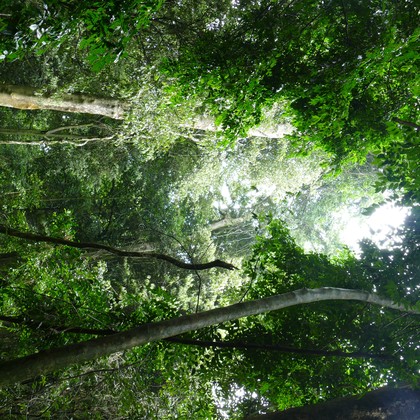
The canopy and edges of moist forest in hills and uplands, riverine forest and tall secondary forest remnants, also shade trees in coffee plantations. It forages in pairs, often in mixed flocks, high in the crowns among leaves and creepers.
Where the bird is most at home, classified by the vegetation units of southern Africa.

Range and movements
Within the region only in north-western Angola, in the moist forests of the hills and escarpment in Uíge and Cuanza Norte. Beyond the region scattered in forested highlands of Cameroon and Nigeria, and from the eastern Democratic Republic of the Congo to Uganda, Kenya and western Tanzania.
- Resident
- dark = core range, pale = thinly spread
How and when to look
Year-round. In Angola search the forest remnants and shaded coffee plantations in the hills around Uíge and in Cuanza Norte. Listen for the clear series high in the crowns and wait until the bird comes to an outer branch; the black throat with the white stripe is the best feature from below.
Conservation status
Not threatened across its range. In Angola its habitat is small and fragmented and shrinking through logging and conversion of forest to fields; the species is local there and little studied.
Scientific name
Apalis jacksoni | Sharpe, 1891
Sharpe described the species in 1891 and placed it straight away in the genus where it still stands. The genus Apalis was introduced in 1833 by Swainson. Apalis comes from the Greek hapalos, 'delicate, gentle' — for these slender, finely built little warblers. jacksoni honours Sir Frederick John Jackson (1860–1929), British colonial administrator and naturalist in Kenya and Uganda. The specimen the first description was based on came from Mount Elgon (Uganda/Kenya).