All species › Passerines › Cisticolas › White-Winged Apalis
White-Winged Apalis | Apalis chariessa
Witvleugelapalis | Apalis Aliblanco
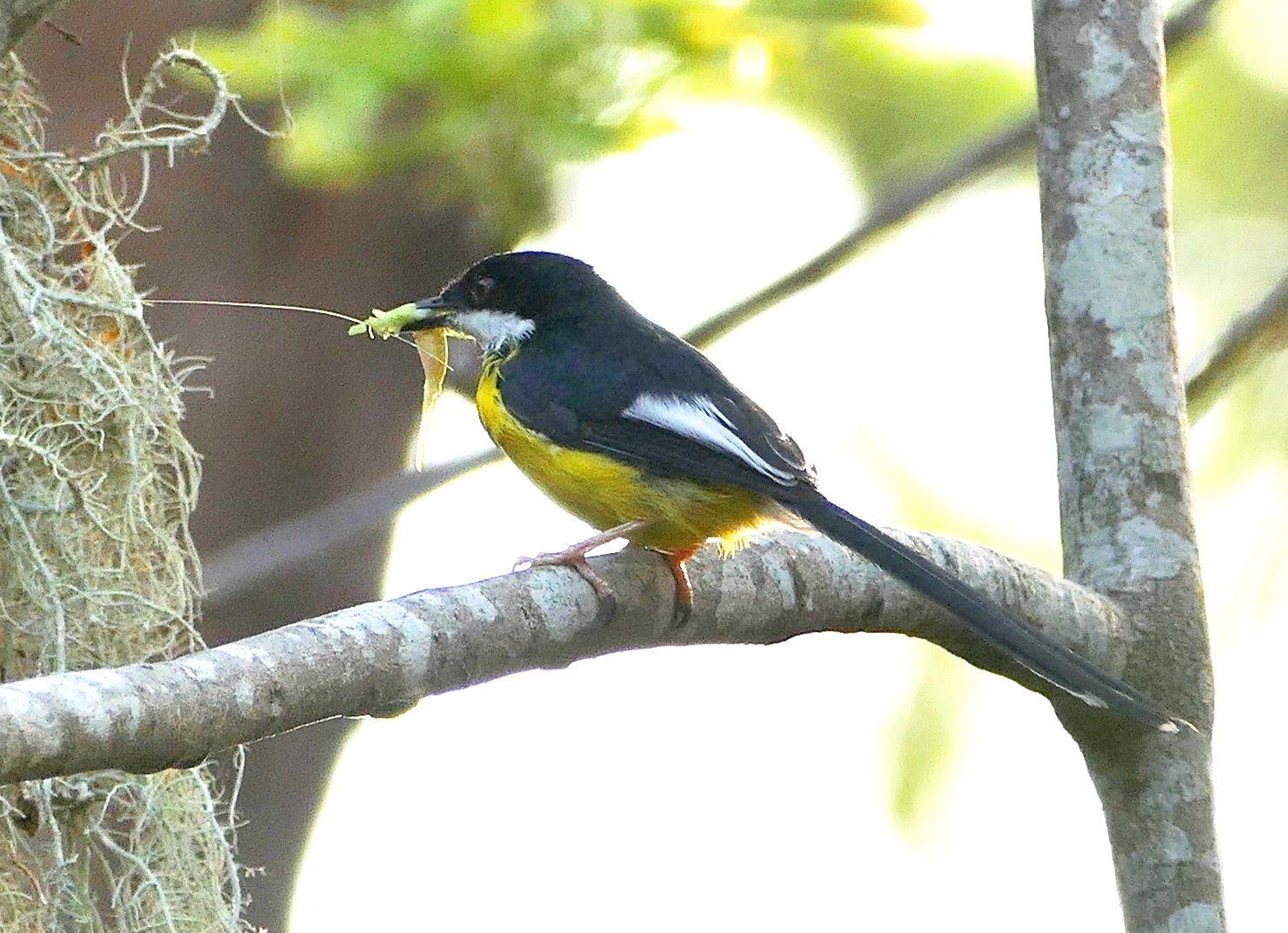
The White-Winged Apalis is an apalis: the male is glossy black above with a white wing stripe, a long graduated tail with white tips, a white throat, a black breast band and warm orange-yellow underparts. It is a scarce, scattered inhabitant of the canopy of lowland and mid-altitude forest, within the region only in Malawi and Mozambique.
Voice
A loud, whistled tee-tew tee-tew or a series of clear wheet-wheet-wheet notes, often as a duet in which the female answers with shorter, higher notes. Also a sharp tchik contact call. The call carries far through the canopy and is usually the first sign of the bird's presence.
Recording: isaac kilusu — CC BY-NC-SA 4.0 · converted to mono · xeno-canto
Identification
13–15 cm, with the longest tail of the region's apalises. Male: crown, cheeks, back and tail black with a bluish gloss; a striking white stripe runs along the closed wing, formed by the edges of the secondaries. The long tail is strongly graduated, the outer feathers with broad white tips. The throat is white, below it a broad black breast band, and the rest of the underparts yellow with an orange to chestnut wash on the breast. Female: black areas replaced by slate-grey, the breast band narrow or absent, the underparts paler yellow; the white wing stripe remains visible. The iris is pale, the bill black, the legs pink.
Confusion species
Black-Headed Apalis Apalis melanocephala also has a black head, but a green or grey back, white underparts without a breast band and no white wing stripe. Bar-Throated Apalis Apalis thoracica is green to grey above with a narrow black collar and likewise lacks a white wing stripe. Yellow-Breasted Apalis Apalis flavida has a grey head and green back. Namuli Apalis Apalis lynesi has a black throat and green back. The white wing stripe, long tail and black, white and yellow pattern are conclusive in a good view; the difficulty is that the bird usually stays high in the canopy.
Habitat
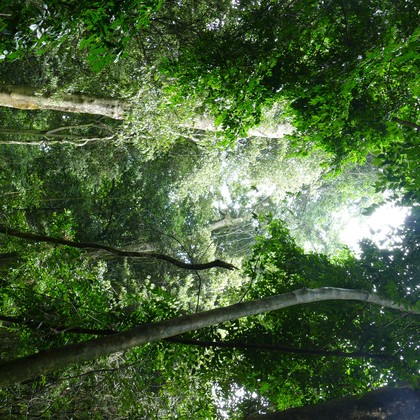
The canopy and high edges of moist lowland and mid-altitude forest, riparian forest and tall forest patches, from about 200 to 1600 m. It keeps to the upper strata and tree crowns, often in mixed flocks, and searches for insects among leaves and creepers.
Where the bird is most at home, classified by the vegetation units of southern Africa.

Range and movements
Within the region in southern Malawi (a few mid-altitude forests in the Shire Highlands) and in northern and central Mozambique, notably on the mid-altitude slopes of Namuli, Mabu and Chiperone and in adjacent forest remnants. Beyond the region in the montane forests of eastern Tanzania (including the Usambaras, Ulugurus and Udzungwas), with a separate subspecies in riverine forest on the lower Tana in Kenya, where it has not been reliably seen for decades.
- Resident
- dark = core range, pale = thinly spread
How and when to look
Year-round, scarce everywhere. The mid-altitude forests of Mabu and Namuli in Mozambique give the best chance; in Malawi the species is very local. Listen for the whistled duet high in the crowns and look for the long, white-tipped tail and the white wing stripe against the sky; a sunny morning at a forest edge with a view over the canopy works best.
Conservation status
Near Threatened. The range is highly fragmented and its habitat, mid-altitude and lowland forest, is being lost to cutting, cultivation and fires. Within the region the little-disturbed forests of Mabu and Namuli are its main stronghold.
Scientific name
Apalis chariessa | Reichenow, 1879
Reichenow described the species in 1879 and placed it straight away in the genus where it still stands. The genus Apalis was introduced in 1833 by Swainson. Apalis comes from the Greek hapalos, 'delicate, gentle' — for these slender, finely built little warblers. chariessa is Greek for 'graceful, elegant' (feminine of charieis), for the handsomely patterned plumage. The specimen the first description was based on came from Mitole, lower Tana River, Kenya.