All species › Passerines › Cisticolas › Lowland Masked Apalis
Lowland Masked Apalis | Apalis binotata
Maskerapalis | Apalis Enmascarado
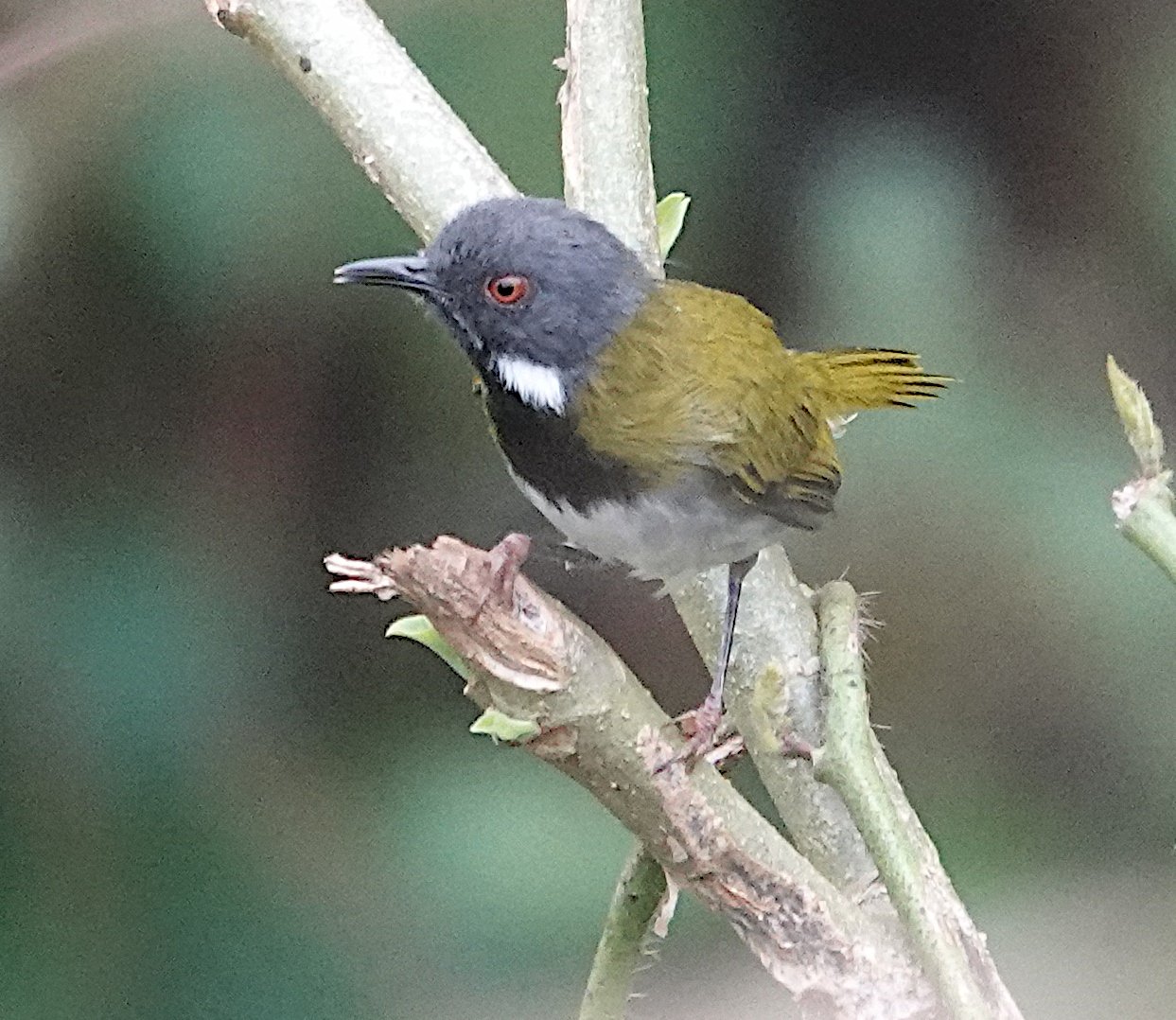
The Lowland Masked Apalis is a small, short-tailed apalis of the lowland rainforest of the Congo Basin, with a green back, grey crown and a black mask and black throat. The region lies at the far southern edge of its range: it is known only from northern Angola, and has been little observed even there.
Voice
A fast, high series of dry notes, tsip-tsip-tsip-tsip or chee-chee-chee, often as a duet in which the female answers with different, rattling notes. The sound usually comes from the middle or upper levels of the forest.
Recording: isaac kilusu — CC BY-NC-SA 4.0 · converted to mono · xeno-canto
Identification
10–11 cm, compact and short-tailed for an apalis. Crown grey, back, wings and tail green, without white outer tail feathers. Lores, cheeks and throat black, forming a dark mask; on each side of the throat, below the cheek, a white spot or stripe that bounds the black of the throat. Breast and belly dingy white to pale grey, the flanks washed yellowish or olive. The iris is pale brown to red, the bill black, the legs pink. The sexes differ little; the female has less intense black on the throat. Juveniles are greener and lack the sharp mask.
Confusion species
Black-Throated Apalis Apalis jacksoni has a similar black face with a white stripe, but is larger, longer-tailed with white outer tail feathers and bright yellow below, and lives in hill and montane forest. Buff-Throated Apalis Apalis rufogularis is dark grey to blackish above, without a black mask. Yellow-Breasted Apalis Apalis flavida has a white throat and a yellow breast band. Green Hylia Hylia prasina is green with a pale supercilium and no black throat. Short tail, black mask and throat, white neck spot and a pale, not yellow, belly point to Lowland Masked Apalis.
Habitat
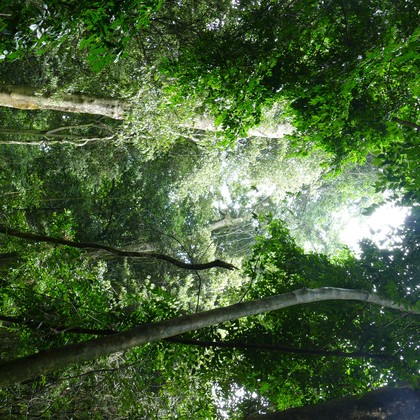
Moist lowland rainforest and its edges, gallery forest along rivers, tall secondary forest and clearings with creepers. It forages in pairs, often in mixed flocks, in the middle stratum and the canopy among leaves and tendrils.
Where the bird is most at home, classified by the vegetation units of southern Africa.

Range and movements
Within the region only in northern Angola, in the rainforest of Cabinda (Maiombe) and in gallery forests in the far north-east along the Congo border; its exact distribution in Angola is poorly known. Beyond the region from Cameroon and Gabon east through the Congo Basin to Uganda, Rwanda and extreme north-western Tanzania.
How and when to look
Year-round, but within the region a rarity that few birders see. The Maiombe forest in Cabinda offers the best chance. In mixed flocks look for a small, short-tailed apalis with a black throat, and record the sound: records from Angola are valuable and best well documented.
Conservation status
Not threatened; common in large parts of the Congo Basin. In Angola confined to a small area of rain and gallery forest that is under pressure from logging and agriculture.
Scientific name
Apalis binotata | Reichenow, 1895
Reichenow described the species in 1895 and placed it straight away in the genus where it still stands. The genus Apalis was introduced in 1833 by Swainson. Apalis comes from the Greek hapalos, 'delicate, gentle' — for these slender, finely built little warblers. binotata is Latin for 'two-spotted', probably for the white marks on either side of the black facial mask. The specimen the first description was based on came from Yaoundé, Cameroon.