All species › Passerines › Cisticolas › Yellow-Breasted Apalis
Yellow-Breasted Apalis | Apalis flavida
Geelborstapalis | Apalis Pechigualdo
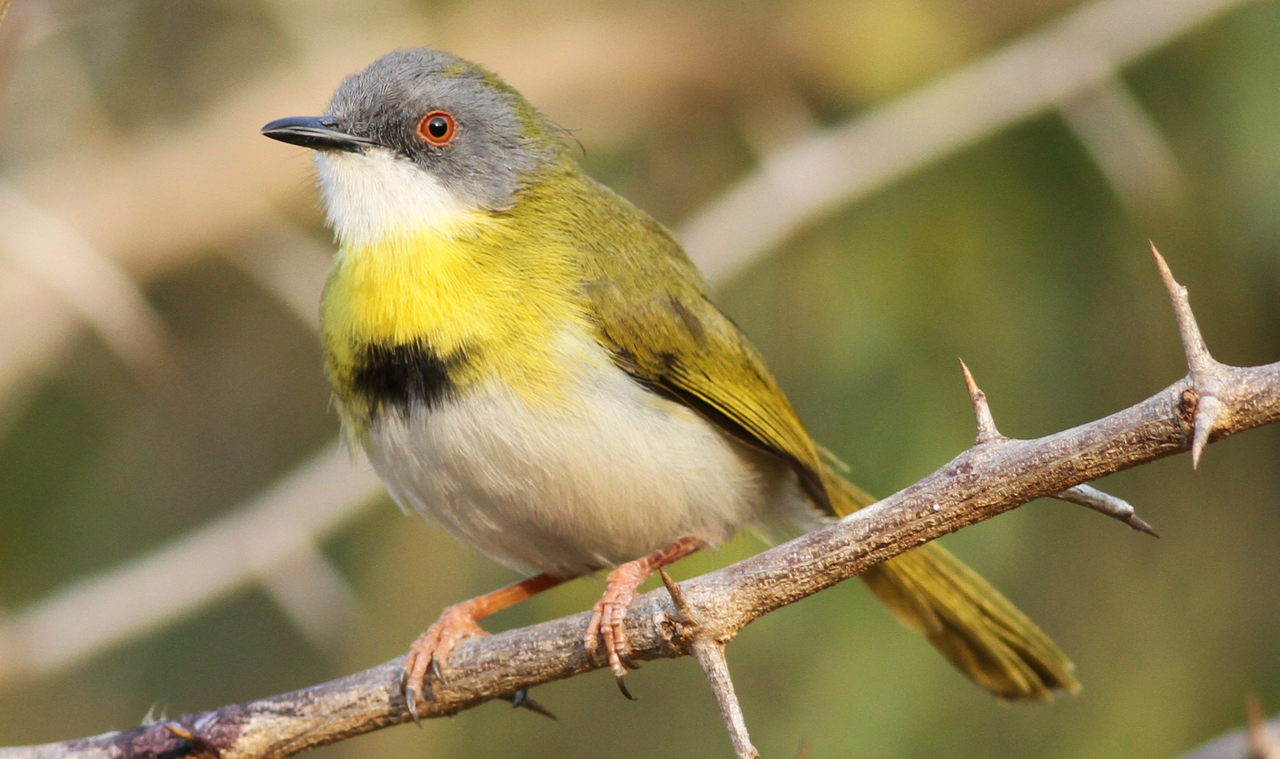
The Yellow-Breasted Apalis is a small, long-tailed warbler with a grey head, green back and a bright yellow band across the breast, which works through the canopy of woodland and riverine forest in pairs. It is the most widespread apalis in the region and often heard before it is seen: male and female sing a fast, buzzy duet.
Voice
The male sings a fast repeated, buzzy chizzik-chizzik-chizzik or krrrip-krrrip, into which the female inserts a higher, faster tee-tee-tee, producing one continuous duet. The alarm is a dry, rattling chrrr. It sings all year, most in the breeding season from September to January.
Recording: Paul Lenrumé — CC BY-NC-SA 4.0 · converted to mono · xeno-canto
Identification
11–12 cm, almost half of which is tail. Head and hindneck grey, the rest of the upperparts olive-green; the tail is green with yellowish to pale tips to the outer feathers. The throat is white, below it a broad bright yellow breast band, and the belly white with a grey wash on the flanks. The male has a small black spot in the centre of the yellow band, absent or tiny in the female. The iris is pale brown to orange, the bill black, the legs pink. Juveniles are duller, with a greener head and a vaguer breast band. The tail is often cocked and the bird moves quickly through the foliage.
Confusion species
Bar-Throated Apalis Apalis thoracica has a narrow black band across a white or yellowish breast instead of a yellow band, a pale iris and white outer tail feathers, and lives mainly in montane and coastal forest. Rudd's Apalis Apalis ruddi of Maputaland and southern Mozambique has a narrow black collar, a pale stripe in front of the eye and no yellow breast. Yellow-Bellied Eremomela Eremomela icteropygialis is yellow on the belly rather than the breast, short-tailed and has a dark eye-stripe. Short-tailed crombecs and camaropteras lack the grey, green and yellow combination altogether. The buzzy duet and the yellow band between white throat and white belly make Yellow-Breasted Apalis safe in the field.
Habitat
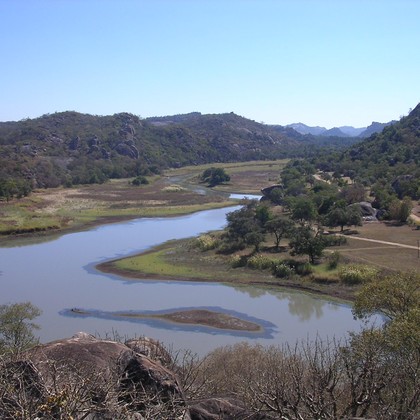
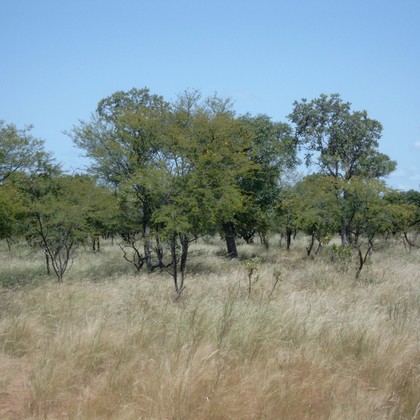
Leafy woodland, riverine forest, the edges of lowland forest, dense acacia and mixed savanna, and gardens and plantations with tall trees. It forages in pairs or small family groups in the middle and upper canopy for insects and larvae, often in mixed flocks with crombecs, eremomelas and tits.
Where the bird is most at home, classified by the vegetation units of southern Africa.

Range and movements
Widespread in the north and east of the region: in northern, western and central Angola, in almost all of Zambia, Malawi and Mozambique, in Zimbabwe (scarcer on the high central plateau), in northern Botswana (Okavango and Chobe) and the Zambezi Region of Namibia, and in eastern South Africa (Limpopo, the Mpumalanga lowveld and northern and eastern KwaZulu-Natal) and Eswatini. Beyond the region from Sierra Leone east through the savanna belt to Ethiopia and Somalia, and south through East Africa.
- Resident
- Summer visitor (c. Oct–Mar)
- Winter visitor (c. Apr–Sep)
- Passage (Mar–Apr, Oct–Nov)
- dark = core range, pale = thinly spread
How and when to look
Year-round; easy to find in the riverine forest of the Kruger Park, along the Zambezi and Chobe, and in the Eswatini lowveld. Listen for the buzzy duet high in a fever tree or acacia and wait until one of the pair comes to the edge of the canopy; the yellow breast band is the first thing seen from below. Pairs often respond inquisitively to pishing.
Conservation status
Not threatened. Common to fairly common over a large range and tolerant of moderate disturbance as long as trees with a closed crown remain. Declines locally where riverine forest is cleared.
Scientific name
Apalis flavida | (Strickland, 1853)
Strickland described the species in 1853 as Drymoeca flavida; because it was later moved to another genus, the author and year stand in brackets. The genus Apalis was introduced in 1833 by Swainson. Apalis comes from the Greek hapalos, 'delicate, gentle' — for these slender, finely built little warblers. flavida is Latin for 'yellowish', for the yellow breast. The specimen the first description was based on came from Damaraland, Namibia (possibly in fact Ngamiland, Botswana).