All species › Passerines › Cisticolas › Rudd's Apalis
Rudd's Apalis | Apalis ruddi
Rudds apalis | Apalis de Rudd
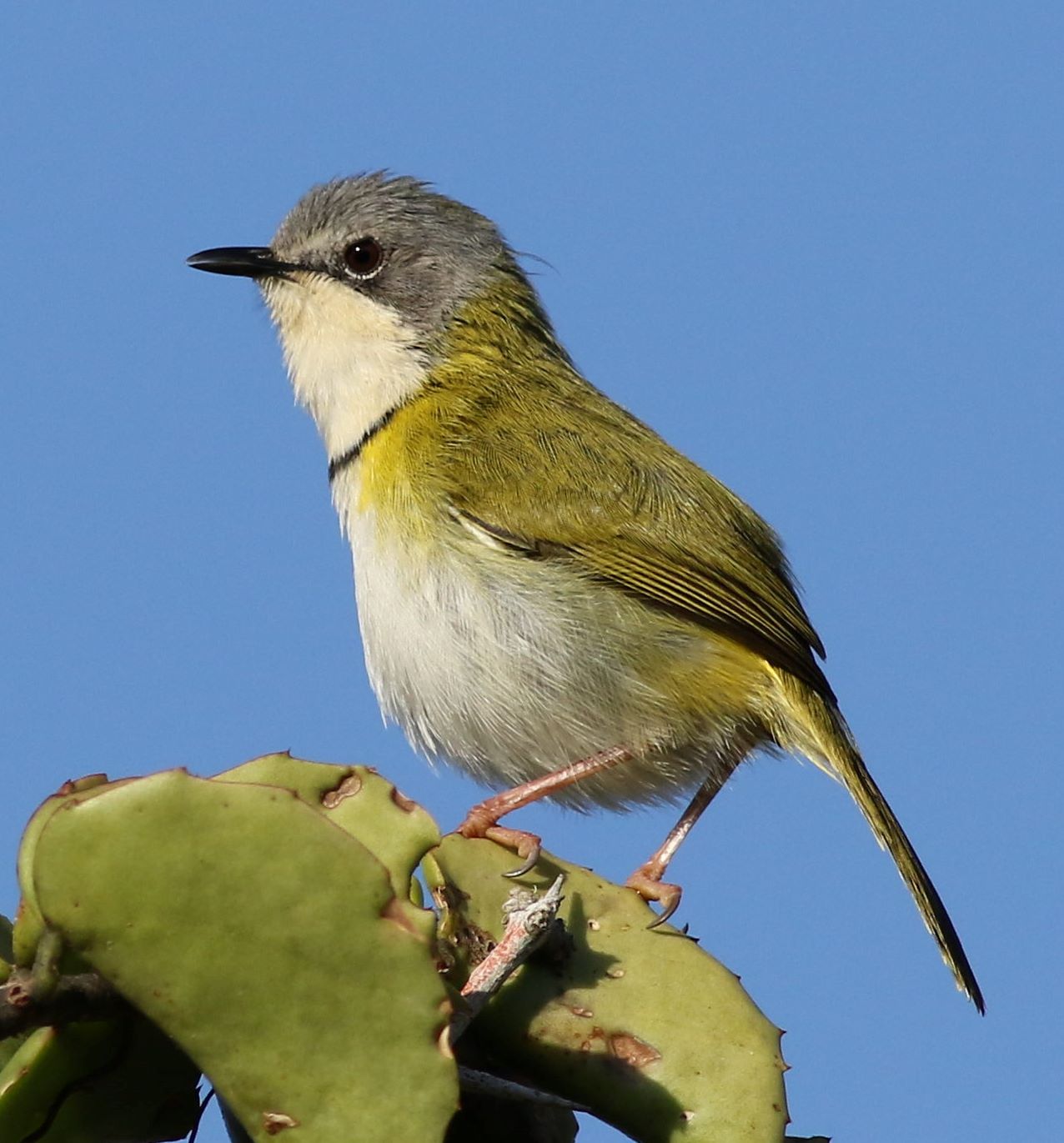
Rudd's Apalis is a small grey-green warbler with a narrow black collar, a white throat and a pale stripe in front of the eye, almost confined to the sand forest and thornveld thickets of the coastal plain of southern Mozambique and Maputaland. It is one of the signature birds of this centre of endemism and is often confused with Bar-Throated Apalis.
Voice
A loud duet: the male gives a fast, rattling prrrrup-prrrrup-prrrrup or chrrr-chrrr, the female answers with a higher, rapid tee-tee-tee-tee. The duet sounds drier and more rattling than that of Yellow-Breasted Apalis. The alarm is a sharp tsik.
Recording: Ehren Eksteen — CC BY-NC-SA 4.0 · converted to mono · xeno-canto
Identification
11–12 cm. Upperparts green, the crown and head greyish green; a narrow white to yellowish stripe runs from the bill base to above the eye. The throat is white, below it a narrow black collar, and breast and belly are off-white with a yellowish to pale yellow wash on the lower belly and flanks. The tail is green with white tips to the outer feathers. The iris is dark, the bill black, the legs pink. The female has a narrower, sometimes broken collar. Juveniles largely lack the band and are yellower below.
Confusion species
Bar-Throated Apalis Apalis thoracica is the main pitfall: it has a greyer head without a pale stripe in front of the eye, a pale yellow iris and more white in the outer tail, and lives mainly in montane and coastal forest inland and on the KwaZulu-Natal coast, barely in Maputaland sand forest. Yellow-Breasted Apalis Apalis flavida shares the range but has a yellow breast band without a black collar and a grey head. Brown-Headed Apalis Apalis alticola does not occur in the same area. The stripe in front of the eye, dark iris, green crown and the sand-forest habitat together settle it.
Habitat
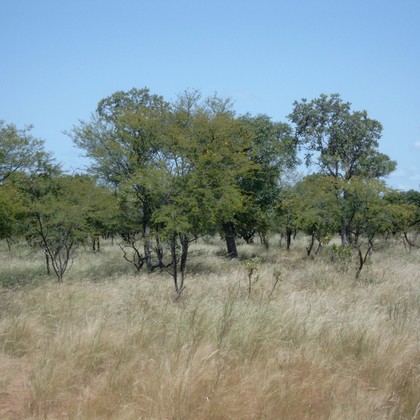
Sand forest, dense coastal forest and dry thicket on sandy soils, dense thorn and scrub vegetation on the coastal plain and along the Lebombo hills, locally also riverine forest and overgrown gardens. It forages in pairs in the middle layer of shrubs and low trees, often in mixed flocks.
Where the bird is most at home, classified by the vegetation units of southern Africa.

Range and movements
Within the region in southern Mozambique (from the coastal plain near Maputo north into Inhambane and the lower Save), in Maputaland in north-eastern KwaZulu-Natal (south to about Lake St Lucia), in eastern Eswatini along the Lebombo hills, and as a separate subspecies in the Zambezi lowlands of central Mozambique and the Lower Shire of southern Malawi. Not known beyond the region: virtually endemic to it.
- Resident
- Summer visitor (c. Oct–Mar)
- Winter visitor (c. Apr–Sep)
- Passage (Mar–Apr, Oct–Nov)
- dark = core range, pale = thinly spread
How and when to look
Year-round; the classic sites are the sand forest of Tembe and Ndumo, Hluhluwe-iMfolozi and Mkhuze in KwaZulu-Natal, and the Maputo Special Reserve in Mozambique. The rattling duet from dense thicket gives the birds away; they often sit lower than Yellow-Breasted Apalis, so the collar and pale eye-stripe can be seen side-on.
Conservation status
Not threatened, but with a small range. Fairly common in protected areas; outside reserves sand forest is lost to cutting for charcoal, agriculture and fires.
Scientific name
Apalis ruddi | Grant, 1908
Grant described the species in 1908 and placed it straight away in the genus where it still stands. The genus Apalis was introduced in 1833 by Swainson. Apalis comes from the Greek hapalos, 'delicate, gentle' — for these slender, finely built little warblers. ruddi honours the British businessman Charles Dunell Rudd (1844–1916), who funded Claude Grant's collecting expedition in southern Africa. The specimen the first description was based on came from Coguno, Inhambane, Mozambique.