All species › Passerines › Finches › Black-Throated Canary
Black-Throated Canary | Crithagra atrogularis
Zwartkeelkanarie | Serín Gorjinegro
The Black-Throated Canary is a small grey-brown canary of dry savanna and woodland, inconspicuous at rest but showing a vivid lemon-yellow rump when it flushes. Its song is rich and varied, which is why it is widely kept as a cagebird.

Voice
A long-sustained, rich and melodious song of rapid trills, whistles and imitations of other birds, often from a treetop. The call is a soft rising tswee or tsoo-weet.
Recording: Dawie de Swardt — CC BY-NC-SA 4.0 · shortened to the first 60 s, mono · xeno-canto
Identification
10–12 cm, small and slim with a short, pointed grey conical bill. Grey-brown above with dark streaks, the head greyer with a faint pale eyebrow. Chin and throat are speckled black; in older males this forms a fairly solid black throat patch, in females and young birds only a few spots. The underparts are dirty white to pale grey, finely streaked on the breast. The rump is bright lemon-yellow, the tail dark with white tips. The sexes are very similar.
Confusion species
Streaky-Headed Seedeater (Crithagra gularis) is larger and browner, with a broad white eyebrow and no yellow rump. Black-Eared Seedeater (Crithagra mennelli) of miombo has black ear coverts, a white eyebrow and a brown rump. The female Yellow Canary (Crithagra flaviventris) is larger and more heavily streaked, with a greenish-yellow rump and a yellowish wash below. Females of Yellow-Fronted Canary (Crithagra mozambica) and Lemon-Breasted Canary (Crithagra citrinipectus) have a yellower head with a clear eyebrow. White-Throated Canary (Crithagra albogularis) is larger, with a heavy bill and a white throat.
Habitat
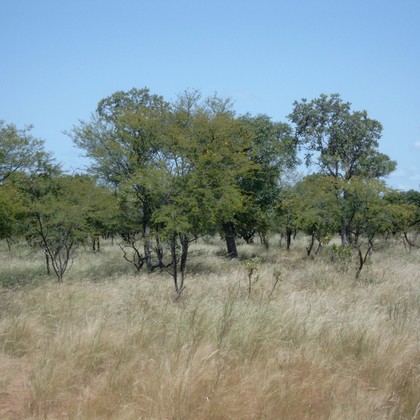
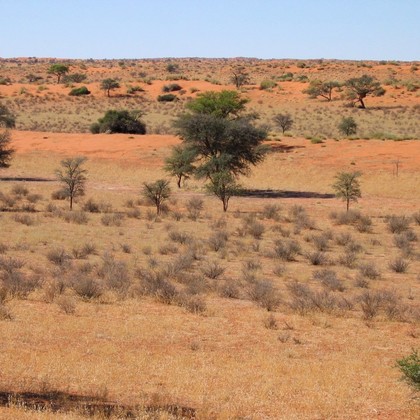
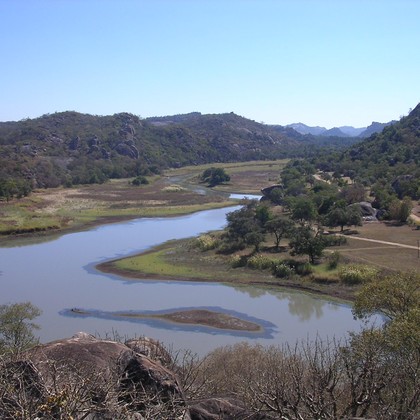
Dry acacia savanna, Kalahari thornveld, open mixed woodland and mopane, also farmyards, field margins, gardens and riverine growth in dry country. It feeds in pairs and small groups on the ground and in low shrubs on seeds, buds and flowers; it drinks regularly and is easily seen at water.
Where the bird is most at home, classified by the vegetation units of southern Africa.
Range and movements
In the region widespread in Namibia (except the Namib), Botswana, southern Angola, southern and western Zambia, western and southern Zimbabwe, south-western Mozambique and, in South Africa, in the Northern Cape, North West, Gauteng, Limpopo, Mpumalanga, the Free State and northern KwaZulu-Natal. Beyond the region to southern Congo; related forms in East Africa are now often treated as separate species.
- Resident
- Summer visitor (c. Oct–Mar)
- Winter visitor (c. Apr–Sep)
- Passage (Mar–Apr, Oct–Nov)
- dark = core range, pale = thinly spread
How and when to look
With every small grey bird that flushes from the ground, watch for the yellow rump: in this species it is the first and best feature. In the Kgalagadi, Etosha and Pilanesberg it often comes to waterholes. The rich song, with mimicked fragments of other birds, betrays it from afar in the breeding season.
Conservation status
Not threatened. Common across much of the dry interior; locally trapped for the cagebird trade, without demonstrable decline.
Scientific name
Crithagra atrogularis | (Smith, 1836)
Smith described the species in 1836 as Linaria atrogularis; because it was later moved to another genus, the author and year stand in brackets. The genus Crithagra was introduced in 1827 by Swainson. Crithagra comes from the Greek krithē, 'barley', and agra, 'hunting' — a 'barley hunter', for the seed-eating diet of these canaries and seedeaters. atrogularis comes from the Latin ater, 'black', and gula, 'throat' — for the black throat patch. The specimen the first description was based on came from Zeerust area, North West, South Africa.