All species › Passerines › Finches › Lemon-Breasted Canary
Lemon-Breasted Canary | Crithagra citrinipectus
Geelborstkanarie | Serín Pechilimón
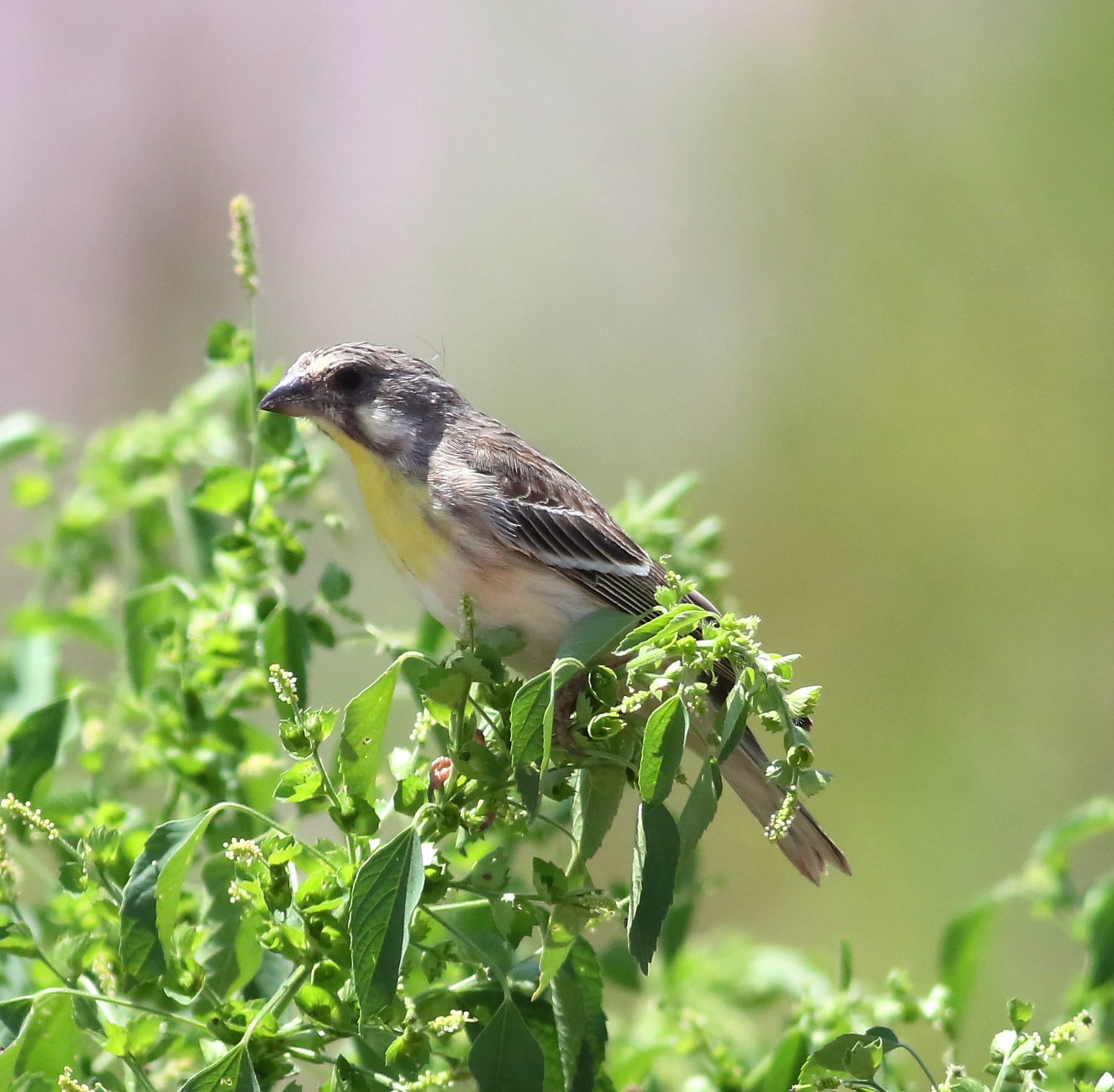
The Lemon-Breasted Canary is a small canary with a restricted range on the coastal plain of southern Mozambique and adjacent areas, strongly tied to savanna with lala palms. The male resembles a Yellow-Fronted Canary but has a lemon-yellow breast shield above a white belly.
Voice
A soft, fast, varied song of trills and whistles, like that of Yellow-Fronted Canary but thinner and less forceful. The call is a soft chee or tsweee.
No recording with a suitable Creative Commons licence is available for this species yet.
Identification
10–11 cm, the smallest canary in the region, with a short grey conical bill. The male has a grey-brown, finely streaked crown and back, a yellow eyebrow, dark eye and malar stripes and a blackish chin. Throat and breast are bright lemon-yellow and contrast sharply with the white belly and pale brown flanks. The rump is bright yellow, the tail dark with white tips. The female is duller, with a pale brown breast and a white belly; yellow is limited to a weakly marked eyebrow and the rump. Juveniles are finely streaked on the breast.
Confusion species
Yellow-Fronted Canary (Crithagra mozambica), with which it often feeds, is larger and wholly yellow below, without a white belly or brown flanks; its female has a yellow belly. Black-Throated Canary (Crithagra atrogularis) is greyer, without a yellow eyebrow and with a black-speckled throat. The female Lemon-Breasted Canary is the most similar to these species: note the white belly, the buffy breast, the small size and the company of a male.
Habitat
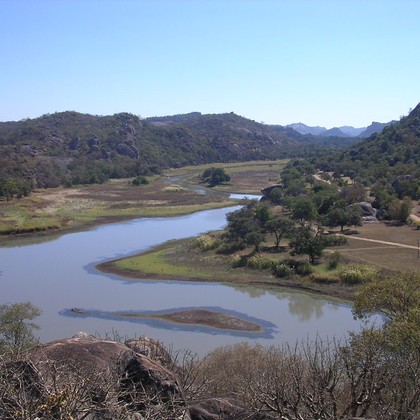
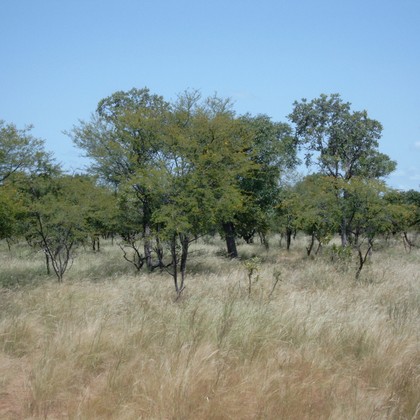
Savanna and grassland with lala palms (Hyphaene coriacea) on sandy soils, often on the coastal plain, and adjacent open woodland, field margins and abandoned gardens. It nests among the palm fronds and uses palm fibres for the nest. It feeds mainly on the ground and in low herbage on seeds, often in mixed flocks with Yellow-Fronted Canaries.
Where the bird is most at home, classified by the vegetation units of southern Africa.
Range and movements
Almost confined to the region: mainly in southern Mozambique (Maputo, Gaza and Inhambane provinces and further north along the coast), in southern Malawi, in south-eastern Zimbabwe and, in South Africa, in northern Zululand (Maputaland, from about St Lucia northwards) and marginally in the north-east of the Kruger National Park. Not known outside the region.
- Resident
- Summer visitor (c. Oct–Mar)
- Passage (Mar–Apr, Oct–Nov)
- dark = core range, pale = thinly spread
How and when to look
Search in Maputaland, for example around Tembe, Ndumo and the Muzi Pans, in palm savanna where lala palms dominate, and check every flock of Yellow-Fronted Canaries for birds with a white belly. It is most often recorded in the breeding season (December–February), when males sing from the palm fronds.
Conservation status
Not threatened on the global assessment, but Near Threatened on South Africa's national red list: its small range is shrinking through the harvesting of lala palms for palm wine and the conversion of palm savanna to fields and timber and sugar plantations. Trapping for the cagebird trade also plays a role.
Scientific name
Crithagra citrinipectus | (Clancey & Lawson, 1960)
Clancey & Lawson described the species in 1960 as Serinus citrinipectus; because it was later moved to another genus, the author and year stand in brackets. The genus Crithagra was introduced in 1827 by Swainson. Crithagra comes from the Greek krithē, 'barley', and agra, 'hunting' — a 'barley hunter', for the seed-eating diet of these canaries and seedeaters. citrinipectus comes from the Latin citrinus, 'lemon-yellow', and pectus, 'breast' — for the male's yellow breast. The specimen the first description was based on came from near Panda, Inhambane, Mozambique.