All species › Waders, gulls and terns › Plovers and lapwings › Black-Winged Lapwing
Black-Winged Lapwing | Vanellus melanopterus
Zwartvleugelkievit | Avefría Lugubroide
The Black-Winged Lapwing is a lapwing of the cool, high grassland of eastern South Africa and Eswatini. Only the southern subspecies minor occurs in the region; the nominate form lives more than three thousand kilometres further north in the highlands of Ethiopia and Kenya.
Voice
A high, double chee-rook and a piercing tee-yoo tee-yoo, mainly in flight; when disturbed, a rapid series of high notes. Also calls at night while on the move.
Recording: Tim Cockcroft — CC BY-NC-SA 4.0 · converted to mono · xeno-canto
Identification
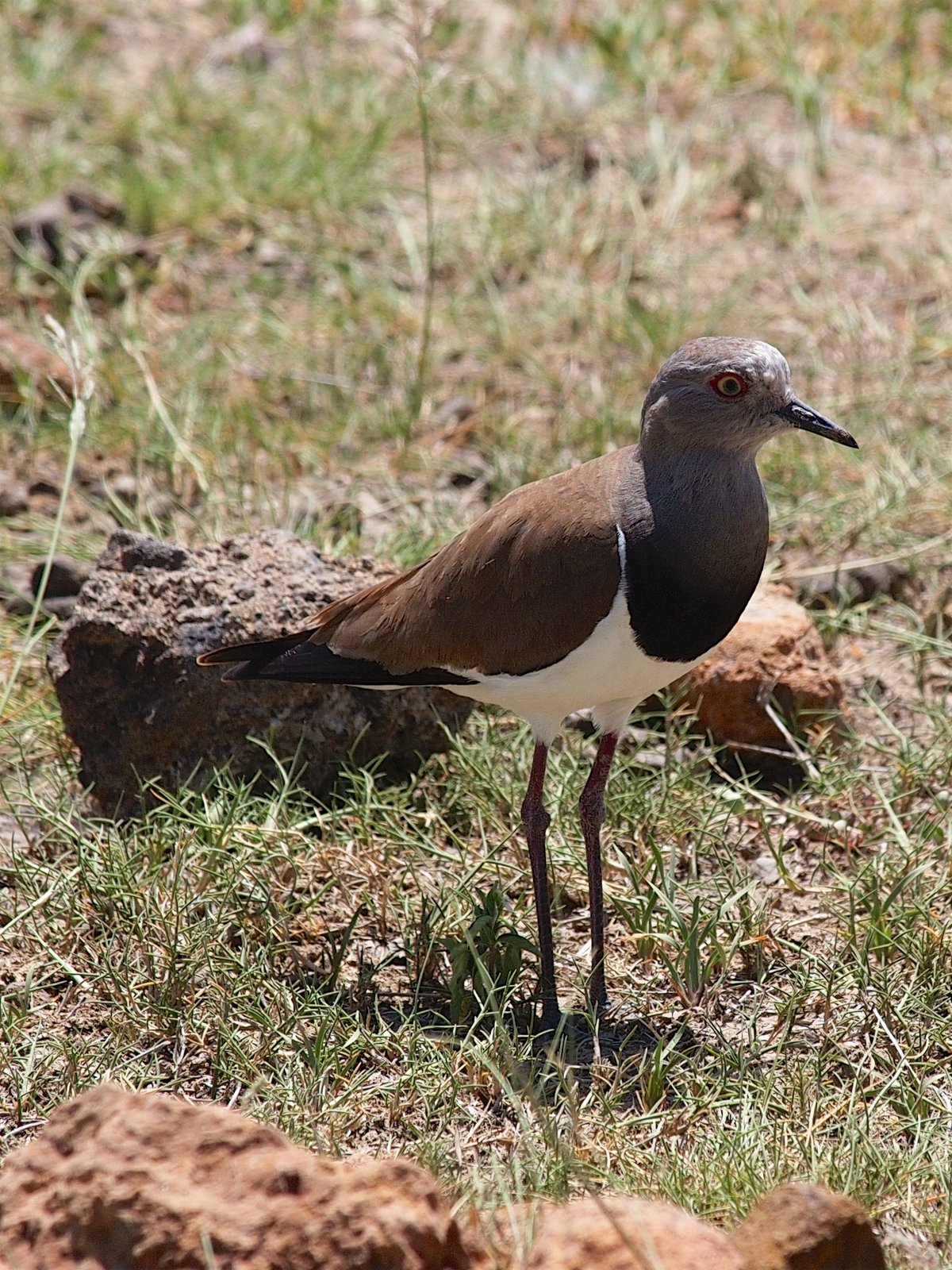
26–27 cm. Head and neck are grey with a large white forehead patch reaching above the eye. Below the grey breast lies a broad black band, and the belly is white. The back is grey-brown. The bill is black, the eye yellow with a red eye-ring, and the legs dull red. In flight the wing shows a white diagonal band across the coverts, black secondaries and primaries, and a white tail with a broad black terminal band. The sexes are alike; juveniles are browner with pale fringes and a narrower, brownish breast band.
Confusion species
Senegal Lapwing Vanellus lugubris is smaller and slimmer, with a smaller white forehead patch, a narrow black breast band and dark legs; in flight it has white secondaries and no white band across the coverts. Crowned Lapwing Vanellus coronatus is larger and sandy brown, with a black cap ringed in white and a red bill base, and often occurs in the same grassland.
Habitat
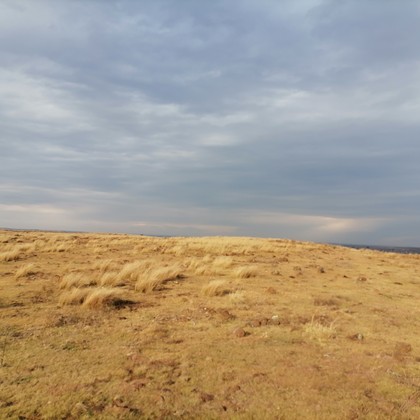
Short, natural grassland in hilly country and on high plateaus, often on freshly burnt slopes, and also closely grazed pasture and sports fields. It avoids tall grass. In winter also in lower-lying grassland and open areas close to the coast.
Where the bird is most at home, classified by the vegetation units of southern Africa.

Range and movements
In the region confined to eastern South Africa and Eswatini: the eastern highveld of Mpumalanga, the midlands and Drakensberg foothills of KwaZulu-Natal and the north-east of the Eastern Cape, with a winter shift to the coastal plain of KwaZulu-Natal and the far south of Mozambique. A vagrant to Zimbabwe. The nominate form lives in Ethiopia, Kenya and northern Tanzania.
- Resident
- Summer visitor (c. Oct–Mar)
- Passage (Mar–Apr, Oct–Nov)
- dark = core range, pale = thinly spread
How and when to look
In the breeding season, August to November, drive the back roads of the KwaZulu-Natal midlands or around Wakkerstroom and watch freshly burnt slopes. In flight the white diagonal wing band is the best feature.
Conservation status
Not threatened, but with a limited range in southern Africa. Conversion of grassland to timber plantations and crops, and the loss of regular grass fires, reduce its breeding area.
Scientific name
Vanellus melanopterus | (Cretzschmar, 1829)
Cretzschmar described the species in 1829 as Charadrius melanopterus; because it was later moved to another genus, the author and year stand in brackets. The genus Vanellus was introduced in 1760 by Brisson. Vanellus is the diminutive of the Latin vannus, 'winnowing fan' — for the sound and shape of the broad, rounded wings in flight, which recall a fan being winnowed. melanopterus comes from the Greek melas, 'black', and pteron, 'wing' — for the broad black band across the wing, conspicuous in flight. The specimen the first description was based on came from Jeddah, Saudi Arabia.