All species › Waders, gulls and terns › Pratincoles and coursers › Black-Winged Pratincole
Black-Winged Pratincole | Glareola nordmanni
Steppevorkstaartplevier | Canastera Alinegra
The Black-Winged Pratincole breeds on the steppes of eastern Europe and central Asia and winters almost entirely in southern Africa, where it roams grasslands in large wandering flocks. It is one of the most unpredictable migrants in the region: flocks of thousands can appear suddenly after rain and vanish just as quickly.

Voice
A sharp, chirping kik or kitti-kit, slightly lower and less rolling than that of Collared Pratincole; flocks call busily in flight.
Recording: Daniel Danckwerts — CC BY-NC-SA 4.0 · converted to mono · xeno-canto
Identification
24–28 cm. Very like Collared Pratincole, but darker olive-brown above, with little contrast between coverts and flight feathers. The underwing coverts are wholly black and the secondaries lack a white trailing edge. The tail is less deeply forked and does not reach the wingtip on a perched bird; the legs are slightly longer and the red bill base is smaller. The throat is cream with a narrow black outline, faint and broken in non-breeding plumage. The belly and rump are white.
Confusion species
Collared Pratincole Glareola pratincola has rufous underwing coverts (also dark against the light), a narrow white trailing edge to the secondaries, paler upperparts with contrasting dark primaries and a tail reaching to or beyond the wingtip. Rock Pratincole Glareola nuchalis is much smaller and darker, with a white nape stripe and red legs.
Habitat
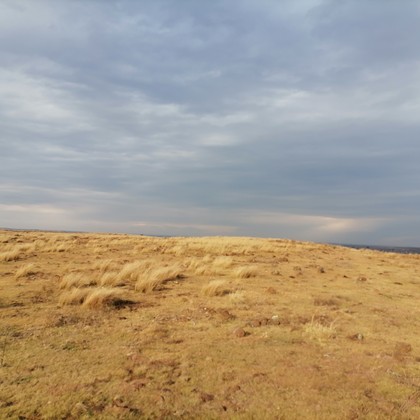
Open grassland, freshly burnt or rain-soaked fields, cultivated land and the edges of pans and vleis. It hawks locusts, termites and other insects in the air like a swallow, often high up and in large flocks, and also feeds on foot. It rests in dense groups on bare ground.
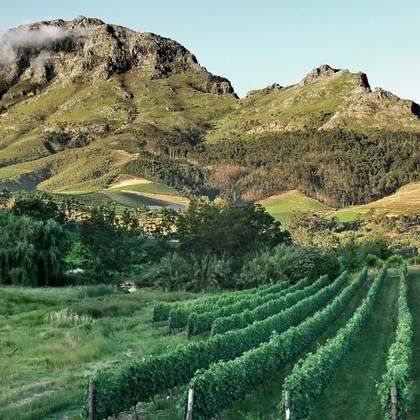
Where the bird is most at home, classified by the vegetation units of southern Africa.

Range and movements
Mainly in the central part of the region: Botswana (including around the Makgadikgadi Pans and in the north), north-eastern Namibia, the Free State and North West in South Africa, and Zambia; scarcer and irregular in Zimbabwe, Angola and the rest of South Africa. It breeds from Romania and Ukraine to Kazakhstan and south-western Siberia and migrates through East Africa.
- Summer visitor (c. Oct–Mar)
- Passage (Mar–Apr, Oct–Nov)
- dark = core range, pale = thinly spread
How and when to look
Flocks often appear after heavy downpours between December and February, when termites and locusts emerge. In flight look for the wholly black underwing and the absence of a white trailing edge: the rufous underwing of Collared Pratincole also looks black against the light, so the trailing edge and, on perched birds, tail length are the best features.
Conservation status
Near Threatened. The breeding population has declined sharply through conversion of steppe to cropland, changes in grazing and the use of pesticides; in the wintering areas loss of grassland and spraying of locust swarms also play a part.
Scientific name
Glareola nordmanni | Fischer von Waldheim, 1842
Fischer von Waldheim described the species in 1842 and placed it straight away in the genus where it still stands. The genus Glareola was introduced in 1760 by Brisson. Glareola is a Latin diminutive of glarea 'gravel', after the bare gravelly ground where pratincoles nest. nordmanni honours the Finnish-born zoologist and explorer Alexander von Nordmann (1803–1866). The specimen the first description was based on came from the steppes of southern Russia.