All species › Waders, gulls and terns › Pratincoles and coursers › Collared Pratincole
Collared Pratincole | Glareola pratincola
Vorkstaartplevier | Canastera Común
The Collared Pratincole is a swallow-like wader of drying floodplains, pans and riverbanks, which breeds locally in colonies within the region. At dusk it hawks flying insects in loose flocks, with its deeply forked tail and long, pointed wings.

Voice
A sharp, tern-like kirrik or kik-kirrik-ik, often in chorus from hunting flocks; at the colony a rolling alarm when disturbed.
Recording: David Darrell-Lambert — CC BY-NC-SA 4.0 · converted to mono · xeno-canto
Identification
24–28 cm. The upperparts are sandy olive-brown, with slightly darker primaries. The throat is cream, outlined by a narrow black line running from the eye to the breast; in non-breeding plumage and in juveniles this line is faint. The breast is warm brownish, the belly and rump white. The bill is short and black with a conspicuous red base; the legs are short and blackish. In flight it shows rufous underwing coverts, which often look dark, and a narrow white trailing edge to the secondaries. The deeply forked black-and-white tail reaches to or beyond the wingtip on a perched bird. Juveniles are scaly with pale feather edges.
Confusion species
Black-Winged Pratincole Glareola nordmanni is darker above, with a wholly black underwing lacking a white trailing edge, a shorter tail that falls short of the wingtip and less red on the bill. Rock Pratincole Glareola nuchalis is smaller and dark grey-brown, with a white nape stripe, coral-red legs and a short tail, and sits on rocks in flowing water.
Habitat
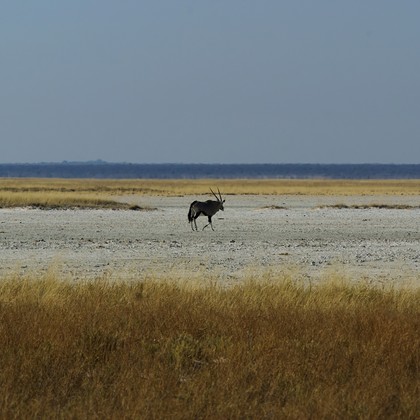
Drying floodplains, lake and pan margins, banks with short grass or bare mud, and sandbanks in rivers. It hawks insects in the air, especially at dusk, but also takes prey on the ground. It breeds in loose colonies; the eggs lie in a scrape on bare or dried mud, and the parents lure intruders away with distraction displays.
Where the bird is most at home, classified by the vegetation units of southern Africa.

Range and movements
Local in the north and east of the region: Angola, Zambia (including the Kafue Flats, Bangweulu and the Barotse Plain), Malawi, Mozambique, Zimbabwe, northern Botswana (Okavango, Chobe, Makgadikgadi), the Caprivi in Namibia, and in South Africa mainly north-eastern KwaZulu-Natal (including iSimangaliso and the Pongola floodplain); rare elsewhere. Beyond the region from southern Europe and North Africa to central Asia, and across much of sub-Saharan Africa.
- Resident
- Summer visitor (c. Oct–Mar)
- Winter visitor (c. Apr–Sep)
- Passage (Mar–Apr, Oct–Nov)
- dark = core range, pale = thinly spread
How and when to look
In the dry season visit large floodplains such as the Kafue Flats or the pans of the Okavango region, where breeding colonies lie on bare mud. Dusk is the best time, when flocks hunt low over the water. On flying birds check for the white trailing edge to the wing to rule out Black-Winged Pratincole.
Conservation status
Not threatened, although it is declining in parts of its range. In southern Africa it depends on seasonal floodplains; dams and changes to water regimes disrupt breeding sites, and in South Africa the species is on the regional Red List.
Scientific name
Glareola pratincola | (Linnaeus, 1766)
Linnaeus described the species in 1766 as Hirundo Pratincola; because it was later moved to another genus, the author and year stand in brackets. The genus Glareola was introduced in 1760 by Brisson. Glareola is a Latin diminutive of glarea 'gravel', after the bare gravelly ground where pratincoles nest. pratincola means 'meadow-dweller', from Latin pratum 'meadow' and incola 'inhabitant'. The specimen the first description was based on came from Austria.