All species › Passerines › Weavers › Black-Winged Red Bishop
Black-Winged Red Bishop | Euplectes hordeaceus
Roodvoorhoofdwever | Obispo Alinegro
The Black-Winged Red Bishop is the northern counterpart of the Southern Red Bishop: a fiery red bishop with a red crown and, unlike that species, wholly black wings and tail. It lives in rank tall grass near fields and damp hollows in the north and east of the region.

Voice
A fast, sizzling and grating song of buzzing notes, zizizi-chrrr-zizizi, given from a grass stem with the red feathers puffed out. The call is a dry chip. In display flight the male buzzes low over the grass with the back feathers fluffed.
Recording: Magnus Wadstein — CC BY-NC-SA 4.0 · converted to mono · xeno-canto
Identification
13–15 cm; the tail is short and barely elongated even in the breeding male. The breeding male is scarlet on crown, nape, back and breast, with a black mask over lores, cheeks and throat that leaves forehead and crown red, a black belly, and black flight feathers and tail without buff edges. The long pale undertail coverts reach almost to the tail tip. The bill is black. The female is tawny with heavy dark streaking above, a pale supercilium and a finely streaked, yellowish breast. The non-breeding male resembles the female but keeps the black wings and tail, the best feature in any plumage.
Confusion species
Southern Red Bishop (Euplectes orix) has a black forecrown and black face, brown wings with pale edges and short undertail coverts; it is more tied to reeds. Zanzibar Red Bishop (Euplectes nigroventris) of coastal Mozambique is smaller and has a red head without a black mask. Red-Headed Quelea (Quelea erythrops) is smaller, with a red head but a brown, streaked back. Females are separable almost only by the blackish wing and tail feathers of this species.
Habitat
Tall rank grass and scrub at the edges of fields, dambos and vleis, riverside tangles, overgrown gardens and sugarcane and sorghum fields, often drier than the sites of Southern Red Bishop. It breeds polygynously; the male defends a territory with several nests in tall grass or low bushes. It eats mainly grass seeds, and insects for the young.
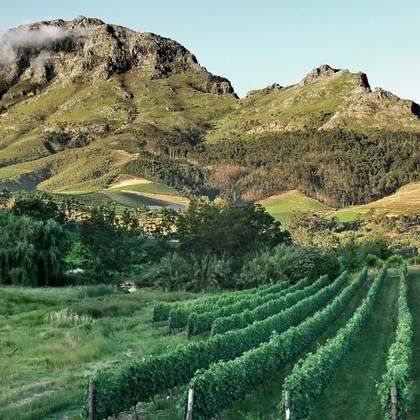
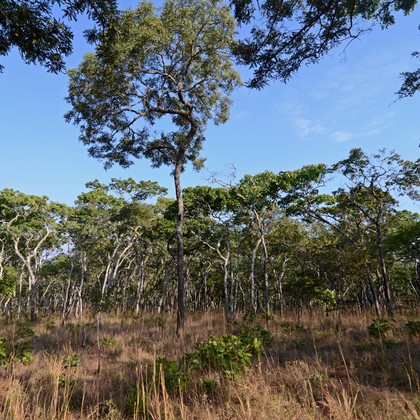
Where the bird is most at home, classified by the vegetation units of southern Africa.

Range and movements
Within the region it occurs in northern and central Angola, almost all of Zambia, Malawi, northern and central Mozambique and northern and eastern Zimbabwe; it is absent from Botswana, Namibia and South Africa apart from vagrants at most. Beyond the region it ranges from Senegal to Ethiopia and south through East Africa.
- Resident
- Summer visitor (c. Oct–Mar)
- Winter visitor (c. Apr–Sep)
- Passage (Mar–Apr, Oct–Nov)
- dark = core range, pale = thinly spread
How and when to look
Best from January to April, when males sing from tall stems over sorghum or overgrown grass. With any red bishop in the north of the region, always check crown and wings: red crown plus black wings means this species. In mixed flocks outside the breeding season the black wing still helps with males.
Conservation status
Not threatened; common in rank grassland and farmland. It benefits locally from fallow land and grain growing, and may be regarded as a pest in ripening sorghum.
Scientific name
Euplectes hordeaceus | (Linnaeus, 1758)
Linnaeus described the species in 1758 as Loxia hordeacea; because it was later moved to another genus, the author and year stand in brackets. The genus Euplectes was introduced in 1829 by Swainson. Euplectes joins Greek eu 'fine, good' to New Latin plectes 'weaver'. hordeaceus is Latin for 'of barley', from hordeum, 'barley' — for a bird of grain fields. The specimen the first description was based on came from Senegal (originally given in error as 'the Indies').