All species › Passerines › Sunbirds › Bocage's Sunbird
Bocage's Sunbird | Nectarinia bocagii
Bocages honingzuiger | Suimanga de Bocage
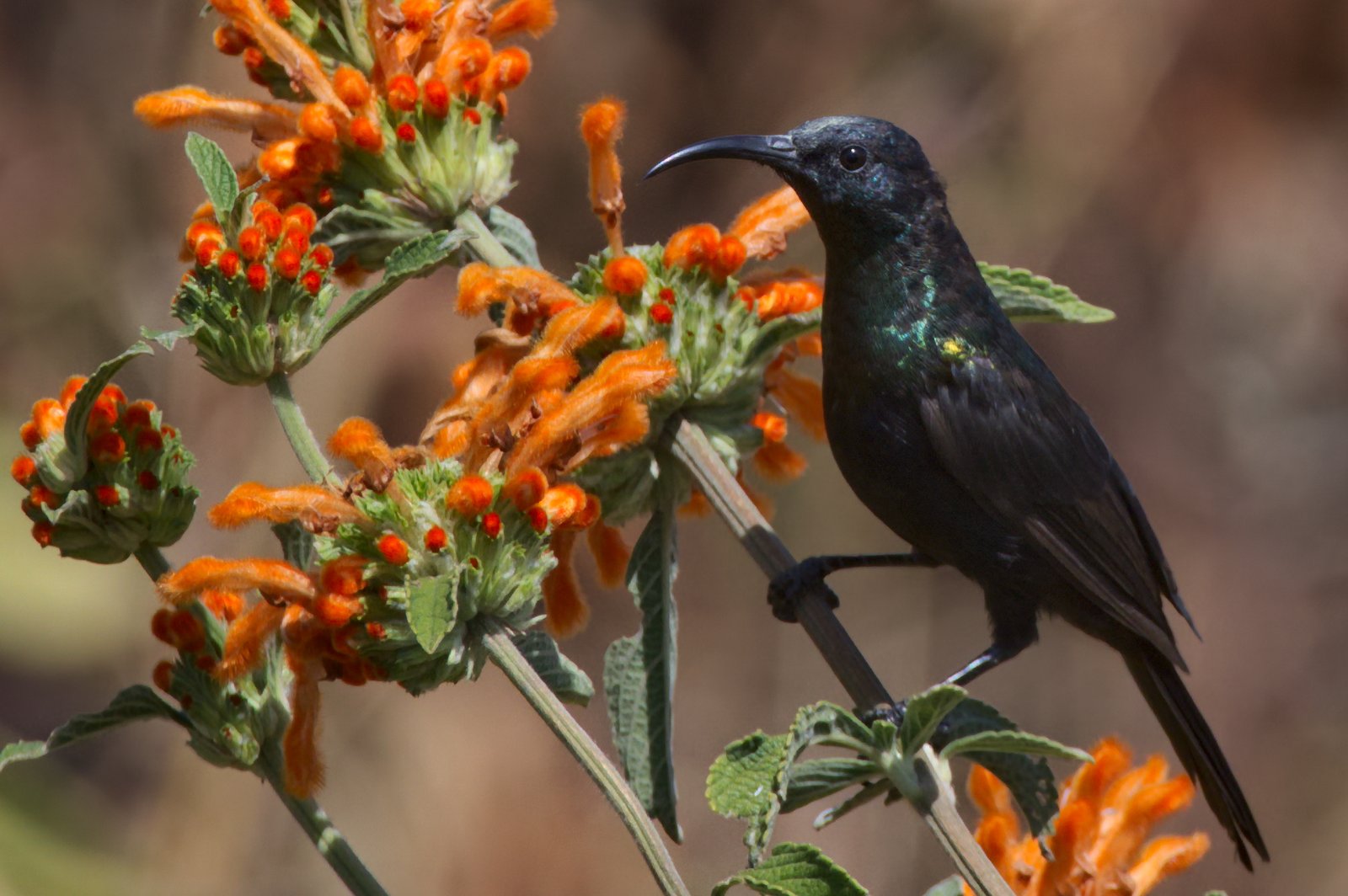
Bocage's Sunbird is a little-known near-endemic sunbird of the Angolan plateau. The male is a dark, violet-blue glossed bird with elongated central tail feathers; it lives in grassland with proteas and scattered shrubs.
Voice
Poorly described. The call is a sharp metallic tchik; the song is a fast, high twitter of chirping notes, as in related long-tailed sunbirds.
Recording: Wayne Paes — CC BY-NC-SA 4.0 · converted to mono · xeno-canto
Identification
The male measures 17 to 19 cm including the elongated central tail feathers, the female about 14 cm. The male has the head, back and breast glossed dark violet-blue to purple, with black wings, belly and tail; there are no pectoral tufts. The female is olive-brown above and dingy yellow below with dark streaking on the throat and breast, and has a short dark tail. The bill is long and strongly decurved. Outside the breeding season the male can be duller.
Confusion species
Bronze Sunbird (Nectarinia kilimensis), which occurs in the highlands of western Angola, has a bronze-green rather than violet-blue gloss; its female closely resembles that of this species, so a female can only be named with confidence in the company of a male. Amethyst Sunbird (Chalcomitra amethystina) has a short tail, a green crown and a purple throat patch on a velvet-black body. Malachite Sunbird (Nectarinia famosa) does not occur in Angola.
Habitat
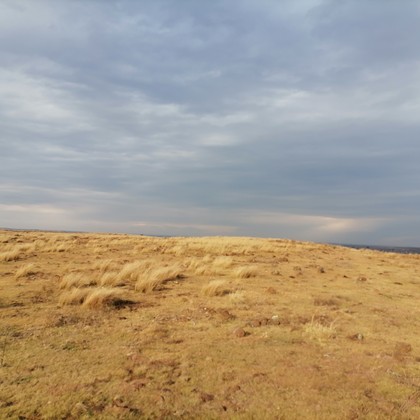
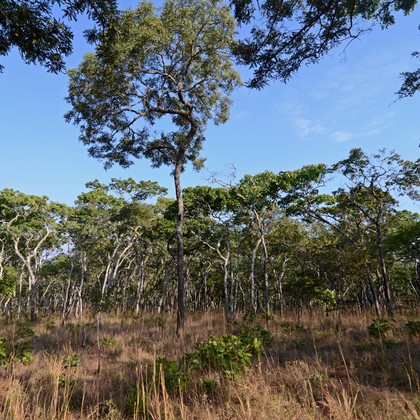
Open and moist grassland on the plateau, often with scattered proteas and shrubs, grassy margins of miombo and moist grassy depressions (dambos), roughly between 1,200 and 1,800 m. It feeds at flowering proteas and other shrubs.
Where the bird is most at home, classified by the vegetation units of southern Africa.
Range and movements
Within the region only in Angola, on the central plateau (the Bié Plateau) and in the grasslands of the east and north-east of the country. Beyond the region only in southern DR Congo. There are no confirmed records from Zambia.
- Resident
- dark = core range, pale = thinly spread
How and when to look
Search open protea grassland on the plateau around Huambo and Bié, especially where proteas are in flower. The male often perches on a protea or a tall grass stem; against the light it looks black, so wait until the sun is full on it to see the violet gloss and long tail.
Conservation status
Not threatened, but little known and seldom seen. Its habitat on the Angolan plateau is under pressure from conversion of grassland to cropland, woodcutting and overly frequent burning.
Scientific name
Nectarinia bocagii | Shelley, 1879
Shelley described the species in 1879 and placed it straight away in the genus where it still stands. The genus Nectarinia was introduced in 1811 by Illiger. Nectarinia derives from the Greek nektar, the drink of the gods in Greek mythology, via nektarinos, 'of nectar' — for the flower nectar on which sunbirds feed. bocagii honours the Portuguese zoologist José Vicente Barbosa du Bocage (1823–1907), director of the Lisbon museum and an authority on the birds of Angola. The specimen the first description was based on came from Caconda, Huíla, Angola.