All species › Swifts › Swifts › Böhm's Spinetail
Böhm's Spinetail | Neafrapus boehmi
Böhms gierzwaluw | Vencejo de Böhm
Böhm's Spinetail is the smallest swift in the region and in the air looks more like a bat than a bird: a tiny, almost tailless body on broad, fluttering wings. It is tied to hot lowland woodland with baobabs, in which it also breeds.

Voice
Usually silent. In flight a soft, high twitter, tsi-tsi-tsi-tsuu, the last note lower, sometimes in short series when two birds chase each other.
Recording: Ken Behrens — CC BY-NC-SA 4.0 · converted to mono · xeno-canto
Identification
About 9 cm. Upperparts blackish brown with a broad white rump; throat and breast grey-brown, grading into a white belly, so that the bird looks strikingly pale from below. The tail is extremely short and enclosed by the long undertail coverts; the protruding shaft spines are visible only at close range. The wings are broad in the hand, narrow at the base and strongly pinched behind the carpal joint, giving a paddle shape. Flight is fluttering and erratic, with rapid swerves and short glides, often low over treetops and clearings. The sexes are alike.
Confusion species
Mottled Spinetail (Telacanthura ussheri) is larger and darker, with a mottled grey throat, a dark belly with only a narrow white band just in front of the vent, and a less obvious rump. Small swallows have longer tails and more direct flight. The combination of virtually no tail, white rump and white belly is diagnostic.
Habitat
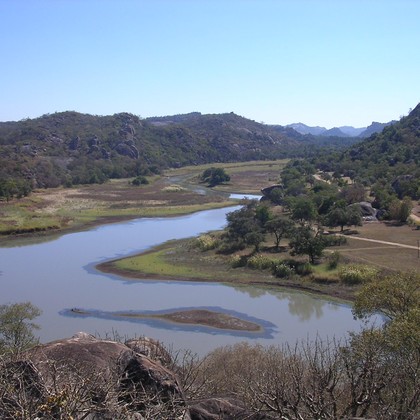
Hot, dry lowland woodland with baobabs, especially in river valleys, and the edges of riverine forest and mopane woodland. It hunts small flying insects, often at treetop height and over clearings. It breeds in hollow baobabs, disused wells and mine shafts, where the small cup of plant material is glued to the wall with saliva.
Where the bird is most at home, classified by the vegetation units of southern Africa.


Range and movements
The north-east of the region: lowland Mozambique, the Zambezi Valley and south-eastern lowveld of Zimbabwe, southern Malawi, eastern Zambia (Luangwa Valley) and the extreme north-east of South Africa (the Pafuri area of the Kruger Park), plus a separate population in western and north-western Angola. Beyond the region from Tanzania to the Kenya coast and in southern DR Congo.
- Resident
- Summer visitor (c. Oct–Mar)
- Winter visitor (c. Apr–Sep)
- Passage (Mar–Apr, Oct–Nov)
- dark = core range, pale = thinly spread
How and when to look
Search around large baobabs in the late-afternoon light, when small groups hunt low over the treetops. Flight gives the species away faster than plumage: look for a small fluttering, tailless silhouette recalling a bat or a large butterfly. In the Kruger Park, Pafuri is the best-known site.
Conservation status
Not threatened, but local and scarce in the region, especially at the southern edge around Pafuri. Loss of old baobabs and other open lowland woodland through clearing and elephant damage can remove breeding sites.
Scientific name
Neafrapus boehmi | (Schalow, 1882)
Schalow described the species in 1882 as Chaetura Böhmi; because it was later moved to another genus, the author and year stand in brackets. The genus Neafrapus was introduced in 1918 by Mathews. Neafrapus combines Greek neos, 'new', Latin Afra, 'African', and the swift genus Apus: 'a new African swift'. boehmi honours the German zoologist and explorer Richard Böhm (1854–1884), who collected in East Africa. The specimen the first description was based on came from Kakoma, Tanzania.