All species › Swifts › Swifts › Scarce Swift
Scarce Swift | Schoutedenapus myoptilus
Shoagierzwaluw | Vencejo de Shoa
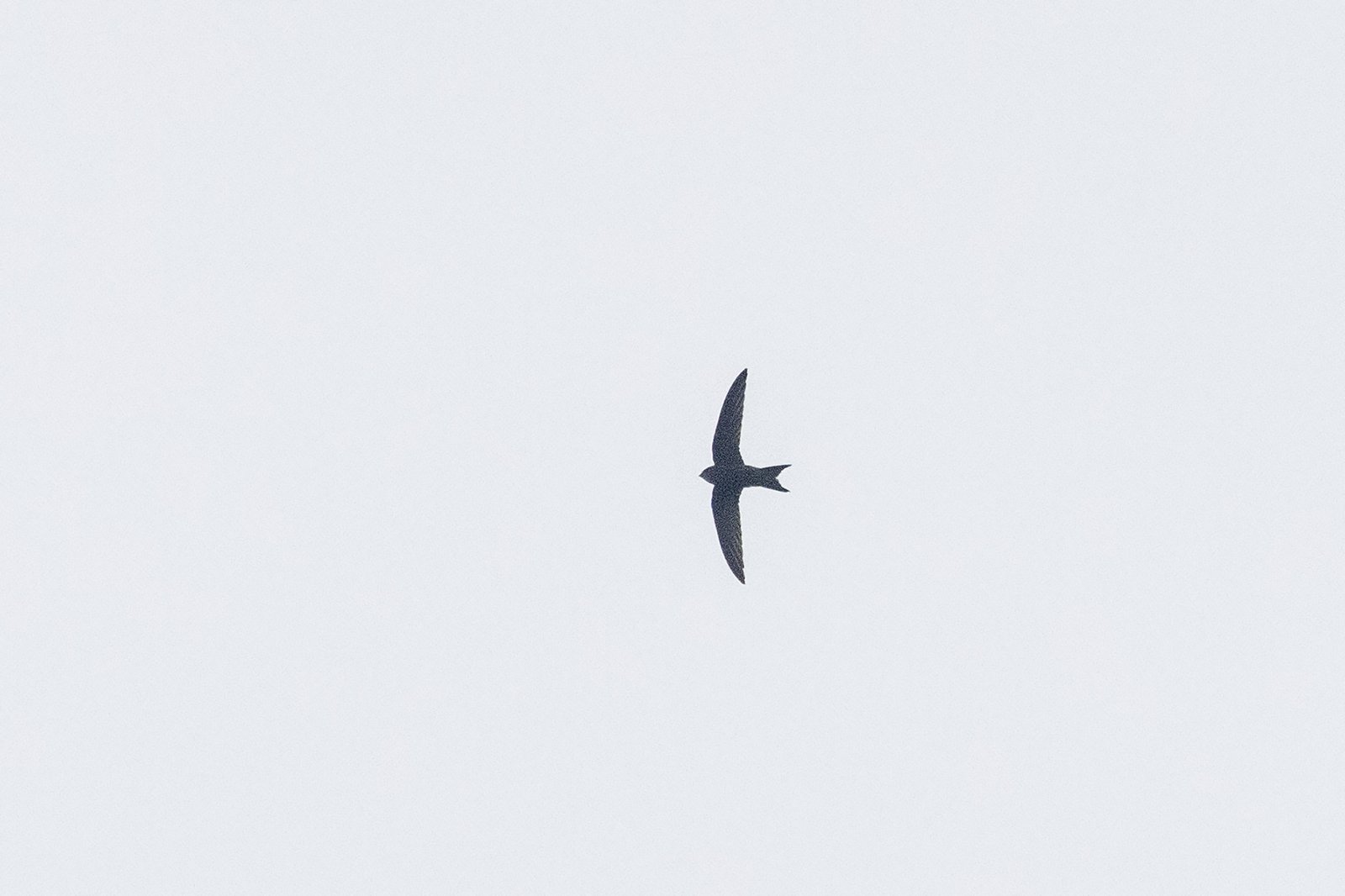
The Scarce Swift is an inconspicuous, dull brown swift of the montane forests in the north-east of the region. It has a long, forked tail and a pale throat and often hunts low over forest edges, in mist and drizzle.
Voice
A soft, high twitter, tsip-tsip or tsi-tsi-tsirr, mainly from small groups hunting over the forest; much less high than other swifts.
Recording: Lars Lachmann — CC BY-NC-SA 4.0 · converted to mono · xeno-canto
Identification
About 16 cm, slim and medium-sized. The plumage is plain dull grey-brown, slightly paler than in most Apus swifts, with a pale grey, ill-defined throat and no white rump. The tail is relatively long and deeply forked, often spread when the bird turns. The wings are narrow with a slightly broader inner hand. Flight is fluttering and agile with short glides, often low along the forest edge or over a clearing. The sexes are alike.
Confusion species
African Black Swift (Apus barbatus) and Common Swift (Apus apus) are larger and darker blackish brown, with more powerful flight and a white or paler throat patch that stands out more sharply. African Palm Swift (Cypsiurus parvus) is paler and flimsier, with an even longer, spike-like tail, and rarely enters montane forest. The combination of dull brown plumage, long tail and pale throat over montane forest points to this species.
Habitat
Montane and Afromontane forest with clearings, forest edges and adjacent montane grassland, mostly above 1,000 m. It hunts small flying insects, often low under cloud or in drizzle; in bad weather it moves down to lower valleys. It probably breeds in rock crevices and cavities in mountain cliffs; nests have hardly been found in the region.
Where the bird is most at home, classified by the vegetation units of southern Africa.


Range and movements
The mountains of the north-east of the region: the Eastern Highlands of Zimbabwe (Nyanga, Vumba, Chimanimani), adjacent mountains of Mozambique (Gorongosa, Namuli), Malawi (Nyika, Zomba, Mulanje) and north-eastern Zambia. Beyond the region in the highlands of East Africa to Ethiopia, in eastern DR Congo and on the Cameroon highlands.
- Resident
- Summer visitor (c. Oct–Mar)
- dark = core range, pale = thinly spread
How and when to look
Search on an overcast morning along forest edges in Zimbabwe's Eastern Highlands or on the Nyika Plateau, when small groups skim low over the canopy. The dull plumage and soft calls make the species easy to overlook; always note tail shape and throat pattern.
Conservation status
Not threatened and spread over a large range, although local and poorly known in the region. Loss of montane forest to clearing and plantations reduces habitat locally.
Scientific name
Schoutedenapus myoptilus | (Salvadori, 1888)
Salvadori described the species in 1888 as Cypselus myoptilus; because it was later moved to another genus, the author and year stand in brackets. The genus Schoutedenapus was introduced in 1968 by De Roo. Schoutedenapus joins the name of the Belgian zoologist Henri Schouteden (1881–1972), explorer of the Congo, to the swift genus Apus. myoptilus comes from Greek mus, 'mouse', and ptilon, 'feather': 'mouse-feathered', for the dull, mousy grey-brown plumage. The specimen the first description was based on came from Let Marefia, Shewa, Ethiopia.