All species › Swifts › Swifts › Mottled Swift
Mottled Swift | Tachymarptis aequatorialis
Geschubde berggierzwaluw | Vencejo Ecuatorial
The Mottled Swift is a large, all-brown swift of rocky hill country, with the build and powerful flight of the Alpine Swift but without the white belly. It breeds colonially in crevices in sheer cliffs and is local in the region.

Voice
A high, trilling scream, sreeeeee, and a rapid twittering trill, higher and thinner than the rolling call of Alpine Swift; loud around the colony.
Recording: Bram Piot — CC BY-NC-SA 4.0 · converted to mono · xeno-canto
Identification
About 20 cm, large and heavily built, with long, broad sickle wings and a moderately forked tail. The plumage is dark grey-brown, with pale fringes on the underparts that give a scaly or mottled pattern at close range, especially on breast and belly. The throat is pale grey to dirty white but does not form a sharply defined white patch. There is no white rump. Flight is fast and powerful, with slow, deep wingbeats alternating with long glides. The sexes are alike.
Confusion species
Alpine Swift (Tachymarptis melba) is the same size but has a bright white belly and throat separated by a brown breast band. African Black Swift (Apus barbatus) and Common Swift (Apus apus) are smaller, darker blackish brown, with faster wingbeats and no obvious scaling. At long range size is decisive: a large dark swift over cliffs in the north is probably this species.
Habitat
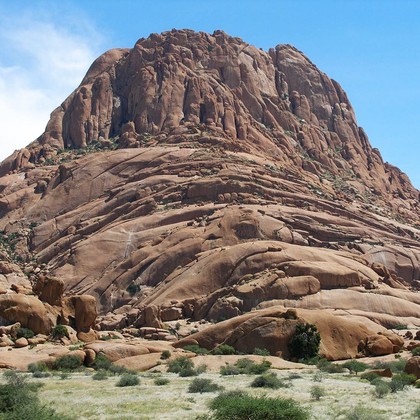
Sheer cliffs, gorges and granite domes in hill country and mountains, and the surrounding montane forest and grassland. It often hunts flying insects high and far from the breeding site, also over woodland, savanna and open water, sometimes in mixed flocks with other swifts. It breeds colonially in deep rock crevices.
Where the bird is most at home, classified by the vegetation units of southern Africa.

Range and movements
Local in the north of the region: rocky mountains and granite country in Zimbabwe (including the Matobo Hills and the Eastern Highlands), adjacent western Mozambique, Malawi, Zambia and Angola. Beyond the region scattered through the highlands of East Africa to Ethiopia, and very locally in West Africa.
- Resident
- Summer visitor (c. Oct–Mar)
- Winter visitor (c. Apr–Sep)
- dark = core range, pale = thinly spread
How and when to look
Search at granite domes and gorges in the Matobo Hills or Zimbabwe's Eastern Highlands, preferably in the early morning or ahead of an approaching storm, when flocks sweep low along the cliff face. Always compare with any Alpine Swifts present: the lack of a white belly is the key field mark.
Conservation status
Not threatened and spread over a large range. Local and little studied in the region; breeding colonies on cliffs face hardly any threats.
Scientific name
Tachymarptis aequatorialis | (Müller, 1851)
Müller described the species in 1851 as Cypselus aequatorialis; because it was later moved to another genus, the author and year stand in brackets. The genus Tachymarptis was introduced in 1922 by Roberts. Tachymarptis is Greek, from takhus 'fast' and marptis 'seizer', after the bird that takes its prey from the air in swift flight. aequatorialis is Latin for 'equatorial', for its range in the tropics around the equator. The specimen the first description was based on came from Ethiopia.